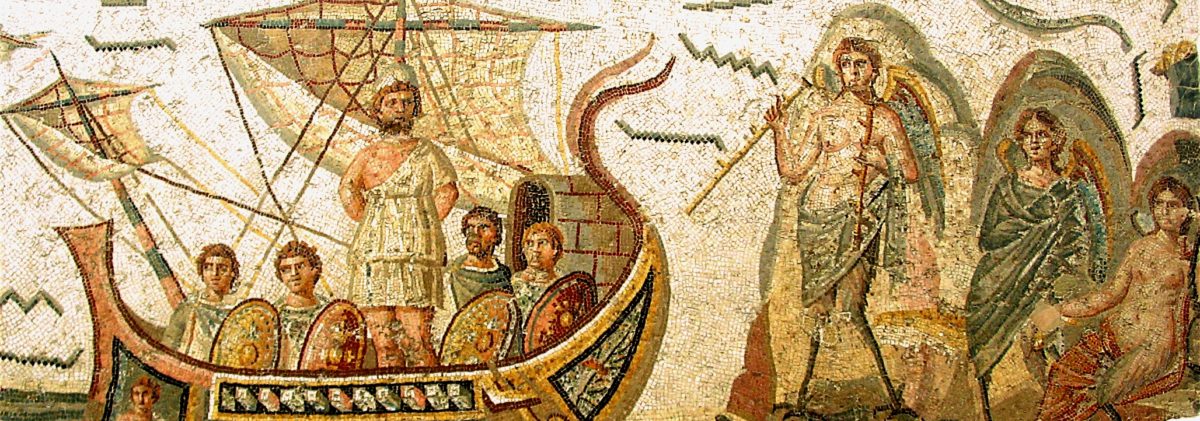
Fascinating Obscure Texts from Ancient Greece and Rome

People often talk about the texts from ancient Greece and Rome that have been lost, but it is worth noting that there are many fascinating texts from ancient Greece and Rome that have survived that are totally obscure and seldom ever read. In this post, I would like to highlight some of these works and hopefully bring them to somewhat greater attention.

Some of the texts I am about to list are better known than others, but the vast majority of them are texts that a person could at least in theory go through an entire undergraduate degree in classics without ever encountering. You will notice that this list skews heavily toward Greek texts over Roman; this is because my main area of interest is in Greek history, so I tend to be more familiar with obscure Greek texts than with obscure Roman texts. Without further ado, let’s dive in.

Continue reading “Fascinating Obscure Texts from Ancient Greece and Rome”

Same-Gender Attraction May Be Much More Common Than Previously Thought

One thing that often puzzles modern people about the ancient Mediterranean world, which I study, is the fact that certain kinds of sexual and romantic attraction and relationships between people of the same gender are attested so widely and spoken of so openly in the ancient sources. This seems very strange to many modern people, who assume that same-gender attraction is a rare phenomenon that only a tiny minority of the population experiences.

Contemporary evidence, though, is starting to show that same-gender attraction may be much more common than many people have previously assumed. Last week, on 17 February 2022, the polling agency Gallup published the results of a new survey, which found that no less than 7.1% of all adults in the United States now openly identify as some variety of LGBT+. This is quite significant, because this is nearly double the percentage it was ten years ago in 2012 when Gallup first started polling the question. Especially striking is the fact that, apparently, in the U.S., around 20.8% of adult members of Generation Z (my own generation) now identify as LGBT+, with the overwhelming majority of that percentage identifying as bisexual.

Continue reading “Same-Gender Attraction May Be Much More Common Than Previously Thought”

How Were Eunuchs Perceived in the Ancient Mediterranean World?

Eunuchs in the ancient world have become something of a major topic of interest for me over the past few years. The perception of eunuchs in various cultures throughout history has varied drastically, depending on the culture, the time period, and the kind of eunuch in question. In this post, I will describe the perception of eunuchs in the ancient Mediterranean world, which is my area of historical specialization.

In general, in the ancient Mediterranean world, eunuchs were heavily socially marginalized. They were often of enslaved status and, because of their castration, they were commonly seen as no longer men, but rather lesser, inferior creatures. Eunuchs, women, and children were commonly seen as belonging to the same essential category and eunuchs were often seen as more similar to women than to non-castrated men. In the highly misogynistic ancient world, this made them seen as inferior and, in some cases, even outright disgusting and debased.

Continue reading “How Were Eunuchs Perceived in the Ancient Mediterranean World?”

Plagiarism on Quora: The Latest Scandal

For those who are not already aware, for at least the past year or so, an account on Quora using the name of “Kevin Richardson” was posting extremely top-notch answers about history. Kevin’s credential claimed that he has a PhD in history from the University of Texas at Austin. It has recently, though, been exposed that this “Kevin Richardson” is not a real person, but rather a fraudulent account created under a fake name. Moreover, every single answer that “Kevin” ever posted was completely plagiarized word-for-word from other sources. Most of his answers were stolen from writers at r/AskHistorians. The moderators of that subreddit are the ones who investigated and exposed him.

In this post, I would first like to discuss just how pitiful Quora’s moderation against plagiarism really is, how “Kevin” managed to fool the entire community of history writers on Quora (myself included), and how his fraud was eventually exposed. I am also going to present a list of people who write excellent answers about history who I can confirm are not plagiarists. Finally, I will explain how I personally came to write on Quora and why I have so far continued to do so, despite (among other things) the endemic plagiarism.

Continue reading “Plagiarism on Quora: The Latest Scandal”

No, Xerxes I Was Not an Eight-Foot-Tall Giant

In the 2007 epic fantasy action film 300, cowritten and directed by Zack Snyder and based on the 1998 limited comic book series of the same name by Frank Miller and Lynn Varley, Xerxes I, the king of the Achaemenid Persian Empire, is portrayed by the Brazilian actor Rodrigo Santoro as a towering giant god-king who goes around almost completely nude, wearing only a very skimpy gold loincloth and a ton of really ornate gold jewelry, which is held on mostly through body piercings.

I’ve already written an entire post about how 300 is not historically accurate and it blatantly promotes a fascist, white supremacist message. Sadly, though, it has recently come to my attention that there are apparently some people on the internet who earnestly think that Xerxes I was really believed in antiquity to have been an eight-foot-tall giant.

Some have tried to prove this claim using a blatantly misquoted passage from the Greek historian Herodotos of Halikarnassos (lived c. 484 – c. 425 BCE) and Achaemenid relief carvings as evidence. In this post, I will show that Xerxes I was not really an eight-foot-tall giant, that Herodotos never claimed that he was an eight-foot-tall giant, and that there is no evidence to suggest that anyone in antiquity ever believed that he was one.

Continue reading “No, Xerxes I Was Not an Eight-Foot-Tall Giant”

No, Ares Was Not the Patron God of Sparta

Many people have gotten the impression that, in ancient Greece, Ares was the patron god of Sparta in the same way that Athena was the patron goddess of Athens. This impression, however, is not rooted in any kind of solid historical evidence, but rather solely in the fact that modern people popularly associate Ares and Sparta with many of the same general sorts of things, such as warfare, bloodshed, masculinity, unstoppable fighting abilities, et cetera. To modern observers, Ares seems to embody the Spartan ethos so perfectly that people simply assume without concrete evidence that the Spartans must have adored him.

The truth, though, is that Ares was not the patron god of Sparta in any sense. As one of the Twelve Olympians, he was certainly a significant deity in both Athens and Sparta, but, in both poleis, he was still relatively minor compared to other deities who were far more prominent. Indeed, ironically, Athena actually seems to have had a much more developed cult presence in Sparta than Ares.

Continue reading “No, Ares Was Not the Patron God of Sparta”

What Did the Ancient Romans Use Latin For?

Someone on Quora has asked: “What was Latin used for in ancient Rome?” At first glance, this question might sound rather silly. After all, it seems obvious that people in ancient Rome used Latin for all different kinds of oral and written communication. This may explain why the people who have answered this question so far have all given brief and flippant responses. I initially thought about giving such a response as well. After a bit of consideration, though, I realized that this is not actually a bad question, or a silly one.

Quite simply, Latin was not the only language that people in the Roman cultural sphere used. There were many Roman people in ancient times who could not speak Latin. Also, many Roman people who did speak Latin spoke it in addition to at least one other language. In this post, I intend to first explain who in ancient Rome actually spoke Latin and then explain in what sorts of contexts multilingual people who knew Latin used it.

Continue reading “What Did the Ancient Romans Use Latin For?”

Why Is the Parthenon So Famous?

The most famous building in Greece today is almost certainly the Parthenon, a spectacular temple to the Greek goddess Athena that towers atop the Athenian Akropolis and is almost universally admired for being supposedly the most “perfect” and “timeless” work of ancient Greek architecture. Some people may be surprised to learn, though, that this was not always the case.

The Parthenon did not immediately become the most famous and admired Greek temple as soon as it was built. It was certainly seen as an important temple in antiquity—one especially notable for its size, its prominent location, and its extraordinary chryselephantine cult statue of Athena, crafted by the master sculptor Pheidias. Its present-day status as the most famous of all Greek buildings, though, is the result of the events and ideological movements of the past 2,400 years of history. If post-classical history had gone differently, the Parthenon’s status might have gone to a different temple.

Continue reading “Why Is the Parthenon So Famous?”

Shocking, Taboo Sex in Ancient Greece and Rome

Ancient Greek and Roman sexuality seems to be a huge topic of interest with the general public. I’ve found that my posts on the subject are regularly among my most popular. Readers seem to be especially fascinated by stories of lurid depravities. For a very long time, the post I wrote in February 2019 about Roman orgies was consistently one of my most frequently viewed articles.

Well, if that’s what you’re interested in, you’re in luck, because, in this post, I will be discussing some of the sexual acts that the ancient Greeks and Romans regarded as the most shocking, disgraceful, unnatural, and taboo. We’ll even discuss some of the most scandalous and lurid tales of Roman imperial debaucheries. Be forewarned that some readers may find some of the acts discussed in the ancient sources I am about to analyze disturbing.

Continue reading “Shocking, Taboo Sex in Ancient Greece and Rome”

Yes, English Does Have Grammatical Gender (Sort Of)

Grammatical gender is a kind of noun class system that exists in many languages, in which nouns are said to possess a certain, inherent “gender” and articles, adjectives, and/or pronouns applied to these nouns are declined to match the gender of the noun. To illustrate, in Ancient Greek, the noun πόλεμος (pólemos), meaning “war,” is considered masculine, so it takes the masculine form of the article, which is ὁ (ho). If you wanted to describe the war as, say, “savage,” you would use the masculine form of the adjective with this meaning, which is ἄγριος (agrios). Thus, you would end up with the phrase ὁ ἄγριος πόλεμος, which means “the savage war.”

The grammatical gender of a noun may or may not correspond to the natural gender of the person or thing to whom it refers. For instance, the Modern High German word for “girl” or “young woman” is Mädchen, which is grammatically neuter, even though the subject’s natural gender would obviously be feminine, because it is a diminutive of the more archaic word Magd, and all diminutives in German are neuter.

It is often stated as objective fact that Modern English has “no grammatical gender.” This is not, however, entirely true. Modern English does, in fact, have grammatical gender to some extent, but it is very limited compared to other Indo-European languages, and a noun’s grammatical gender usually corresponds to the natural gender of the person or thing to whom it refers.

Continue reading “Yes, English Does Have Grammatical Gender (Sort Of)”