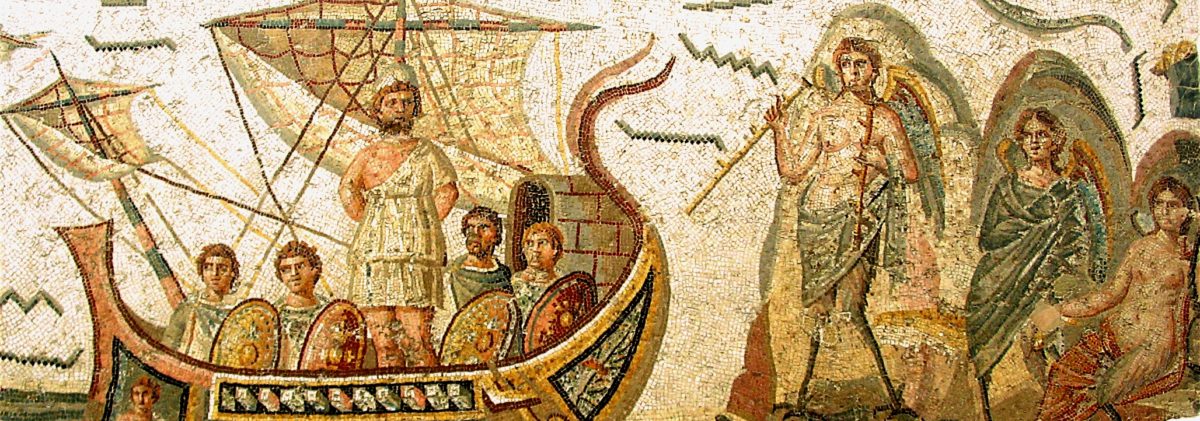

Three and a half millennia ago, the people of the Bronze Age Minoan civilization revered the double-headed ax, which is conventionally known today as a labrys (plural form: labryes), as a religious symbol associated with powerful goddesses. Over a thousand years later, the historical Greeks and Romans often depicted Amazons, mythical female warriors who lived in a society without men, as wielding the labrys in battle. Today, the labrys has become a prominent symbol associated with lesbian feminism and female power. This post will tell the strange, extraordinary story, spanning nearly four millennia across four continents, of how a Bronze Age religious symbol became a defining symbol of queer women’s liberation.
If you’re new to this blog, I hold a master’s degree in Ancient Greek and Roman Studies and bachelor’s degrees in history and classical studies, and I’ve been writing about ancient history online for the past ten years now. I am also a trans woman who is attracted to women and who is personally quite fond of the labrys as a queer and feminist symbol—despite people who use it to represent trans-exclusionary ideas and movements. I’ve been working on this post on-and-off for the past four years, and, unusually for one of my blog posts, I believe it actually breaks new historical ground by identifying the precise avenue of how the labrys crossed over from an archaeological find known only to scholars to a mainstream queer feminist symbol.
Introducing the ancient Minoans
In order to understand what a labrys is and the range of symbolic meanings that it communicates today, one first needs to know some basic information about the Minoan civilization, which flourished on Krete, the largest and southernmost of the Greek islands, during the Bronze Age. The Minoans’ cultural peak lasted from around 2000 BCE until around 1450 BCE, when the Mycenaeans (early speakers of the Greek language from mainland Greece) seem to have become politically dominate on Krete, most likely through conquest.
The Minoans developed and wrote in two main scripts. Modern scholars have labeled the older of these scripts Kretan hieroglyphs and the later script Linear A. Examples of writing in both of these scripts have survived, but, sadly, no one alive today can read either of them, and, due to various factors, unless archaeologists suddenly uncover new evidence, it is highly unlikely that anyone will decipher either of them in the near future.
The Minoan archaeological site that has yielded the most extensive remains is Knossos, which is located in northern central Krete near the modern city of Herakleion. In addition to being the largest Minoan site, Knossos was also the first to be thoroughly excavated. As a result of these factors, it is by far the best known of all Minoan sites today with the general public. The English archaeologist Sir Arthur J. Evans (lived 1851 – 1941) began the first thorough excavation of the site in the year 1900 and continued his work there for most of the next few decades.

ABOVE: Map from Wikimedia Commons showing Minoan sites on the island of Krete

The man, Sir Arthur J. Evans
It is difficult to overstate just how much influence Evans has exerted on the modern popular perception of the Minoan civilization. Throughout the early decades of the twentieth century, he published and lectured prolifically about the Minoans and promulgated a vivid interpretation of Minoan society, culture, religion, and politics that appealed to the cultural milieu of the time.
Evans’s vision of Minoan society was heavily shaped by his own life experience, personal beliefs, and politics. His father John Evans was the wealthy partial owner of the successful Dickinson paper mill as well as an amateur archaeologist, geologist, and antiquities collector who was well-respected in British upper-class intellectual circles.
Evans himself was a stubborn, ardent Romantic who was obdurately convinced that the Greek myths about King Minos, the Minotaur, the labyrinth, Ariadne, and Theseus were rooted in historical fact and who routinely fancifully interpreted the ruins and artifacts he found at Knossos as proof that this preconceived conviction was correct. Politically, he was an avowed Gladstone liberal, a pacifist, and also something of a British nationalist, although he certainly did not hesitate to publicly criticize the actions and policies of his home country when he disagreed with them.
On racial matters, Evans was, as Cathy Gere has aptly put it, “as instinctively racist as any of his contemporaries,” but, in sharp contrast to many prominent contemporary archaeologists such as Heinrich Schliemann and William Flinders Petrie, he “had no truck with Aryan theory” and was convinced that the Minoan people originated from lands outside of Europe, particularly Libya, Egypt, and Asia Minor (Gere 2009, 12).
Sexually, Evans was most likely attracted to both women and men. He married his first and only wife Margaret Freeman in 1878. By all accounts, he was a devoted husband who loved her very dearly. Then, in March 1893, Margaret died of an unknown illness at the age of forty-five, with Evans at her bedside clutching her hand. Margaret’s death devastated Evans, and he never fully recovered from it; he never remarried and used black-bordered stationary for the rest of his life as a sign of mourning.
Nevertheless, over three decades after Margaret’s death, Evans did have sex with at least one young man on at least one occasion. In a biography published in 2000, the archaeologist Joseph Alexander MacGillivray uncovers evidence that London police arrested Evans on the night of January 29th, 1924, for having had some kind of apparently consensual sexual contact with a seventeen-year-old boy named George Cook in Hyde Park. Although both defendants disputed some of the prosecution’s claims about the encounter, neither disputed that the offense itself took place (MacGillivray 2000, 281).
Although MacGillivray’s biography is unfairly hostile to Evans in many ways and is rightly regarded as something of a hit piece, scholars have generally come to accept its evidence that Evans was sexually attracted to young men and acted on this attraction on at least one occasion. Gere has (I think rightly) argued that Evans’s own queer inclinations influenced his reconstruction of Minoan Krete as “an invert’s paradise of female deities, cross-dressing priests, and girl athletes” (Gere 2009, 12).
Although archaeological evidence does support some of Evans’s conclusions, many of his claims are highly speculative and founded on little or no actual evidence. Nonetheless, due to his status as the primary excavator of Knossos, much of what he wrote about the Minoans, including much that is not well grounded in evidence, has become popularly accepted as fact, even though, especially over the past fifty years, professional scholars have come to view many of his ideas more skeptically.

ABOVE: Photograph of Sir Arthur J. Evans, the British archaeologist who excavated the Minoan site of Knossos, gave the Minoans their name, and established the main narratives about what their society was supposedly like
It is a testament to Evans’s lasting influence on Minoan studies that even the name Minoan itself is his invention. At the time when he excavated Knossos, no one had any idea what the people of Bronze Age Krete called themselves. Evans therefore coined and popularized the name Minoan based on the name of the legendary King Minos, who, according to a myth attested in Greek sources from the historical period, ruled the island of Krete with his capital at Knossos during the Age of Heroes.
Scholars still don’t know what the Minoans called themselves, but we do know that Egyptian hieroglyphic inscriptions contemporary to the existence of the Minoan civilization refer to the Minoans as k-f-t-i-w, which scholars conventionally vowelize as Keftiu. Two passages of the Hebrew Bible (Amos 9:7 and Jeremiah 47:4) use a related term כַּפְתּוֹר (Kaftōr) to refer to Krete as the original homeland of the Philistines. Later Greek-language texts from the historical period (e.g., Odyssey 19.172–177) refer to indigenous inhabitants of Krete who seem to have spoken a late form of the Minoan language as Ἐτεόκρητες (Eteókrētes), which means “true Kretans.”
It would be more historically grounded to call the people of Bronze Age Krete “Keftiu,” “Eteokretans,” or just “Kretans” rather than “Minoans,” but the romantic, myth-inspired name Evans invented for them has stuck permanently.

ABOVE: Wall painting from the tomb of Rekhmire, an Egyptian nobleman who served as a royal vizier to pharaohs Thutmose III and Amenhotep II and died around 1400 BCE, depicting men described as “Keftiu” (i.e., Minoans) bearing recognizably Kretan gifts for the pharaoh
The Minoan double ax
Since Evans’s excavations at Knossos in the early twentieth century, archaeologists excavating on Krete have discovered many examples of double-headed axes in Minoan contexts. In most cases, it is clear that these axes were not used as actual combat weapons, since they are made from impractical materials such as gold, are overly ornate, or are otherwise not constructed with combat practicality in mind.

ABOVE: Photograph from Wikimedia Commons showing a Minoan ceremonial gold double-headed ax, popularly described as a “labrys,” even though that word almost certainly did not exist in the Minoan language, now held in the Archaeological Museum of Herakleion

Additionally, archaeologists have frequently found double-headed axes in contexts that strongly suggest they held ritual significance. For instance, on the southern east wing of the Minoan complex at Knossos is a small room that was converted sometime between c. 1375 and c. 1200 BCE into a shrine, which Evans dubbed the “Shrine of the Double-Axes.” On a small altar at the back of the shrine, Evans’s team found a stone double ax, two sets of stone bulls’ horns, and clay votive figures, including one depicting a female figure with raised arms, who is probably either a goddess, a priestess, or a priestess taking the role of a goddess.

ABOVE: Photograph taken by Sir Arthur Evans’s excavation showing the so-called “Shrine of the Double Axes”
Some surviving Minoan artworks also depict double axes set up as symbols in contexts where they seem to denote religious or ritual authority. Interestingly, in these depictions, the double ax only ever appears alongside goddesses and women; it never appears alongside any male figure in any context. This fact has greatly puzzled many scholars of Minoan religion, such as Nanno Marinatos, who remarks, “It is paradoxical that [the double ax] is held by females rather than a male weather god” (Marinatos 1993, 5).
One example of this occurs on the Agia Triada sarcophagus, which most likely dates between c. 1370 and c. 1320 BCE and was found in a chamber tomb near the Minoan site of Agia Triada in southern Krete. Side A of the sarcophagus bears a painted scene of a ritual procession, at the front of which a woman is pouring a libation from a vessel she is holding into a larger vessel, which is supported between two poles, each of which has a double ax head mounted at the top.

ABOVE: Side A of the Agia Triada sarcophagus. Notice the double ax heads above the poles supporting the vessel into which the woman is pouring the libation on the far left.
A gold ring found at Mycenae (a major citadel on the Greek mainland that was built and inhabited by Bronze Age Greeks) that is possibly of Minoan workmanship bears a highly detailed image in which a female figure (most likely a goddess) sits under a tree holding three poppy seedcases in her left hand.
A smaller figure (perhaps a child) approaches the poppy goddess holding a set of flowers. Behind her, another full-sized female figure (possibly a goddess, a priestess, or other human worshipper) is also approaching the poppy goddess and reaching out her hand over the smaller figure’s head toward the seedcases. In the center of the image, between the poppy goddess and the female figure who is reaching out, above the smaller figure’s head, is a double ax, which may be either floating in space or simply standing in the background.
No one knows exactly what this image or the iconography it features is supposed to mean or why it is significant, but it most likely depicts some kind of religious scene.

ABOVE: Drawing of an image on a gold ring from Mycenae depicting a double ax in the background behind a group of female figures who probably represent goddesses
Where does the word labrys come from?
Although it is impossible to say what exactly the double ax symbolized for the Minoans beyond its generic association with ritual authority and powerful female figures, the symbol has taken on a plethora of rich new meanings in modern societies over the course of the twentieth and twenty-first centuries. I will explore the history of these meanings throughout the remaining portion of this post.
As one might expect, Evans has exerted an enormous influence on the general public’s perception of the Minoan double ax. In fact, it is mostly because of him that everyone today goes around calling this ax a labrys, which is neither a Minoan nor a Classical Greek word. Because the Minoan language remains undeciphered, no one knows what the Minoan word for a double-headed ax was. Meanwhile, the word for a double ax in Classical Greek is actually πέλεκυς (pélekys).
The source of the word labrys actually lies east of the Aegean in Karia, a region along the southwestern coast of Asia Minor. In antiquity, a people known as the Karians, who originally spoke a non-Greek language, inhabited this region. In it, they had a sanctuary known as Λάβρανδα (Lábranda), where they worshipped a local form of Zeus known as Ζεὺς Λαβρανδεύς (Zeùs Labrandéus), whom they depicted holding a double ax. In the fourth century BCE, satraps of Karia under the Achaemenid Empire minted coins depicting Zeus in this form.
The Greek biographer and Middle Platonist philosopher Ploutarkhos (Plutarch) of Khaironeia (lived c. 46 – after c. 119 CE), who lived in Greece during a time when it was ruled by the Roman Empire, attempts to answer in his antiquarian treatise Quaestiones Graecae (Greek Questions) 45 why the Karians depicted Zeus holding a double ax instead of a thunderbolt and why they called this form of Zeus Labrandeus. He explains that the word for a double-headed ax in the language of the Lydians (a people who inhabited western Asia Minor in the historical period) was λάβρυς (lábrys).

ABOVE: Image from Wikimedia Commons of a silver drachm minted by Hidrieus, a satrap of Karia, between c. 351 and c. 343 BCE, depicting Zeus Labrandeus carrying a double ax on the reverse

Evans was convinced that the Minoan language was most closely related to Karian. He therefore concluded that lábrys was not only a word for a double ax in Lydian and Karian, but also in the Minoan language. Based on this assumption, he concluded that Λαβύρινθος (Labýrinthos), which, in Greek myth, is the name of the maze underneath the palace of King Minos at Knossos where the Minotaur dwelt, literally means “place of the lábrys” (Evans 1901, 10–11).
It’s easy to see how someone might find these speculations superficially persuasive. The problem is that the actual data to support Evans’s conclusions is quite lacking. Even in his own time, there was never any particularly compelling evidence to support his belief that the Minoan language is most closely related to Karian. Moreover, the discoveries of the past century have seriously undermined his association of the name Labýrinthos with lábrys.
The first problem for Evans’s hypothesis arises from the fact that archaeologists have now found double-headed axes at Minoan sites all over the island of Krete, not just at Knossos. This opens up the question of why, if Evans’s etymology were correct, Knossos specifically would be known as the “place of the double ax.”
The second problem is that, although scholars still cannot read Linear A, they have deciphered Linear B, a script based on Linear A that the Mycenaeans used to write a very early form of the Greek language between roughly 1400 and 1200 BCE. A Linear B tablet found at Knossos (Kn Gg 702), which dates to the period when the Mycenaeans were occupying Krete, appears to render the name Labýrinthos in Linear B script as 𐀅𐀢𐀪𐀵𐀍 (da-pu2-ri-to-jo), which is much more phonologically distant from lábrys compared to the form that is attested in the later historical period.
Thus, there is little reason to think that the ancient Minoans would have called a double ax a “labrys,” but, largely thanks to Evans, this Lydian word has become the standard in English.

ABOVE: Photograph from Wikimedia Commons of the Karian sanctuary site of Labranda in Asia Minor

Evans’s perception of the Minoans as a society with matriarchal elements
Evans’s broader speculations about the nature of Minoan society have also greatly informed the way that the general public understands and interprets the labrys symbol today. To understand how and why this is, we first need to take a step back in time to examine the older scholarship that Evans relied on.
In 1861, the Swiss law professor and philologist Johann Jakob Bachofen published an influential book in the German language titled Das Mutterrecht: Eine Untersuchung über die Gynaikokratie der Alten Welt und ihrer religiösen und rechtlichen Natur (The Motherlaw: An Examination of the Gynocracy of the Ancient World and Her Religious and Legal Nature), in which he argues that all human societies have progressed through the same series of stages of social organization.
Bachofen asserts that the social organization of the earliest human settled societies was matriarchy, which he portrays as a primitive, archaic, and ultimately unworkable system that patriarchy, which he portrays as more modern and more civilized, eventually replaced.
There is no good historical evidence to support this hypothesis, and scholars of the ancient world today in the twenty-first century widely reject it. Nonetheless, it became quite influential among western scholars of the late nineteenth and early twentieth centuries because it served their political and ideological goals of asserting male supremacy over women and the supremacy of white, western culture over other cultures that they viewed as backwards and “primitive.”

ABOVE: Portrait of the Swiss scholar Johann Jakob Bachofen, who promulgated the hypothesis that the original social order of all humanity was matriarchy in his 1861 book Das Mutterrecht
Like many archaeologists of his generation, Evans read and was influenced by Bachofen’s ideas. Then, during his excavations at Knossos, he uncovered numerous Minoan artistic depictions of female figures in positions of power and authority. The most famous examples of this are three faience figurines of women wearing dresses with flounced skirts and open fronts that reveal their breasts.
The largest of the three figures, whom Evans dubbed the “snake goddess,” has a snake wound around each outstretched arm, while the smaller mostly complete figure, whom Evans dubbed the “snake priestess,” is clutching a snake in each hand. Only the dress of the third figure survives.
Based on his preconceived belief that the earliest civilized humans were matriarchal and his discovery of these kinds of artistic depictions of female figures in apparent positions of authority, Evans concluded as early as 1900 that the civilizations of the Aegean Bronze Age, including both the Minoans and the Mycenaean Greeks of the mainland, retained many aspects of the primitive matriarchal system, especially in the domain of religion (Evans 1900, 42–43, no. 1; Evans 1901, 70).

ABOVE: Photograph originally printed in the book The Palace of Minos by Sir Arthur Evans, published in 1921, showing what the faience statuette of the so-called “snake priestess” that Evans found in the so-called “temple repositories” at Knossos looked like before any modern restoration

ABOVE: Photograph from Wikimedia Commons showing the so-called “snake goddess” and “snake priestess” statues and the third partial figure that Evans found in the so-called “temple repositories” at Knossos as they appear today in the Herakleion Archaeological Museum on Krete

Although scholars today in the twenty-first century no longer accept the hypothesis of primitive matriarchy, the available evidence does strongly indicate that the worship of at least one important goddess (probably numerous goddesses) was central to Minoan religion and that, within Minoan society, at least some mortal women were able to attain some status of socially acceptable authority and importance. In fact, within the past century, archaeologists have found even stronger evidence of this than was available to Evans a hundred years ago.
One of the most intriguing pieces of evidence comes from Thera, an island in the Kykladic archipelago located just north of Krete. Today, Thera is known to the general public by the modern name Santorini and is a popular tourist destination. In a Bronze Age, a major settlement existed on this island at a site known as Akrotiri, which may have been a Minoan colony or an indigenous settlement that was heavily influenced by the culture of nearby Minoan Krete.
In any case, archaeologists have found extensive Minoan-style frescoes in various buildings at Akrotiri, many of which are better preserved than those Evans found at Knossos. One large building known as Xeste 3, which archaeologists believe was most likely some kind of religious center, contained some especially well-preserved frescoes, which date to the seventeenth century BCE.
In room three of this building, on the north wall of the first floor, archaeologists found a fresco depicting a young woman and a human-sized blue monkey, who is walking on his hind legs like a human, offering saffron to a very large female figure, who wears a flounced skirt and elaborate jewelry and sits on a cushioned seat atop a high platform with a griffin at her side.
The seated woman’s supernaturally large size, the fact that the young woman and the monkey are making offerings to her, her elevated position atop the cushioned seat on the raised platform, the elaborateness of her dress and jewelry, and the presence of the supernatural griffin at her side all strongly indicate that she is a goddess. Scholars generally view the large, seated woman in this fresco as the clearest depiction of a Minoan deity (Younger & Rehak 2008, 169). In my own mind, the Xeste 3 fresco seals the case that the worship of at least one powerful goddess was central to Minoan religion.
Although the language of Linear A remains undeciphered, because the Linear A script shares many signs in common with Linear B, which was deciphered in the 1950s, scholars are able to identify some of the sounds that the symbols of Linear A represent. Through this discovery, scholars have been able to identify a word that occurs repeatedly in many Linear A texts, especially ones found at peak sanctuaries: YA-SA-SA-RA or Yasasara. This may be the name of an important Minoan goddess, perhaps the very goddess who appears in the Xeste 3 fresco (Younger & Rehak 2008, 174–177).

ABOVE: Photo from Wikimedia Commons showing the original fresco from Xeste 3 of the girl and the blue monkey offering saffron to the goddess with the griffin


ABOVE: Reconstruction of the fresco from Xeste 3
Sadly, there is not nearly enough evidence to draw any more specific conclusions about the role of women in Minoan religion and society than I have drawn above. We cannot even determine which specific social roles in Minoan society were open to women and which ones (if any) were closed to them.
I cannot emphasize enough that evidence for the mere existence of divine and mortal female figures of authority in Minoan society does not automatically imply that the Minoans were matriarchal. After all, the Classical Greeks worshipped goddesses, and they ascribed religious authority to certain female religious figures, such as oracles and priestesses, but Classical Greek society was still deeply patriarchal in every fundamental way. (For a more detailed discussion of the tension between the authority of female figures in Classical Greek religion and the marginalization of women in most other areas of Greek society, see this blog post I wrote in July 2021.)
Even if some individual Minoan women could attain broad political authority over society at large beyond merely the religious sphere, this still would not necessarily make Minoan society matriarchal, since, throughout human history, individual women have risen to positions of power within many patriarchal societies without this resulting in any broader restructuring of power. For instance, Elizabeth I became queen of England, but, throughout her reign, the structure of English society remained fixedly patriarchal.
Female bull-leapers in Minoan art
The unusual presentation of women in Minoan art, however, goes beyond just representations of women in positions of authority. Minoan frescoes also notably depict women as participating in certain dangerous athletic activities that nineteenth and early twentieth-century western societies would never have allowed them to participate in.
During Evans’s excavation at Knossos, in the east wing of the complex (which he believed was a domestic quarter), he found well-preserved fragments of a fresco dating between c. 1600 and c. 1450 BCE depicting a scene of three athletes leaping over a charging bull. Enough of the fresco is preserved to leave no doubt about the genders of the bull-leapers; one of them is a man, and the other two are women.
On the left side of the fresco, a woman stands directly in front of the charging bull, taking the bull by the horns as though she is preparing to jump over it. Meanwhile, a male bull-leaper is in the middle of flipping over the bull, upside-down with his legs in the air over his head and his arms supporting him on the bull’s back. Finally, at the right end of the fresco, a second woman stands with her arms outstretched, as though she has just landed after leaping over the bull herself.
All three of the bull-leapers are bare-chested and wear loincloths with codpieces. The two women are differentiated from the man not by any aspect of their clothing or adornment, but solely by their white skin and bare breasts. (Minoan painters had an artistic convention of portraying men with reddish brown skin and women with white skin—a convention which the historical Greeks and Romans continued, as I discuss in this post from September 2020.)

ABOVE: Photo from Wikimedia Commons of the famous bull-leapers’ fresco Evans discovered at Knossos
.jpg)

ABOVE: Detail of the woman grasping the bull by the horns on the left side of the fresco

ABOVE: Detail of the woman on the right side of the fresco, behind the bull
In addition to the famous fresco of the bull-leapers that Evans discovered at Knossos, dozens of other artistic depictions of people leaping over bulls have survived from the Bronze Age Aegean. On the basis of these depictions, Evans was convinced that the Minoans had an actual athletic event in which people, including both men and women, physically leapt over bulls in the same manner the depictions portray.
It is at least possible that this interpretation is correct. It is certainly possible for a human to do a somersault over a charging bull in this manner. Today, in Spain, a sport exists known as recortes in which athletes known as recortadores attempt to acrobatically dodge and evade charging bulls, including by somersaulting over them. Although the sport has historically been restricted to men, in recent years, female recortadores have emerged.
Unfortunately, it is impossible to determine on the basis of artistic depictions whether the Minoans actually had a sport like modern Spanish recortes, since the artistic depictions of people leaping over bulls could just as easily represent a myth or trope, rather than an actual event.
Nonetheless, whether the scenes these depictions portray actually took place or not, at the very least, the fresco of the bull-leapers from Knossos shows that Minoan painters imagined that women could do backflips over charging bulls just as well as men. That says something important about Minoan culture, especially when one considers that, even in twenty-first-century Spain, the vast majority of recortadores are men, and women have only begun to enter the sport very recently (mainly within the past decade).

ABOVE: Photo from Wikimedia Commons showing a modern Spanish recortador doing a backwards somersault over a charging bull at Plaça de Bous, Valencia, on October 9th, 2018

Minoan society, female homosociality, and homoeroticism
Androgynous female bull-leapers are not the only aspect of Minoan culture that tends to strike modern people as somewhat queer. Although the original artists may not have intended it, many Minoan paintings of women also lend themselves easily for modern viewers to interpret in homoerotic ways.
Minoan frescoes are full of scenes of beautiful women with elaborately coifed hair and baroque clothing standing or sitting closely together, often touching and/or facing each other. Notably, one of the better-preserved Minoan frescoes that Evans’s team excavated at Knossos is the so-called “Grandstand Fresco,” the original of which dates between c. 1525 and c. 1450 BCE.
Evans discovered fragments of the fresco in a corner room just off the Central Court at Knossos and paid the Swiss artist Émile Gilliéron to create a (rather heavy-handed) reconstruction of what the fresco might have originally looked like based on these fragments.
The fresco depicts a crowd of people watching a ritual or performance of some kind. Although most of the people in the crowd are represented as merely a sea of heads, the fresco specifically highlights a row of probably elite women who are sitting close together in the front of the crowd, with their legs tucked behind them, facing each other in pairs. Some women are reaching out and touching their pair-partners. Although it would be too speculative to claim that the women sitting in pairs in this fresco are erotic partners, they do seem to share intimate bonds with each other in some sense.

ABOVE: Photo I took myself of a section of the “Grandstand Fresco” in the Archaeological Museum of Herakleion, showing some of the Minoan ladies sitting together

ABOVE: Photo I took of another section of the “Grandstand Fresco”
Meanwhile, one of the most famous Minoan frescoes today is the so-called “Ladies in Blue” fresco, which depicts three elite Minoan ladies sitting or standing so close to each other that their shoulders overlap. The original fresco dates between c. 1525 and c. 1450 BCE. Evans’s team discovered fragments of it near the Royal Magazines at Knossos in 1914. As with the “Grandstand Fresco,” Evans paid Gilliéron to create a reconstruction of the fresco as it might have originally looked.
Gilliéron’s reconstruction arguably went beyond what the evidence warranted. The only substantial part of the original fresco that survives is the left side of the woman on the viewer’s right’s body; only a few fragments of the woman in the middle and the woman on the viewer’s left have survived at all. Not even a single piece of any of the women’s heads have survived. Nonetheless, Gilliéron reconstructed the two women on the left and in the middle based on the assumption that their bodies resemble the woman on the right. He reconstructed the women’s heads based entirely on the assumption that they resembled the heads of women in other, better-preserved frescoes.
Despite its speculative nature, Gilliéron’s reconstruction of the “Ladies in Blue” fresco has become probably the most iconic image of the Minoan civilization in the modern popular consciousness. It is reproduced in nearly every book about the Minoans and has graced the front covers of countless books, including, most recently, the front cover of Emily Wilson’s bestselling translation of the Odyssey.
The widespread publicity of artistic depictions like these have led scholars and the general public since the early twentieth century to associate the Minoan civilization closely with female homosociality, intimacy, and gender nonconformity.

ABOVE: Photo I took myself of the famous “Ladies in Blue” fresco, original dating to between c. 1525 and c. 1450 BCE, now held in the Archaeological Museum of Herakleion
The Greek islands’ more general association with female homoeroticism
Although it is safe to assume that at least some Minoan women experienced erotic attraction to other women, since the existence of homoerotic attraction is basically universal across attested human societies, the evidence from the Bronze Age is far too scant and ambiguous to reveal any information about how widespread or socially acceptable female homoerotic relationships were.
If we move forward in time by about a thousand years, however, several pieces of evidence suggest that, during the Greek Archaic Period (lasted c. 800 – c. 490 BCE), female homoerotic relationships were fairly common and at least tacitly allowed in at least some of the Aegean islands. I discuss this topic in greater depth in this post I wrote in April 2022, but I will cover a few important aspects of it here.
Possibly the oldest surviving relatively unambiguous artistic depiction of female homoerotic courtship, at least in the western artistic tradition, is a polychrome plate dated around 620 BCE that was discovered on the island of Thera (Santorini). The plate shows two women who appear to be of similar age and social status holding garlands. One woman is reaching out to touch the other woman’s chin—a gesture which, in Archaic Greek art, consistently indicates erotic courtship.

ABOVE: Photograph from Wikimedia Commons showing a polychrome plate from Thera dated c. 620 BCE depicting a homoerotic scene of two women, with one woman touching the other’s chin in a gesture of courtship
One of the earliest Greek poets who has any work that has survived to the present day is Sappho (lived c. 630 – c. 570 BCE), a female lyric poet who flourished on the island of Lesbos, which is located in the eastern Aegean just off the west coast of Asia Minor. In many of Sappho’s surviving poems (including, most explicitly, fragments 1, 16, 31, and 94), her female speaker, who probably represents a fictionalized version of the poet herself, speaks openly about her erotic desire for other women. (For a more detailed discussion of Sappho’s sexuality, see this post I wrote in August 2021.)
Another early Greek lyric poet Anakreon (lived c. 582 – c. 485 BCE), a male poet who was born in the city of Teos on the west coast of Asia Minor and spent a significant part of his career on the island of Samos, has a surviving poetic fragment (fr. 358) in which his male speaker describes his failed attempt to seduce a young woman from the island of Lesbos who rejects his advances because she is “gaping after another woman.”
For centuries, westerners have associated Lesbos and the Greek islands in general, with Sappho. The English Romantic poet Lord George Gordon Byron in his poem “The Isles of Greece,” which he wrote in 1819 and published in 1821, famously recalls them as the place “where burning Sappho loved and sung.” Since the late nineteenth century especially, westerners have also increasingly come to associate Sappho (and, by extension, the Greek islands) with female homoeroticism. Modern people sometimes extend this association to Krete, because it is one of the Greek islands.
As a result of all these factors, ever since Evans’s discoveries at Knossos first reached popular attention in the early twentieth century, the Minoan civilization has tended to intrigue feminists and queer women.

ABOVE: Photo I took myself of an Attic red-figure hydria dated between c. 440 and c. 430 BCE, depicting Sappho reading one of her poems aloud from a roll of papyrus to an audience of three women, one of whom is holding a lyre, now held in the National Archaeological Museum in Athens
The double ax and the Amazons
The double ax’s association with the Minoans, however, is not the only reason why modern people associate it with the ideas of female power, homosociality, and homoeroticism. Ancient Greek and Roman authors and artists from the historical period also associate the double-headed ax with the Amazons, a group of mythic female warriors who are said to have lived in an all-female society separate from men, only associated with men on rare occasions for the purpose of procreation, and only kept their female offspring.
As I discuss in this blog post I wrote back in June 2019, although the Amazons are mythical, it is possible that Greek stories about them may be inspired by real-life female warriors who existed among the Skythian and Sauromatian peoples who inhabited in the lands north of the Black Sea between the sixth century BCE and second century CE.
In the very same discussion of the cult of Zeus Labrandeus in which he mentions labrys as the Lydian word for a double ax, Ploutarkhos tells the myth that Hippolyte, the queen of the Amazons, fought with a double-headed ax. Then, he says, the demigod Herakles killed her, took her ax, and gave it as a present to Queen Omphale of Lydia.
Ploutarkhos says that the Lydian kings after Omphale regarded the ax that Herakles took from Hippolyte as a sacred relic until one king named Kandaules carelessly gave it away to one of his companions. When man named Gyges happened to lead a revolt, a Karian prince named Arselis allied with him, killed both Kandaules and his companion who had the ax, and took the ax to Labranda, where he made a cult statue of Zeus and put the ax in its hand.
In addition to Ploutarkhos’s story of Hippolyte fighting with a double ax, some ancient Greek and Roman artworks also portray Amazons wielding double axes. For instance, the Roman mosaic shown below, which comes from the city of Antioch on the Orontes and dates to the fourth century CE, shows a Greek warrior on horseback grabbing the helmet of an Amazon, who is riding on a horse and wielding a double ax. Two more double axes of different sizes lie on the ground beside her horse, where she seems to have dropped them in her struggle.

ABOVE: Photo from Wikimedia Commons of a Roman mosaic from Antioch dating to the fourth century CE depicting a Greek horseman grabbing the helmet of a horseback-mounted Amazon wielding a double-headed ax, now held in the Louvre Museum in Paris

Jane Ellen Harrison and the Minoans
One of the first queer women to take an interest in the Minoans was the English classical scholar Jane Ellen Harrison (lived 1850 – 1928), who came from an upper-class upbringing and studied undergraduate classics at the University of Cambridge’s newly-founded all-female Newnham College. Although women were not eligible to earn PhDs at universities in the U.K. at the time, she received a couple of honorary doctorates for her work in the 1890s, and, in 1898, she became a lecturer at Newnham College, making her the first woman to receive a salaried career academic position at a university in the U.K.
Harrison was an atheist, held pacifist leanings, and self-identified as a “moderate” feminist and suffragette, although her views on gender were actually quite conservative compared to those of more radical feminists of her own day and especially those of later twentieth-century feminists. She was widely known as a charismatic and eccentric intellectual figure.
Sadly, many details of Harrison’s personal life remain murky due to the fact that she deliberately burned all her own letters, journals, and papers in 1922, but the records that do exist indicate that she was mainly (although not exclusively) erotically attracted to women, and it is likely that she had relationships with several women over the course of her life. She spent the final sixteen years of her life, from 1912 until her death in 1928, living with her former student and romantic partner, the poet and novelist Hope Mirrlees, who was thirty-seven years younger than her and became her archivist after her death.
Harrison’s primary research interest was in ancient Greek religion and myth. She drew extensively on the earlier ideas of Bachofen, the Scottish anthropologist Sir James George Frazer, and Evans, and she was a founding member of a school of thought known as the “Cambridge Ritualists,” who sought to understand Greek myth with the starting assumption that myths originate from ritual.
In February 1901, Harrison went on a long tour of Italy and Greece, during which she made not one, but two, visits to Krete and spent a total of three days at Knossos with Evans. Upon returning to Cambridge, she gave a series of lectures on Greek religion, which were inspired to a significant degree by Evans’s discoveries (Gere 2009, 89). She subsequently edited these lectures into what would become her most important scholarly monograph, Prolegomena on the Study of Greek Religion, the first edition of which was published in 1903, with subsequent revised editions in 1906 and 1922.
Harrison argued that matriarchy was the original social order of the whole Aegean world and identified Minoan Krete as the archetypal matriarchal society. She argued that many aspects of later Greek religion and myth reflect the supposed transition from matriarchy to patriarchy, which she envisioned as a traumatic and radical break from the more ancient past.
Although the current scholarly consensus (rightly) rejects these positions and many others that Harrison supported, her work was tremendously influential on both scholarly and popular perceptions of Greek religion and the Minoan civilization in the early decades of the twentieth century and is still considered one of the most important foundational works of modern scholarship on the topic even today. Her Prolegomena on the Study of Greek Religion has never been out of print.

ABOVE: Pencil portrait drawn in 1925 by the artist Théo van Rysselberghe of the elderly Jane Ellen Harrison, bequeathed by Harrison’s partner Hope Mirrlees to the National Portrait Gallery
Robert Graves’s The White Goddess (1948)
In the mid-twentieth century, the English poet and novelist Robert Graves (lived 1895 – 1985), who had attained fame as an author through his bestselling historical novel I, Claudius (1934) and its sequel Claudius the God (1935), played an important role in popularizing the association of Minoan Krete with matriarchal religion and erotic love of women.
Graves probably had repressed bisexual inclinations. As an adolescent, he attended Charterhouse School, which was, at the time, an all-male private boarding school, and became romantically infatuated with a boy in his choir group who was three years younger than him. He formed an attachment with him that he later described as “pseudo homosexual.” Nonetheless, as an adult, he held exclusively heteroerotic relationships and stridently promoted the claim that male heteroerotic love of women was the source of all true poetry (Gere 2009, 195).
In 1948, Graves published the first edition of his book The White Goddess, in which he creatively synthesizes all kinds of speculative ideas drawn from Bachofen, Frazer, Evans, and Harrison to support his own claim that, in prehistoric times, people all across Europe worshipped a pan-European goddess, whom he calls “the White Goddess.” He argues that every true poet is a worshipper of this “White Goddess” and that all true poetry stems from her.
Although The White Goddess never specifically mentions the labrys, it draws heavily on Minoan iconography and the ideas Evans and other early twentieth-century scholars had about the nature of Minoan society. The front cover of the first edition of the book features Minoan-inspired artwork, and, in the book itself, Graves maintains that the worship of the “White Goddess” originated in Minoan Krete and that the Minoans taught her worship (and, along with it, poetry) to the Greeks, Hebrews, and Celts.
If one evaluates Graves’s The White Goddess as a work of historical or religious studies scholarship, then his arguments fail every test to which one might put them. They rely heavily on factual errors, outdated sources, bad linguistics, wild speculation, selective use of evidence, anachronistic interpretations, and vague parallels. He commits basically every fallacy a scholar can commit.

ABOVE: First edition cover of Robert Graves’s book The White Goddess
In addition to Graves’s arguments themselves being wildly fallacious, their ideological underpinnings are also questionable to say the least. It is not hard to see the white supremacist agenda behind his idea that all European peoples in prehistoric times worshipped a single “white goddess,” whose worship is the sole source of all true poetry. This agenda occasionally bubbles to the surface, such as when Graves insists (p. 235) that the Phoenicians could not possibly have really invented the first alphabet, because:
Semites, though good business men, were not an inventive people and the unexplained names of the letters are therefore likely to be Greek.
Graves’s work also absolutely bleeds with “benevolent” sexism. Although he claims that women are living embodiments of the Goddess and naturally superior to men, he remains heavily invested in affirming traditional gender roles and restrictions on women’s behavior.
Notably, Graves insists that only men can be true poets and the proper role of women is as “Muses” who inspire male poetry. He flatly declares (p. 446): “[W]oman is not a poet: she is either a Muse or she is nothing.” He immediately walks back on this pronouncement, but only partially and confusingly, saying: “This is not to say that a woman should refrain from writing poems; only, that she should write as a woman, not as if she were an honorary man.”
Graves’s own internalized homophobia also pervades The White Goddess. He denounces “ideal homosexuality” as a “moral aberrancy” (p. 12) and declares that poems written by homosexuals “belong to a morbid pathology” (p. 446).
When The White Goddess was published, scholars with actual expertise in the fields relevant to the topics Graves addresses in the book largely ignored it. Scholars who have commented on it have universally panned it as a work of nonsense. Nonetheless, the book became extremely popular and influenced many Neopagan religious movements in the second half of the twentieth century, including Wicca, Neodruidism, and the Goddess movement. In the over seventy years since its publication, it has never been out of print.
Mary Renault’s The King Must Die (1958) and The Bull from the Sea (1962)
Evans, Harrison, and Graves’s theories all profoundly influenced the author whose work would have an unrivaled impact in popularizing the labrys beyond the ivory tower of academia as the preeminent symbol associated with matriarchy and goddess worship: the British novelist Eileen Mary Challans (lived 1905 – 1983), who is better known by her pen name, Mary Renault.
Challans attended the all-female St Hugh’s College at the University of Oxford from 1924 to 1928. There, she majored in English while also studying ancient history, literature, philosophy, and myth. The young J. R. R. Tolkien, who would later go on to publish The Hobbit and The Lord of the Rings, was one of her professors and had a formative influence on her.
During her time at Oxford, Challans also boarded in an accommodation owned by the medieval art historian Joan Evans, who was Sir Arthur J. Evans’s half-sister (younger than him by forty-two years). Evans most likely introduced Challans to her brother’s archaeological discoveries, which would continue to fascinate Challans for the rest of her life.
Challans herself was a lesbian, and, in 1933, while she was training as a nurse, she met her lifelong romantic partner Julie Mullard, with whom she remained in a committed relationship for five decades until her death in 1983. In 1948, Challans and Mullard moved together to South Africa, where they joined a thriving gay expatriate community. Although they would live together in South Africa until Challans’s death, both women actively campaigned against Apartheid.
Challans adopted the pen name Mary Renault, which she would use for the rest of her life, and attained international fame as an author through her novels The Charioteer (1953) and The Last of the Wine (1956), both of which glorify male homoerotic love and relationships. The Charioteer is a contemporary gay romance with ancient Greek themes, while The Last of the Wine is a historical novel set in Athens in the late fifth century BCE. These were among the very few traditionally published novels at the time that portrayed homoerotic love positively and, as a result, became enormously popular among English-language queer readers.
Renault could read Ancient Greek and Latin and was highly familiar with ancient primary sources. The Last of the Wine in particular displays close attention to historical detail and a high level of cultural authenticity.

ABOVE: Photo of the British South African novelist Eileen Mary Challans, who published under the pen name Mary Renault, taken c. 1946
Renault’s second historical novel, The King Must Die (published in 1958) is a euhemeristic retelling of the myth of Theseus that sets the story in the historical Bronze Age Aegean, removes all supernatural elements, and is told in the first-person from Theseus’s own perspective. Renault uses the first-person narrative to focus on Theseus’s inner psychology, fleshing him out as a realistic, human character. This treatment of Greek myth was highly innovative for its time and turned what many people at the time saw as a silly, fantastic story for children into a riveting story for adults.
In the novel, the empire of Krete forces the city of Athens to send an annual tribute of seven adolescent boys and seven adolescent girls to Knossos, where the tributes must compete in a ritualistic athletic event known as “bull-dancing,” in which they must leap over charging bulls, with the expectation that the tributes will all die within a year. Theseus volunteers to go to Knossos as one of the tributes and manages to keep all his team members alive.
Although same-sex desire is not as prominent in The King Must Die as in The Last of the Wine, Renault portrays it as a normal and unremarkable part of life and describes some of the bull-dancers as taking same-sex lovers.
Renault drew heavy inspiration from Evans and Harrison’s interpretations of the archaeological evidence, Sir James George Frazer’s anthropological theories, and Robert Graves’s speculations about prehistoric European religion for her portrayal of Kretan society. She portrays Minoan Krete as a formerly matriarchal society with a religion centered around the worship of a single Goddess, whose sacred symbol is the double ax. In the novel, Theseus visits a Minoan shrine of the Goddess and sees double axes marking the entrance (p. 230):
At last we came out into a great chamber. Within the door stood either side on a pillar mount the Cretan double ax, the sacred Labrys. So I knew this huge place was a shrine. And at the far end, picked out in light that slanted from the roof, I saw the Goddess. She stood ten feet tall, crowned with a golden diadem; round her waist a gold apron lay over a skirt of many flounces, worked cunningly in enamel and precious gems. Her face was ivory; ivory were her round bare breasts, and her outstretched arms entwined with golden serpents. Her hands were held low over the earth, as if they said, “Be still.”
Later in the novel, Asterion, the Kretan prince who bears the title Minotauros, performs a ritual to make himself the new Minos in which he wears a bull mask and holds a double-headed ax, and Theseus uses this same weapon to kill Asterion in ritualistic sacrifice.
The King Must Die quickly became a wildly popular international bestseller. The New York Times hailed it as “one of the truly fine historical novels of modern times.” John F. Kennedy read it in 1960 while he was campaigning for president of the United States, and, when a reporter asked him who his favorite author was, he replied, “Mary Renault.”

ABOVE: Front cover of the first edition of Mary Renault’s novel The King Must Die (1958)
On the heels of the The King Must Die’s critical and commercial success, Renault wrote a sequel titled The Bull from the Sea (published in 1962), which continues the story of Theseus after his return from Krete and introduces the mythical Amazons. Renault portrays the double ax as sacred for the Amazons just as for the Kretans and, following Ploutarkhos’s account in his Greek Questions 45, describes the Amazon queen Hippolyta as wielding one. She introduces Hippolyta as follows (p. 131):
The fight was scattered on the hillside, lost in the twilight among the rocks. The dogs fought too. It was like a fever dream one cannot wake from. Then I heard the horse-hoofs clatter, and saw her come.
These were the Amazons who had heard the call with waking ears.
They rode, or ran with the mounts of the riders. On their arms were their crescent shields, in their hands their war-spears.
In the dimming west a last cloud burned; a deep russet tinged the mountain. Through this glimmer she rode, her red clothes deepened to crimson, her pale hood of hair loosened and free, her throat bare as she had made ready for the dance. In her hand was the sacred ax, with the crescent blade of the Moon Maids. Its silver inlay glittered as she swung its slender shaft above her head. Her cold pure young voice sang out the war-call.
Like its predecessor, The Bull from the Sea became a bestseller and critical success. Both C. S. Lewis and J. R. R. Tolkien read both novels and praised them highly. Tolkien mentions Renault’s novels, especially The King Must Die and The Bull from the Sea, in his Letter 294 (dated February 8th, 1967) as being among the few works of contemporary fiction that had “deeply engaged” him.
Even today, Renault’s Theseus duology continues to influence twenty-first-century literature. Its narrative premise of an empire punishing its subjects for a rebellion by forcing them to send an annual tribute of an equal number of male and female adolescents to compete in games in which they are expected to die directly inspired Suzanne Collins’s young adult dystopian novel The Hunger Games (2008). Meanwhile, its form and style as a novelistic Greek myth retelling using an introspective, first-person narrative grounded in psychological realism inspired Madeline Miller’s novels The Song of Achilles (2011) and Circe (2018), which have, in turn, spawned a whole genre of imitations.

ABOVE: Front cover of the first edition of Mary Renault’s novel The Bull from the Sea (1962)
The first gay rights organizations in the United States
Although The King Must Die and The Bull from the Sea were popular with mainstream audiences, they achieved their greatest popularity among queer readers due to Renault’s already-established status as a queer cult author. And it just so happened that the novels’ popularity came at a moment when a dramatic shift for the western queer community was looming.
The first major queer rights organizations in the United States had been founded in the early 1950s, and, from the very beginning, they had used names and symbols inspired by ancient and medieval cultures. In 1950, a group of queer men, including the communist activist Harry Hay, founded the Mattachine Society in Los Angeles as a civil rights organization for queer men. They named the organization after the Société Mattachine, a fraternity of townsmen in late medieval and Renaissance France who performed masked songs and dances, and used the Carnival mask as a symbol to represent the idea that society forces homophiles to wear a “mask” to hide who they truly are.
In 1955, in San Francisco, a group of eight lesbians, including Del Martin and Phyllis Lyon (a couple who both had degrees in journalism), cofounded the Daughters of Bilitis (also known as the DOB), initially as a social club. They took the name “Bilitis” from Les Chansons de Bilitis (The Songs of Bilitis), a collection of erotic poems by the French poet and novelist Pierre Louÿs, published in 1894, which dealt with themes of lesbian desire and fictitiously claimed to be a translation of the work of a supposed ancient Greek courtesan, poet, and contemporary of Sappho named Bilitis. Martin and Lyon later explained the choice of this name saying, “If anyone asked us, we could always say we belong to a poetry club.”
Despite its origin as a social club, the DOB quickly moved into political activism and became the women’s counterpart to the Mattachine Society. In 1956, Martin and Lyon began publishing the first nationally distributed lesbian magazine, The Ladder.
During the 1950s, the Mattachine Society and DOB both focused primarily on promoting education about same-sex attraction. They preferred the name “homophile,” rather than “homosexual,” because they sought to emphasize same-sex love rather than same-sex sexuality. Their official policies discouraged overt gender nonconformity and promoted the view that homophiles could and should blend into mainstream straight society.
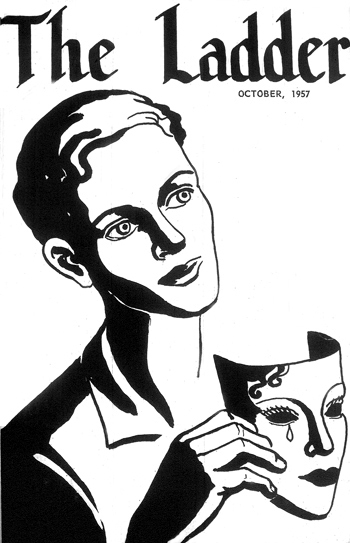
ABOVE: Front cover of the October 1957 edition of The Ladder, a lesbian bimonthly magazine distributed nationally throughout the United States, published by the Daughters of Bilitis (DOB), depicting a woman taking off a carnival mask
The Stonewall uprising and the emergence of the gay liberation movement
This incrementalist, education-focused activism held sway for about a decade, but, by the mid-1960s, some queer activists, especially younger ones, were starting to grow fed up with these tactics, which they saw as ineffective, and began to embrace more radical tactics and aims.
The face of queer activism changed forever on the sweltering night of June 27–28, 1969, when police raided the Stonewall Inn, a gay bar owned by the Mafia in the neighborhood of Greenwich Village of Lower Manhattan in New York City. The regular patrons of the Stonewall Inn were overwhelmingly the most socially outcast members of the queer community; most were poor or working class, gender-nonconforming, and/or people of color. They included drag queens, effeminate gay men, butch lesbians, and many people who would be described today as trans, such as Marsha P. Johnson, a gender-nonconforming, homeless, Black drag queen and sex worker.
Police had raided the Stonewall many times before, but, on this particular night, patrons began to fight back against the police. They hurled bricks and beer cans, called the police “pigs” and other insults, forced the police to barricade themselves inside the bar, smashed windows, and used an uprooted parking meter as a battering ram to break down the bar doors. Further riots raged through the Greenwich Village for days afterward.
The adoption of the labrys as a lesbian feminist symbol
After Stonewall, organizations advocating gay liberation proliferated, and their tactics and goals became increasingly radical. Many engaged in marches and protests, confrontations, civil resistance, and direct action.
Mary Renault, as a white, upper-class lesbian who belonged to an older, more conservative generation and whose sympathies lay with the incrementalist, education-focused approach of the 1950s, abhorred the new, confrontational, identity-focused gay liberation movement that arose after Stonewall and publicly condemned it. She wrote in an afterword to her lesbian novel The Friendly Young Ladies:
Congregated homosexuals waving banners are really not conducive to a goodnatured ‘Vive la difference!’ . . . People who do not consider themselves to be, primarily, human beings amongst their fellow humans, deserve to be discriminated against, and ought not to make a meal of it.
But Renault was powerless to stop the most radical offshoots of the gay liberation movement from embracing the ideas and imagery they found in her novels. Her vivid description in The Bull from the Sea of the fierce, crimson-clothed Amazon queen riding her horse beneath the last red cloud of sunset, with her hair flowing wild and free, bellowing the war-cry, and wielding the sacred battleax of ancient matriarchy, appealed immediately, viscerally, and powerfully to both the fury and radical aspirations of the new movement.
Many lesbians who were involved in the gay liberation movement were also involved in the contemporary women’s liberation movement. They encountered sexism from gay men on the one hand and homophobia from straight women in the women’s lib movement on the other, which led them to form their own cultural movement based around the intersection of queer and women’s identities, known as lesbian feminism.
Some lesbians embraced an especially radical form of lesbian feminism known as lesbian separatism, which held that all women should totally renounce relationships with men and establish women-only communities, in which they would have relationships and sex exclusively with other women. They drew inspiration for this idea from the mythical Amazons, whose image in popular culture Mary Renault’s novels had played a major role in shaping.
In September 1972, a pair of lesbian separatists named Marizel Rios and Jane Lurie founded the first feminist bookstore in New York City. They named the store Labyris [sic] Books and used the labrys as their symbol because they associated it with the Amazons—an association they most likely derived from Renault, who derived it from Ploutarkhos.
According to the NYC LGBT Historic Sites Project website, Labyris Books sold various merchandise, including non-sexist children’s books, books and pamphlets about lesbian sexuality and lesbian separatism, and women’s studies textbooks, but it was mainly a place for lesbian feminists to gather. The store hosted talks by lesbian feminist authors and speakers, including Audre Lorde.
In 1975, Labyris created a white T-shirt which bore the slogan “The Future Is Female” in all-capital blue letters on the front. On the back, the T-shirt bore an image of a labrys with the name “Labyris Books” and the same slogan from the front repeated, only with a labrys as the letter L in “female.” In that year, the artist Liza Cowan, a supporter of Labyris Books, took a photo of her girlfriend, the folk musician Alix Dobkin, wearing this T-shirt in order to use it for a photo essay titled “What the Well Dressed Dyke Will Wear.”
This T-shirt and the slogan it bore remained mostly obscure until 2015, when the lesbian history Instagram account @h_e_r_s_t_o_r_y shared Cowan’s photo of Dobkin wearing the shirt. This share received lots of attention and the boutique store Otherwild, with Cowan’s permission, began to make and sell copies of the shirt. The slogan quickly became so popular that Hillary Clinton (a mainstream liberal politician if there ever was one) used it during her 2016 presidential campaign. Today, the slogan has become associated with mainstream liberal feminism, and most people who use it today have no idea that it originated in 1970s lesbian separatism.

ABOVE: Liza Cowan’s photo showing her girlfriend Alix Dobkin wearing Labyris Books’ T-shirt with the slogan “The Future Is Female”
The mid-1970s lesbian separatist schism over trans people
In the mid-1970s, a split emerged among lesbian separatist groups over how their movement should regard trans women. Some lesbian separatists believed that trans women are women and should be included in the movement, while others regarded trans women as men and thought they should be excluded.
In 1973, a lesbian separatist collective founded Olivia Records as an all-lesbian record label. Around 1974, the collective’s representatives reached out to Sandy Stone, an out trans woman. As Stone herself described in an interview with The Trans Advocate, the collective’s members already knew that Stone was trans, they considered her to be a woman, and they wanted to include her in their collective, because they desperately needed a sound engineer, and Stone had the necessary skills for the role. Stone agreed and joined the collective.
A lesbian separatist named Janice Raymond, who was not a member of Olivia Records or affiliated with it in any way, however, found out about Stone and organized a hate campaign against her, which led to vicious, persistent harassment and death threats against the members of the collective, including Stone. The harassment and death threats led Stone to leave the collective in 1978, even though the other members wanted her to stay.
The next year, in 1979, Raymond published a book titled The Transsexual Empire: The Making of the She-Male, which is more-or-less an unhinged screed attacking the existence of trans women. Raymond starts from the position that sex is biologically innate, discernable from a person’s genitals at birth, binary, and immutable. She argues on this basis that trans women are dangerous, perverted, mutilated, misogynistic men who seek to “colonize” women’s identities and spaces in the name of male dominance. She spends a large portion of the book attacking Sandy Stone specifically.
Raymond writes that all trans women rape “real” (i.e., cisgender) women’s bodies “by deception” just by physically resembling women when they are not really women—even if they are not using any force or engaging in any sexual conduct whatsoever (p. 104, 1994 Teachers College Press ed.). She writes:
All transsexuals rape women’s bodies by reducing the real female form to an artifact, appropriating this body for themselves.
As a “solution” to the supposed “problem” of transgender people existing, Raymond argues that society should do everything in its power to mandate trans people out of existence (p. 178):
I contend that the problem of transsexualism would best be served by morally mandating it out of existence.
Over the course of the next few decades, the mainstream gay liberation movement generally moved toward trans inclusion, but the lesbian separatist and radical feminist movements generally moved in the opposite direction. Raymond’s anti-transgender position became accepted as orthodoxy, and the movement doubled down hard on biological gender essentialism.

ABOVE: Front cover of the first edition of Janice Raymond’s 1979 book The Transsexual Empire
Some of those who had used the labrys as a lesbian feminist symbol in the mid-70s supported Raymond’s position on trans people. Notably, Alix Dobkin, who was photographed wearing the Labyris Books T-shirt, strongly opposed the inclusion of trans people in the lesbian feminist movement. She wrote in a column in 1998:
For over twenty years men have declared themselves ‘women,’ manipulated their bodies and then demanded the feminist seal of approval from survivors of girlhood.
Dobkin remained an ardent critic of trans people for the next over two decades until her death in 2021.
The labrys lesbian Pride flag
Despite the schism among lesbian feminists over trans inclusion in the movement, by the close of the twentieth century, the labrys’s status as a symbol of lesbian feminism had been thoroughly cemented.
In 1999, the graphic designer Sean Campbell, a cisgender gay feminist man, created the first lesbian Pride flag, with the labrys at its center, in order to thank lesbians for supporting queer men during the HIV/AIDS pandemic. Campbell’s design combined the labrys with two other preexisting symbols of lesbian identity that had developed over the course of the twentieth century: the inverted black triangle and the color violet. Because both of these symbols are closely associated with the labrys due their appearance together on the labrys flag, I will explain their histories, beginning with the inverted black triangle.
In Nazi Germany, Paragraph 175 criminalized sexual activity between persons assigned male at birth. The Nazi regime regularly arrested, imprisoned, tortured, and sometimes murdered people whom they believed were gay men (which also included some people who would today be considered trans women). The Nazis forced those whom they imprisoned in their concentration camps for being “homosexuals” to wear an inverted pink triangle on their uniforms. Camp authorities and other prisoners treated these prisoners in an especially cruel and degrading manner; rape, torture, heinous “experiments,” and brutal killings of “homosexual” prisoners were the norm.
In the early 1970s, German gay liberation groups began to use the pink triangle to commemorate gay victims of Nazi persecution. By the mid-1970s, activists had begun to use the pink triangle to symbolize gay endurance and defiance of oppression.
In the late 1980s, activists who analogized the HIV/AIDS pandemic to the Holocaust transformed the pink triangle into a symbol of support for those who had died of or were living with HIV/AIDS. In 1986, the Silence=Death Project pasted flyers bearing the pink triangle all over New York City as part of a campaign to raise awareness of the HIV/AIDS pandemic, which the organization ACT UP subsequently reproduced.

ABOVE: Image from Wikimedia Commons showing the inverted pink triangle that the Nazis forced people whom they designated “homosexuals” to wear in their concentration camps

The Nazis didn’t systematically persecute queer women or trans men for gender and sexual nonconformity in the way they systematically persecuted queer men. This was mainly because, due to misogyny, the Nazis regarded people assigned male at birth who exhibited feminine behavior as degenerate and their existence as a threat to the continued flourishing of the Aryan race, but they did not perceive people assigned female at birth who exhibited masculine behavior as being as serious of a threat. Some Nazis also worried that, if they persecuted women for same-sex activity, they would risk persecuting innocent Aryan housewives on false charges.
Nonetheless, the Nazis did arrest and imprison some queer women as “asocials” (a broad category which included many different kinds of people whom the Nazis deemed socially undesirable, including disabled people, alcoholics, homeless people, sex workers, Romani people, pacifists, and draft evaders). The symbol that they forced all these so-called “asocials” to wear in concentration camps was an inverted black triangle.
Starting in the 1970s, queer women followed the example of queer men reclaiming in the pink triangle by reclaiming the inverted black triangle as their own symbol to represent queer women’s resistance to oppression. In the context of the HIV/AIDS pandemic, the black triangle also became a symbol of queer women’s support for queer men who had died of or were living with HIV/AIDS.

ABOVE: Image from Wikimedia Commons showing the inverted black triangle that the Nazis forced people whom they designated “asocials” to wear in their concentration camps

The violet background of Campbell’s 1999 lesbian Pride flag design references the long association of violet flowers with sapphic love, which traces its history all the way back to Sappho’s poems. In one poem (fragment 94, which is sometimes called “Sappho’s Confession”), Sappho describes herself and her lover (a woman) as putting on “στέφανοι ἴων” (“crowns of violets”) together. Just a few lines later in the same fragment (94.21–23), she makes the only explicit reference to woman-woman sex in any of her surviving poems.
As I discuss in this post I made in January 2023 about the transmission of Sappho’s poems, fr. 94 is preserved in P. Berol. 9722, a scrap of a parchment codex from Egypt dating to the sixth century CE. A German vice-consul acquired this parchment by unknown means and donated it to the Egyptian Museum of Berlin in 1896. The German ancient historian Wilhelm Schubart published the editio princeps (i.e., the first scholarly edition of the Greek text) of P. Berol. 9722 six years later in 1902. This was the first major expansion of Sappho’s surviving corpus as a result of a modern manuscript discovery.
Fr. 94’s mention of Sappho and her lover putting on “crowns of violets” may have helped to inspire the use of violets as a symbol of sapphic love in the first half of the twentieth century. The French playwright Édouard Bourdet’s 1926 play La Prisonnière (The Captive) portrayed a lesbian character as leaving a bouquet of violets for the woman she loves. Lesbians who attended the play wore violets pinned to their lapels as a show of solidarity with the character, which promoted an association of violets with sapphic attraction.
Campbell brought all three of these symbols—the labrys, the inverted black triangle, and the color violet—together in his 1999 lesbian Pride flag design. In the center of the flag is a labrys, representing lesbian feminism and women’s empowerment. Behind it is an inverted black triangle, representing lesbian resistance to oppression and solidarity with queer men during the HIV/AIDS crisis. The background of the flag is violet, recalling the violets of Sappho 94 and The Captive.

ABOVE: Image from Wikimedia Commons of the labrys lesbian feminist flag, designed by Sean Campbell in 1999, making it the oldest lesbian Pride flag

TERFs, trans women, and the future of the labrys
Campbell published his lesbian Pride flag design in the June 2000 Palm Springs edition of the Gay and Lesbian Times Pride issue. Lesbians largely embraced the flag, and it has been a mainstay at Pride events ever since. Unfortunately, one particular group has especially embraced it: TERF lesbians.
Around 2008, the trans-inclusive radical feminist blogger Viv Smythe popularized the term TERF (an acronym for trans-exclusionary radical feminist) to describe those who call themselves “radical feminists” who do not consider trans women real women and oppose their inclusion in women’s spaces. In the eighteen years since then, TERFs (who now usually call themselves “gender-critical feminists”) have become a major cultural force with a whole ideology, which largely descends from Janice Raymond’s The Transsexual Empire. TERFs are especially influential in the U.K., where the British media constantly platforms their views.
In contrast to most radical feminists and lesbian separatists of the 1970s (many of whom were transphobic, but had other interests besides trans issues), present-day TERFs focus almost exclusively on attacking trans people and, although they usually claim to be left-wing feminists, have found common ground with the far right due to their shared hatred of trans people. The largest proportion of TERFs are straight women, but some are lesbians, and TERF lesbians really love the labrys flag, which they have tried to appropriate to represent their ideology.
The vast majority of lesbians, however, oppose TERFs and support trans rights. For young lesbians, this is especially true. A 2023 survey of LGBTQ+ people between the ages of eighteen and twenty-five by the charity Just Like Us found that 96% of lesbians within the age range of the survey described themselves as “supportive” or “very supportive” of trans people. Among young LGBTQ+ people, lesbians are the most trans-supportive of all LGBTQ+ identities other than trans and nonbinary people themselves.
Many lesbians who support trans rights, including many trans lesbians, appreciate the labrys symbol and the labrys flag design and have sought to reclaim them from the TERFs who have appropriated them. Some have designed expressly trans-inclusive versions of the flag that show the labrys in trans colors, while others display the flag alongside the trans Pride flag or the Progress Pride flag (which incorporates the trans colors).

ABOVE: Example of a trans-inclusive labrys flag design that is available for sale on Etsy at a store with which I have no affiliation
Why we shouldn’t let TERFs have this flag
As a trans lesbian myself, I personally think the labrys flag is the best lesbian flag design. It’s visually striking, it looks badass, and it has far more queer history embedded in it than any other Pride flag. Every symbol that appears on the flag has an association with queer women that predates Stonewall.
Many people today unfortunately think of the labrys flag as a “TERF flag,” but, as I’ve shown above, it bears so many much older associations. It reminds us of the Minoans, the Amazons, Sappho’s poems, The Captive, the Nazi persecution of queer people, Mary Renault’s novels, the lesbian separatist movement, and 1980s HIV/AIDS awareness activism, all in one design.
Moreover, the history of the labrys is one of constant re-appropriation. People have been fighting over this symbol for nearly four thousand years, and the current fight between TERF lesbians and trans-inclusive lesbians is just the most recent iteration of this age-old fight. For the Minoans, the labrys was a symbol of powerful goddesses. The Karians made it a symbol of Zeus, the male, patriarchal thunder god, but then early twentieth-century scholars like Sir Arthur J. Evans and Jane Ellen Harrison re-appropriated it as a symbol of prehistoric matriarchy.
The lesbian novelist who inadvertently made the labrys into a queer symbol thought that the gay liberation movement was too confrontational and identity-focused, but the lesbian separatists took the symbol that appeared in her novels and used it to represent their very confrontational and identity-focused movement. The lesbian separatists wanted to separate themselves from all men, but it was a man who put their symbol on a lesbian Pride flag to thank lesbians for supporting queer men during the HIV/AIDS crisis.
Just when the labrys starts to mean one thing, another group uses it to mean the opposite. Its history is so varied and complex that, no matter what your ideological persuasion is, there’s some meaning in it that you can probably get behind. Its history and complexity of meaning are precisely the main reasons why I like it so much.
We cannot let TERFs have this flag. We should use it everywhere, either with trans colors on the ax or paired with trans flags, to reclaim it.
Works cited
- Evans, Arthur J. 1900. “Knossos I. The Palace.” Annual of the British School at Athens 6: 3–70.
- Evans, Arthur J. 1901. The Mycenaean Tree and Pillar Cult and Its Mediterranean Relations, with Illustrations from Recent Cretan Finds. MacMillan and Co.
- Gere, Cathy. 2009. Knossos and the Prophets of Modernism. University of Chicago Press.
- MacGillivray, Joseph Alexander. 2000. Minotaur: Sir Arthur Evans and the Archaeology of the Minoan Myth. Hill & Wang.
- Marinatos, Nanno. 1993. Minoan Religion: Ritual Image, and Symbol. University of South Carolina Press.
- Gulizio, Joann and Dimitri Nakassis. 2014. “The Minoan Goddess(es): Textual Evidence for Minoan Religion.” In KE-RA-ME-JA: Studies Presented to Cynthia W. Shelmerdine, edited by Dimitri Nakassis, Joann Gulizio, and Sarah A. James, 115–128. INSTAP Academic Press.
- Unwin, Naomi Carless. 2017. Caria and Crete in Antiquity: Cultural Interaction between Anatolia and the Aegean. Cambridge University Press.
- Younger, John G. and Raul Rehak. 2008. “Minoan Culture: Religion, Burial Customs, and Administration.” In The Cambridge Companion to the Aegean Bronze Age, edited by Cynthia Shelmerdine, 165–185. Cambridge University Press.

Please be aware that I will delete all comments expressing transphobic views or support for TERFs. Those views are not acceptable in this comment section.
Especially if JK Rowling tries to comment.
I highly doubt that J. K. Rowling will read this post.
Because it’s too genius for her to handle.
I wondered whether the double headed ax that Vichy France used as a symbol was a labrys, but I see that it was just a throwing ax that was used by the Franks that Maréchal Pétain used as his personal insignia. https://en.wikipedia.org/wiki/Order_of_the_Francisque
Frankish for sure.
If this post actually breaks new historical ground, it’d be great if you could get the information you discovered into a peer-reviewed paper, but I don’t know if you’d actually be able to do that any time soon. Great post anyway.
This post mostly covers publicly available information. The specific part that I think may actually break new historical ground, though, is the identification of the probable chain of transmission for the idea of Amazons wielding labryes from Ploutarkhos’s Greek Questions to Mary Renault’s The Bull from the Sea to 1970s lesbian separatists.
All of the histories I’ve found covering the use of the labrys as a lesbian symbol simply begin with the lesbian separatists in the 1970s and say that they used it because it was associated with the Amazons, but none of them identify where they got this association from. The thing is, the idea of Amazons wielding the labrys is not actually very widespread. As far as I’m aware, the only ancient textual source that makes this association is Ploutarkhos’s Greek Questions, and I’m certain that lesbian separatists in New York in the 1970s were not reading obscure antiquarian treatises by Ploutarkhos. Mary Renault, however, adapts this tradition from Ploutarkhos in The Bull from the Sea, which seems to be the link between Ploutarkhos and Labyris Books.
Alright then, if it’s not originally called a labrys axe, what DID the Knossi/Minoan people call it?
No one knows what the Minoans called it.
Great! Then I guess Labrys is going to be the best name for it by default.
Would’ve liked to know the native name though. So, that will be a forever unsolved mystery.
I mean, we could just call it a double-headed ax or use the Classical Greek word and call it a pelekys.
I’d run with double-headed ax
It’s a shame the labrys has been co-opted by hateful people. Oh well.
In regards to Minoan matriarchy, it’s been noted that Minoan art shows men in an objectified way while women are remain as figures of power, the inverse of surrounding cultures. This has been used to argue as evidence for them being a true matriarchy, though as you say there is nuance that art alone may not convey
Don’t worry; This isn’t a swastika scenario.
I am in the UK, and can confirm that there does seem to be a well funded, politically minded, vocal TERF movement who seemingly want to change our culture.
My partner is an NHS nurse and if he met you in his hospital he would 1) assume you were a woman 2) check how you would like to be identified and addressed 3) place you for your MEDICAL needs in the most appropriate location.
TERF’s have campaigned against these basic rights. They have even won a legal case in Darlington “forcing female staff to share single-sex changing areas with a transgender woman breached staff dignity and created a hostile environment”. Ironic, given that they didn’t even care to address the fact that most NHS Trusts expect their male and female colleagues to share changing spaces and bathrooms.
I’m not sure how a trans person has become so disquieting for these campaigners, when an incident could surely also come from a female (according to their terms) sexually predatory lesbian, in this so-called newly protected space.
Thanks for the history, sorry for the rant.
Interesting read and well detailed account of how the journey of this ancient Greek symbol and physical religious/ritual artifact, as well as even as a martial weapon used on the battlefield in other contexts, has traveled through time, has transformed and evolved, and furthermore, has even become a reappropriated symbol by so many different groups of people, and in more recent times, has currently been embraced by particular groups of people based on the compounded personal interjections and speculations offered surrounding it’s origins, meaning, and uses (as a symbol and/or physical artifact) by a few several individuals within the past century and something.
Amazing how the labrys has changed in meaning over it’s more than 4000 years of known existence/history and how over that time period it’s also come to mean and represent a symbol of so many completely different things, to so many completely different groups of people.
It begs the question for one to just wonder what the Bronze Age Minoan and Mycenaean Greeks, or even their descendants the Iron Age Ancient Greeks for that matter, would all think about the labrys, in some contexts, now being reappropriated as one of the symbols representing that of feminists and lesbians in our modern times? To a certain extent it’s like how the Nazis reappropriated and adapted the original ancient swastika symbol (initially found in numerous different ancient cultures and civilizations and with different wonderful meanings) to represent their own identity as well as their particular sociopolitical views, beliefs, values and ideology, and thus making it forever after that simply nothing more than a toxic symbol and unfortunately exclusively associated thereafter only with them… at least that’s how most people(unfortunately) tend to view the swastika symbol nowadays and simply just either completely disregard, ignore, and/or just don’t know anything further about any of the details or ancient cultural, historical, and religious contexts and meanings or significance that are actually associated with it and that it holds beyond it’s (now) narrow association with the Nazis, which is truly sad.
It’s really hard to know what the Minoans and Mycenaeans would think of the present-day use of the labrys, especially since scholars still don’t fully understand what the symbol meant to them.
Very true, and I agree that it is difficult to know what the Minoan and Mycenaean Greeks would think about the various modern day symbolic meanings that the labrys has evolved into currently conveying and hold meanings for so many, various, and different groups of people.
I think, however, we are fairly certain that the labrys was some kind of religious or perhaps spiritual or ritualistic artifact for them and that apparently they used often in various public settings… but true, again, we currently do not know much more specifically than just that, that is, just that this particular thing held some sort of special significance to them. Hopefully more details will soon come to the surface (pun intended) and more discoveries will be made to shed more light about these extraordinary Bronze Age Aegean people, culture, and civilization…and further, how they shaped and laid the foundations for their subsequent descendants the Iron Age Greeks and deeper insights into how (Ancient and onwards) Greek culture, language, religion, traditions, customs, knowledge, and civilization evolved from there. Alas, let me stop here before diving even deeper into a transgressive dialogue.
I remember reading Robert Graves’s Greek Myths, from my understanding he’s a better teller of these stories than interpreter in what they probably meant historically or culturally. Very least he provides the Greek and Roman sources that he based his own versions off, even if he makes his own occasional innovations (like Hestia stepping aside as the twelfth Olympian in favor of Dionysus).
Graves was an extremely talented writer and storyteller, but his historical and mythographic theories were ludicrous.
To be fair I never really bothered checking out his interpretations part, simply cause that wasn’t what I was interested.
Another thorough, fascinating article! Your tracing of the thread from Cretan art to Plutarch to Mary Renault to lesbian activists etc. was not only original, but highlighted for me how strongly popular literature (especially literature that offers alternative, exotic/erotic interpretations) has influenced how we see the past. I love knowing where such ideas come from, and I also love knowing the more scholarly understanding of things.
I appreciate how you give context to everything you address and explain it clearly and in depth. I often feel after finishing one of your pieces that everyone in my circle needs to read it, and so I recommend your site often.
Thanks! I’m glad that you found the piece educational, and I appreciate you sharing my posts.