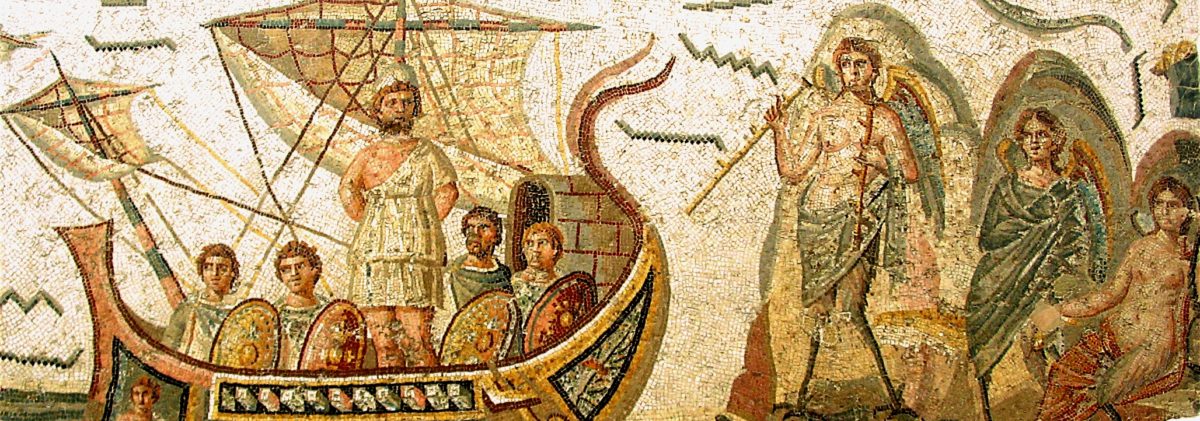
What Really Happened to the Athena Parthenos?

The Athena Parthenos, a colossal gold and ivory statue of the goddess Athena created between 447 and 438 BC by the renowned ancient Athenian sculptor Pheidias (lived c. 480 – c. 430 BC) that originally stood in the naos of the Parthenon on the Athenian Akropolis, is one of the most famous of all ancient Greek statues.

Unlike the Venus de Milo, which, as I talk about in this article from September 2019, wasn’t famous in antiquity and is mostly only famous today because of a French propaganda campaign in the nineteenth century, the Athena Parthenos really was famous in antiquity. In fact, it is only famous today because of its ancient reputation, since the statue itself has not survived.

Many people have wondered what happened to the Athena Parthenos, but its ultimate fate is actually far less mysterious than many people have been led to believe. The story of how the Athena Parthenos was destroyed, recreated, and destroyed again is as fascinating as any story from the ancient world.

Continue reading “What Really Happened to the Athena Parthenos?”

The Fascinating Truth about the Four Horsemen of the Apocalypse

The Four Horsemen of the Apocalypse are symbolic figures that appear in the Book of Revelation, the last book in the New Testament canon. They seem like familiar figures to most of us. Even if you aren’t a Christian or weren’t raised as a Christian, you’ve probably been exposed to the idea of the “Four Horsemen” through popular culture. Popular culture’s portrayal of the Four Horsemen, though, isn’t very accurate. For instance, nearly all popular culture adaptations get the identity of the first horseman wrong.

Even if you have read the original descriptions of the Four Horsemen from the Book of Revelation, chances are you aren’t aware of the complex cultural background and symbolism that these descriptions draw on. For instance, original readers of the Book of Revelation may have imagined the first horseman as a Parthian archer and the fourth horseman, Death, as a naked young man with wings, since that’s how the personification of Death is usually portrayed in ancient Greek art.

Continue reading “The Fascinating Truth about the Four Horsemen of the Apocalypse”

How Violent Was the Pre-Modern World Really?

It is no secret that the ancient and medieval worlds were, in general, more violent than today’s world. After all, today in the twenty-first century, most countries do not have crucifixions, gladiator fights, or public executions that involve people being torn apart by wild beasts. Cities today rarely have to worry about rival cities attacking them and most modern cities are not even fortified. Clearly, the world has changed quite drastically since antiquity.

Nonetheless, the degree of violence that existed in the ancient and medieval worlds was not nearly so great as many people have been led to believe by popular films and television shows, which often portray an absurd level of violence that is completely beyond the amount of violence that actually existed during any period of human history.

Continue reading “How Violent Was the Pre-Modern World Really?”

Did Christians Really Burn Sappho’s Poetry?

Sappho of Lesbos (lived c. 630 – c. 570 BCE) was the most praised and highly regarded of all Greek lyric poets in antiquity. She was known as the “tenth Muse” and some ancient authors regarded her work as on par with that of Homer (the putative author of the Iliad and the Odyssey and most revered of all ancient Greek poets) himself. She produced an enormous body of poems, but, sadly, extremely little of her work has survived to the present day.

In the third century BCE, the Greek scholars working at the Great Library of Alexandria produced a standard text for all of Sappho’s poems that was divided into at least eight “books” or rolls of papyrus. Many scholars believe that the collection probably contained nine books for the nine Muses. Today, though, less than seven hundred lines of Sappho’s poetry are extant. Only one of her poems, Fragment 1 (known as the “Ode to Aphrodite”), has survived to the present day totally complete with no lacunae or parts missing. A few other poems have survived to the present day nearly complete, including Fragment 16 (the “Anaktoria Poem”), Fragment 31 (“Phainetai Moi”), Fragment 58 (the “Tithonos Poem”), and the “Brothers Poem.”

The most common explanation that people give for why so little of Sappho’s poetry has survived to the present day is that (supposedly) Christian authorities in late antiquity or the Middle Ages had all the collections of her poems rounded up and burned, because they were disgusted and horrified by how openly she describes her erotic desire for other women. This makes for a good story with clear villains. Unfortunately, it is probably not true. In reality, as I shall explain in this post, we have no evidence to support the idea that Christians went around burning Sappho’s poems. The real reasons why so little of her poetry has survived are far more complicated—and actually far more interesting.

Continue reading “Did Christians Really Burn Sappho’s Poetry?”

Just How Pagan Is Christmas Really?

The Christmas season is upon us and, if there’s one thing I know I’m going to get for Christmas, it’s spurious claims about modern Christmas traditions supposedly having ancient “pagan” origins. Most of my readers are probably already familiar with the sorts of claims I am referring to; it is popularly believed that Christmas is really an ancient “pagan” holiday that was hijacked by early Christians and that modern, twenty-first-century, secular American Christmas traditions are actually of ancient “pagan” origin.

Well, I’m here to tell you that, although there was a time when Christmas did indeed incorporate some pre-Christian traditions, virtually none of the traditions associated with Christmas in the United States today are actually of ancient pre-Christian origin. In fact, virtually all of the Christmas traditions that you usually hear people going around claiming are “pagan” are actually traditions that only arose within the past two hundred years or so, within a Christian cultural context.

Continue reading “Just How Pagan Is Christmas Really?”

The Long, Strange, Fascinating History of Santa Claus

Have you ever wondered where the story of Santa Claus comes from, why he is said to bring presents to children at Christmas, why he is said to live at the North Pole, or why he is said to have a sleigh pulled by flying reindeer? Well, as it turns out, the history of Santa Claus is an incredibly long, twisted, and strange one.

It involves a building project by a Byzantine emperor, a story about a father preparing to sell his own daughters into prostitution, a hoard of stolen human bones reputed to have magical properties, armies of Crusading knights, Protestant zealots, the author of “Rip Van Winkle” and “Sleepy Hollow,” a poem you probably read as a child but didn’t realize how influential it was, a “Nast”-y nineteenth-century political cartoonist, and Coca-Cola.

This may seem like a bizarre assortment incredibly disparate things, but I promise you, everything I just mentioned is actually vital to the development of Santa Claus as we know him today. Let’s go all the way back to the beginning of it all in late antiquity and embark on this odyssey together to discover the origins of Santa Claus!

Continue reading “The Long, Strange, Fascinating History of Santa Claus”

Was Jesus Copied Off the Greek God Dionysos?

As everyone reading this is doubtlessly already aware, there are hundreds of memes and articles out there on the internet claiming that Jesus was “copied off” various pagan deities. The usual culprits include Horus, Dionysos, Mithras, Attis, Tammuz, Adonis, Sol Invictus, et cetera. I have already written a detailed article debunking claims about Jesus being copied off of Horus. Now I am going to debunk the claims about Jesus being copied off of Dionysos.

This article will be a lot more nuanced than my article about the alleged parallels between Horus and Jesus, however, since there really are some significant parallels between Jesus and Dionysos; they just aren’t nearly as numerous or as significant as Mythicists on the internet often claim. There is some evidence that some Christians may have intentionally shaped certain stories about Jesus in response to stories about Dionysos, but there is no good evidence to suggest that Christians just “copied” Jesus wholesale off of Dionysos.

Continue reading “Was Jesus Copied Off the Greek God Dionysos?”

The Truth about the Archimedes Palimpsest

If you have an interest in ancient science or mathematics, chances are you have probably heard at some point about the Archimedes Palimpsest. According to the narrative that New Atheist writers and media outlets keep pushing, the ancient Greek mathematician Archimedes of Syracuse (lived c. 287 – c. 212 BC) wrote groundbreaking mathematical treatises that were millennia ahead of their time.

Then, according to the standard narrative being pushed, in the thirteenth century AD, ignorant, obscurantist Christians who did not care about science or mathematics erased the text of the manuscript containing the last known copies of several of Archimedes’s treatises and reused the parchment to make a prayer book. Now—or so the story goes—Archimedes’s previously lost groundbreaking works are being recovered through the brilliancy of modern secular technology.

Unfortunately, this narrative that I have just outlined is deeply, deeply misrepresentative and based on an extremely selective presentation of the evidence. If the media would tell the full story of the Archimedes Palimpsest, we would be getting a very different narrative—a narrative not about how religion is inherently dangerous and destructive, but rather a far more complex narrative in which religious individuals are neither inherently evil nor inherently good but simply human beings capable of both good and evil.

Continue reading “The Truth about the Archimedes Palimpsest”

When Was Jesus Really Born?

Most people assume that Jesus of Nazareth was born on 25 December 1 AD. Superficially speaking, this assumption makes a great deal of sense. After all, Christians today celebrate Jesus’s birth every year on December 25th and our modern Anno Domini dating system, which is ostensibly based on the year when Jesus was born, begins with the year 1 AD.

Unfortunately, things are never quite so simple. The truth is, we genuinely have very little idea when Jesus was born. There is no mention of the exact date of Jesus’s birth anywhere in any of the earliest surviving Christian writings and it was not until around the fourth century AD that December 25th was settled on as the day on which Christians would celebrate Jesus’s birth. Even the year of Jesus’s birth is uncertain; all we can say is that he was probably born sometime between c. 10 BC and c. 4 AD.

Continue reading “When Was Jesus Really Born?”

Was Jesus Copied Off the Egyptian God Horus?

Every year, around this time, you start seeing memes claiming that Jesus is “a copy of” some pre-Christian deity. One of the most popular deities for people to claim Jesus is “a copy of” is Horus, a god who was worshipped in ancient Egypt from prehistoric times until after the rise of Christianity in around the fourth century AD. Horus was believed to have been the son of the god Osiris and the goddess Isis. He was closely associated with the pharaoh and he is usually depicted in ancient Egyptian art with the head of a falcon.

The truth is, all the memes claiming that Jesus is “a copy of” such-and-such deity are wrong. Historians agree that Jesus of Nazareth was a historical figure who lived in Galilee in the early first century AD and who was crucified in Jerusalem in either 30 or 33 AD under the orders of the Roman governor of Judaea, Pontius Pilatus. The stories about Jesus’s life recorded in the gospels are certainly heavily embellished with legend and fiction, but, ultimately, there was a real man who stands behind the mythological tradition. While the stories about Jesus recorded in the gospels have probably been influenced to varying extents by stories of various pagan deities, it is entirely wrong for anyone to claim that the whole story of Jesus is copied directly from any single pagan deity.

Of all the deities Jesus is often claimed to have been copied off of, Horus is one of the most commonly mentioned, but also one of the most absurd. I actually included an extremely brief debunking of the claim that Jesus is based on Horus in this article I published on my website in March 2018, but I received some flak over the fact that I did not quote any specific claims from proponents of the Jesus-Horus connection and respond to them. I suppose, then, it is about time that I wrote a more complete response to the alleged connections between Jesus and Horus.

Continue reading “Was Jesus Copied Off the Egyptian God Horus?”