Scholars Have Discovered How to Pronounce the True Name of God

Today, most Jews, Christians, and Muslims simply call their god “God,” but it is fairly common knowledge that the texts of the Hebrew Bible refer to the God of Israel by his proper name, which, in Hebrew, is written as four letters: יהוה (YHWH), known as the tetragrammaton. At the time when the texts of the Hebrew Bible were written, the people of Israel and Judah regularly used this name to refer to their god. By the first century CE, however, a taboo forbade ordinary Jews from saying the proper name of God aloud. Instead, when a Jewish person was reading the Hebrew Bible and came across this name, they would substitute either the word אֲדֹנָי (ăḏonāi), which means “my Lord,” or הַשֵּׁם (ha-shem), which means “the name.” For this reason, English translations of the Hebrew Bible traditionally render the proper name of God as “the LORD.”

At the time of the Hebrew Bible’s composition, the written forms of the Hebrew and Aramaic languages recorded only consonants, not vowels. Much later, between the seventh and tenth centuries CE, the compilers of the standard text of the Hebrew Bible, known as the Masoretic Text, added symbols known as “vowel points” to indicate the vowels of most words, but, when the tetragrammaton occurred in the text, they gave it the vowel points of ăḏonāi, because that was the word a reader was supposed to substitute for it, and did not preserve the vowels of the name itself. For this reason, most Christian seminaries and Jewish rabbinical schools teach that no one today knows how the name of God was pronounced.

This makes for a good story, and it was actually true at one time. For roughly the past century now, though, scholars have actually had compelling evidence that the ancient peoples of Israel and Judah pronounced the proper name of their god Yahweh. There is slight ambiguity about the exact vowel qualities, but not much. In this post, I will explain the ancient evidence supporting this scholarly reconstruction. To do this, I will have to use some linguistics jargon, but I will do my best to explain the meanings of all the terms I use.

Continue reading “Scholars Have Discovered How to Pronounce the True Name of God”

Is Athena Named After Athens, or Vice Versa?

In ancient times, the people of the Greek city-state of Athens regarded the goddess Athena as their patron. The special relationship between the goddess and the city is reflected in their shared name, and, naturally, many people have assumed that the Athenians named their city in honor of Athena. Startlingly, however, historical and linguistic evidence may support the opposite conclusion: that the goddess Athena derived her name from the city of Athens, rather than vice versa.

Continue reading “Is Athena Named After Athens, or Vice Versa?”

Update on My First Few Weeks of Law School, the Future of This Blog, and My Novel (September 2nd, 2025)

Hello everyone! I am about to begin my third week of law school classes. I have been gradually acclimating myself to this new field of study. So far, my classes are going well, and I’ve found that I’m actually kind of enjoying the material. My knowledge of Latin and premodern history have even proven useful on a few occasions! For instance, in my torts class last week, we read and discussed I de S et ux. v. W de S, a 1348 English Court of Assizes case that is preserved in the Liber Assisarum et Placitorum Corone (Book of Assizes and Appeals to the Crown). I had a lot of fun in class explaining the Year Books, late medieval English scribal practices, how to interpret medieval Latin shorthand, and the common law doctrine of coverture and how it limited married women’s ability to sue in court. (I also covered the facts, procedural history, reasoning, and holding of the case.)

I have been continuing to read and study history, literature, and philosophy for my own edification in the available time I have, and I do plan to continue making posts on this blog when I am able to do so. That being said, my available time for writing is limited because I have a lot of reading, studying, and writing for class to do and, inevitably, my schoolwork must take priority over this blog. I am hoping to make at least one post about actual historical content per month going forward, but we will see how well I hold to that.

In the meantime, I am also continuing to work on my novel in progress, Mother of the Gods. Progress on the novel has been slow recently due to my limited available time, but I do not intend to abandon it, and I did spend a few hours working on it just last week.

Why Do Ancient Egyptian Gods Have Animal Heads???

Modern people have often found ancient Egyptian depictions of their gods perplexing and strange, since many of them bear the heads or other features of animals. If you’ve ever wondered why the Egyptians did this, you’re certainly not the first. Even in ancient times, Greek, Roman, and early Christian writers mocked their Egyptian contemporaries for their animal-headed gods (even while some Greeks and Romans adopted them). Later, nineteenth and early twentieth-century western writers claimed the Egyptians’ animal-headed gods as evidence of their culture’s supposed primitivity and inferiority to Greece and Rome.

In reality, Egypt is far from the only ancient culture in which people depicted deities with mixed human and animal features. Therianthropomorphic (i.e., human-animal hybrid) deities are fairly common in the ancient Middle East, North Africa, and southern Europe, including even in ancient Greece and Rome. The Egyptians were no strangers to fully anthropomorphic deities either. By exploring the context and history of Egypt’s animal-headed deities, this post will show that, far from indicating lack of cultural sophistication, they actually display ancient Egypt’s creativity and cultural dynamism.

Continue reading “Why Do Ancient Egyptian Gods Have Animal Heads???”

What Was the First Conlang?

A constructed language or “conlang” is a language that an individual or group has deliberately created with a purpose in mind, as opposed to languages that have arisen naturally. Today, when most people today hear this term, they think immediately of languages used in works of fiction, such as J. R. R. Tolkien’s Elvish language Quenya (which he created long before he used it in his novels The Hobbit and The Lord of the Rings), Klingon from the television series Star Trek, or Dothraki and High Valyrian from Game of Thrones.

Many people may be surprised to learn that the oldest examples of what we might call constructed languages were not created for fictional worldbuilding at all, but rather as a philosophical or theological exercise. Such examples are also far older than many readers may realize, dating all the way back to the Middle Ages.

Continue reading “What Was the First Conlang?”

Well, I’m Going to Law School

Hello everyone, I’m sorry that I haven’t written much the past few months. I have been seriously rethinking my career plans ever since I did not get into a PhD program last year and have been doing so even more since I learned that I will not be admitted to a classics PhD program with funding this year either. For at least a decade now, I’ve known that it was extraordinarily unlikely that I would ever land a tenure-track professorship in ancient history, but I was just so stubbornly, stupidly committed to it that I was unwilling to give it up and pursue an actually realistically viable career path.

At this point, though, my thinking has changed. I’ve realized that I can’t keep wasting my life on something that has virtually no chance of ever turning into a stable living. The odds of landing long-term employment as an academic ancient historian are so low and so random that pursuing a PhD with that goal is like betting one’s future prospects of employability on rolling sixes on a die six times in a row. Under normal circumstances, we wouldn’t call that a career plan; we’d call it a gambling addiction.

Instead of going into a PhD program, I’ve decided to go to law school and become a lawyer. This was not an easy decision to make. Before I made it, I spoke to a professional career counselor, I reached out to three different practicing attorneys who work in different areas of law and a current law student at IU Bloomington, all of whom very generously agreed to speak to me, and had long conservations with them about what law school and legal practice are like. I did a lot of reading and research on my own, I had many conversations with my parents, and I spent many weeks thinking it over.

The truth is that I’ve been interested in the law for a long time and it is a career that is well suited to my skills and interests. Even back when I was in high school, my father and several of my teachers encouraged me to become a lawyer, but, at the time, I just couldn’t see myself as one, mostly because I was already certain that I wanted to be an ancient history professor.

I made the decision to apply to law school in April of this year. By that time, the deadlines for this year for most programs were already passed and the next offering of the LSAT was not until June 7th (after even the latest of all the deadlines), but I managed to find a way around this, since the IU Bloomington Maurer School of Law has recently started accepting the GRE as a substitute for the LSAT and had a late application deadline this year of June 1st. As it happens, I took the GRE one time without studying four years ago when I was preparing to apply to PhD programs the first time and got a perfect score (170 out of 170, 99th percentile) on the verbal reasoning section. My scores are still valid, so I sent them in and submitted my application to Maurer in May. On Thursday of last week, I received official notice that I have been admitted and that I have also received a merit-based scholarship covering part of the tuition for the program. I have now accepted my offer of admission and signed a lease for an apartment in Bloomington. Orientation is on August 13th.

Continue reading “Well, I’m Going to Law School”
Why Are Oxbridge Professors, Catholic Priests, and Crime Bosses All Called ‘Don’?

Generally speaking, a professor at the English universities of Oxford or Cambridge, a Catholic priest or abbot, and a crime boss don’t have much in common—but they do at least share one thing: the title don or dom (which has one etymological root). To some, it may seem confusing why people from such radically different walks of life share the same honorific. How did this happen? As is often the case with etymological quandaries such as this, the answer goes back over two thousand years to the ancient Romans.

Continue reading “Why Are Oxbridge Professors, Catholic Priests, and Crime Bosses All Called ‘Don’?”

Lost Ancient Cities That No One Has Ever Found

When most people hear the words “lost ancient cities,” their first thought is of Atlantis, which, as I discuss in this post I made back in 2019, is definitely fictional and never really existed. There are, however, many very real and highly significant ancient cities whose exact locations are still unknown or disputed. Perhaps the most famous example is the ancient city of Akkad; most people have heard at some point of the ancient Akkadian Empire and its founding king Sargon of Akkad (ruled c. 2334 – c. 2279 BCE), but not everyone knows that archaeologists still aren’t sure exactly where this famous ancient city was. Strong evidence suggests that it was somewhere in the area of modern Baghdad, but no one has ever conclusively identified its ruins.

Akkad is far from the only ancient city that has so far eluded modern archaeology. In this post, I will discuss other major ancient cities that are still “lost” and where archaeologists currently hypothesize they may have been.

Continue reading “Lost Ancient Cities That No One Has Ever Found”

Everything I Liked and Hated about Uberto Pasolini’s ‘The Return’ (2024)

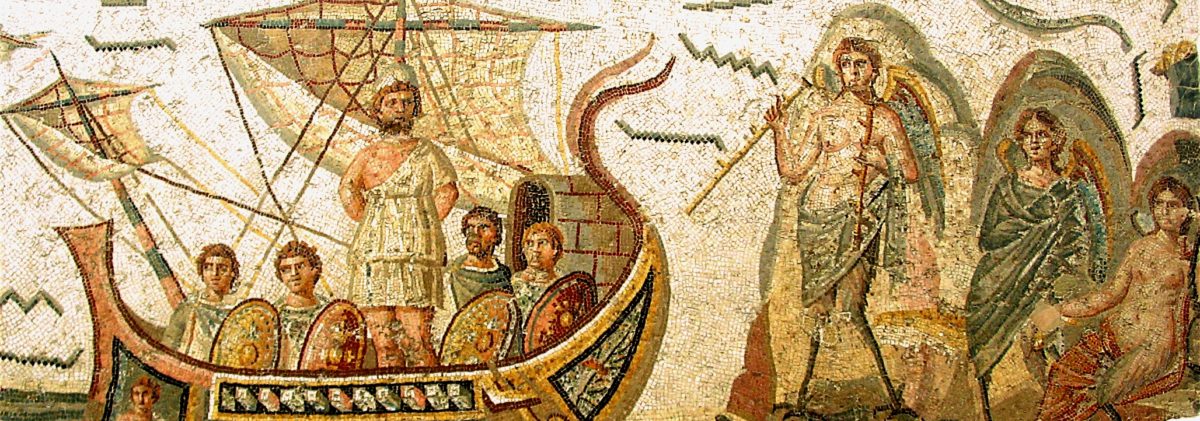
The Odyssey, an ancient Greek epic poem, is one of the most famous works of world literature. Countless adaptations of it have come out over the years in virtually all forms of media including books, stage plays, films, television series, video games, and musicals—but one thing most of these adaptations have in common is that they focus on one relatively small section of the epic. Although the whole epic consists of twenty-four “books” (which are roughly the length of chapters), most adaptations focus mostly or entirely on Books 9–12, a first-person account by Odysseus of his various adventures while trying to return to his home island of Ithaka. The stories found in these four books have become so iconic that, when one mentions the Odyssey, they are what most people immediately think of: the man-eating Kyklops, the Lotos-eaters, the sorceress Kirke who turns men into pigs, the summoning of the dead, Skylla and Kharybdis, and the Sirens who lure sailors to their deaths.

Many people who haven’t read the original epic don’t realize that Odysseus arrives back on Ithaka in Book 13 and the entire second half of the epic (Books 13–24) describes what happens after he gets back. It’s easy to see why the second half of the epic receives less attention than the first half; the pace is slower, the events described are less fantastic and more mundane, and modern audiences who have been conditioned to see the epic as being about Odysseus’s journey home may assume that the story is over once he arrives on Ithaka’s shore. The second half of the epic, however, is a tour de force of storytelling containing some of the greatest drama and pathos in the whole epic.

This is why I was initially very excited about the film The Return, directed by Uberto Pasolini and starring Ralph Fiennes and Juliette Binoche, which was released on December 6th, 2024. The film is an adaptation of the last twelve books of the Odyssey that begins with Odysseus’s arrival home, omitting his better-known earlier adventures. I promised that I would write a review of the film and now I am coming through on that promise (albeit three months late). Unfortunately, having now seen the film, I have mixed feelings about it. It contains some strong acting and truly great moments (including a twist on the bow scene worthy of the original Odyssey), but the film’s dialogue is weak, it fundamentally mischaracterizes Odysseus in a way that erases his complexity and makes him less interesting, its characterization of Penelope is wildly inconsistent, and certain changes to the plot result in convoluted storytelling.

Continue reading “Everything I Liked and Hated about Uberto Pasolini’s ‘The Return’ (2024)”

Update (February 28th, 2025)

Hello everyone, unfortunately, I have bad news, which is that I have been informed that the classics PhD program at the University of Washington has made their two offers of funding for this year to other applicants. I am on the waitlist for funding, but I don’t know where I am on the list at present. Neither of the offer holders for funding this year has officially accepted their offer yet, but, based on what I’ve been told, it sounds like all signs indicate that they will both most likely accept. I cannot afford to accept my offer of admission to the program without funding. Meanwhile, so far, none of the seven other PhD programs I applied to this year have made me any offers of admission and, at this point, it is late enough in the season that it seems unlikely that any of them will, so the unfunded offer for UW is most likely the only one I will receive this year.

Thus, unless something unexpectedly good happens, it appears most likely that, yet again, I will not be going into a PhD program this year. This is my third time applying to PhD programs in classics and ancient history and I haven’t gotten in anywhere any time I have applied. I doubt that it would be worth applying a fourth time, since my odds won’t be much better next year than this year. This most likely means that I will not be going into a PhD program at all. By this point, I know enough about the application process to understand that a lot of random and arbitrary factors influence these decisions, that it is mostly a matter of luck, and that it is not in any way a reflection on my talent or abilities, but that doesn’t do much to change how I feel.

Becoming a professor of the classics has been my dream ever since I was in middle school and it is what I have (very foolishly) built all my plans and life decisions around for roughly the past thirteen years. I have known for a long time that it was very unlikely that I could achieve that dream given the current state of the academic job market. Now it appears that the dream is definitely over. As you can all probably imagine, I feel very disappointed, frustrated, and disillusioned about this whole process, about academia, and about the world in general. I planned to make this post a week ago after I first found out, but I’ve put it off until now out of shame and embarrassment.

Continue reading “Update (February 28th, 2025)”