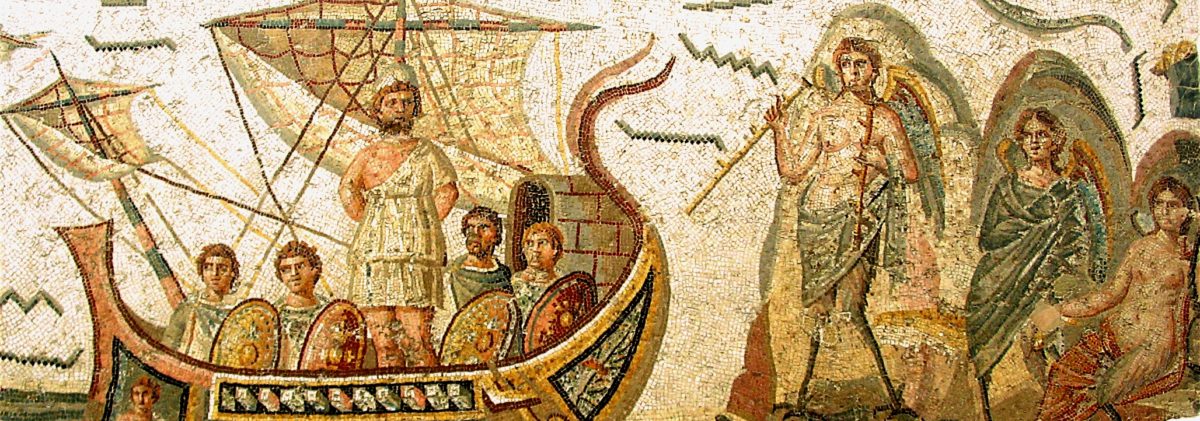

Christopher Nolan’s The Odyssey is perhaps the most highly anticipated new film of the 2020s. It has already received near-universal acclaim from film critics and earned more at the box office in its opening weekend than any of Nolan’s previous films, including The Dark Knight Rises (2012) and Oppenheimer (2023). It has only been out for one week and is already fueling a culture-wide resurgence of interest in ancient Greek myth and literature.
Although Nolan’s creative decisions for the film raised controversy even before the film was released, I promised myself early on that I would not weigh in on the film until after I had seen it myself. And I will be honest: I went into Nolan’s Odyssey with the expectation, based on my previous experience with big Hollywood adaptations of Greek myths and the images and previews that I had seen beforehand, that it would be unconscionably bad. As I watched it, I found some things I disliked, but, overall, I was pleasantly surprised. By the time I was about an hour or so into it, I found myself really enjoying it and actually liking some (although certainly not all) of the creative decisions Nolan made.
If I had directed a film adaptation of the Odyssey, I would have done it very differently, but, as I have reminded myself repeatedly, I am not the target audience of this film; this film is for normal people who like movies, spectacle, and mythic fantasy, not a nerd like me who has spent over a decade studying ancient Greek history and literature, can read Ancient Greek and Latin, has a master’s degree in Ancient Greek and Roman Studies, and has been writing an ancient history blog for the past decade. In this post, I will lay out my thoughts on the film itself and some of the criticisms other people have made of it.
No such thing as a “historically accurate” Odyssey
Before I get into my own review of the film, I want to briefly address some of the criticisms other people have made of it.
One of the most prominent criticisms of Nolan’s Odyssey has been that the material culture depicted in the film is not “historically accurate.” It is factually true that the film’s costumes, sets, and props do not accurately reflect Greek material culture in any historical period, and most of the costumes especially are purely fantastical with no historical basis. The film does include occasional nods to historical Greek material culture (which I will discuss later), but these are rare.
Nonetheless, the use of this as a criticism of the film reflects a fundamental misunderstanding of the original Odyssey. There is no such thing as a “historically accurate” Odyssey, nor can there ever be, because the original Odyssey itself is not set in a real historical time period; it is set in the Age of Heroes, which is a vague, imaginary, mythical time in the remote past. Although modern readers have tried to equate the Age of Heroes to the historical Late Bronze Age in the Aegean, there is very little in either the Iliad or the Odyssey that is actually characteristic of the real-life Bronze Age.
During the historical Late Bronze Age, Greece was dominated by centralized states with powerful kings and highly developed bureaucracies manned by educated, literate scribes, who kept administrative records on clay tablets using the Linear B syllabary. A large amount of scholarly knowledge of Mycenaean Greece comes from these administrative records. The Linear B tablets include records of sacrifices, which indicate that, during this period, the most prominent deities worshipped in these kingdoms were Zeus, Poseidon, and a goddess called “Potnia,” which means “the Mistress.”
As the name “Bronze Age” might suggest, during this period, bronze was overwhelmingly the dominant metal for both weapons and tools. The Mycenaean kingdoms were highly interconnected with other great empires of the Late Bronze Age eastern Mediterranean, and a significant rival to these kingdoms was the Hittite Empire, which was the dominant power in Asia Minor.

ABOVE: Photo from Wikimedia Commons of a Mycenaean Linear B tablet from Pylos, dated c. 1450 BCE, on display in the National Archaeological Museum in Athens

The world of the Homeric epics looks nothing like this. Instead, the Iliad and the Odyssey depict a decentralized world in which petty, insecure “big men” rule a patchwork of small, local kingdoms. The poems never mention any of these kingdoms as having any kind of scribal administrators or a scribal education system.
In fact, there is only one brief, apparent mention of writing at all in either of the Homeric epics; this occurs in the Iliad 6.168–170, in which King Proitos of Argos inscribes “σήματα λυγρά,” which means “baleful signs,” on a folded tablet, gives it to the hero Bellerophon, and orders him to deliver it to the king of Lykia. Unbeknownst to Bellerophon, the signs on the tablet instruct the king of Lykia to execute its bearer. The poem treats writing as a strange, sinister, novel invention.
The Homeric epics sometimes use “Potnia” as an epithet of certain goddesses, including Hera, Athena, and Artemis, but they contain no memory of the time when a major goddess was known primarily by this title. By contrast, Aphrodite (who is never mentioned at all in any sources from the Bronze Age) is a major deity in both the Iliad and the Odyssey, and the poems display no memory of a time when she was not worshipped in the Greek world.
Although most of the weapons in the Iliad and the Odyssey are made of bronze, ordinary tools are invariably made of iron. Even the use of bronze for weapons is probably less a genuine memory of the Bronze Age and more a result of the fact that, in the seventh century BCE, bronze was valued more highly than iron and seen as more prestigious. Neither of the Homeric epics contain any mention or memory whatsoever of Hittite Empire or the Hittites; as far as the epics are concerned, the Hittites simply don’t exist.
But the Homeric epics don’t accurately represent the world of the seventh century BCE either! Instead, they depict a fantasy world full of what the Homerist Peter Gainsford calls “false archaism.”
To give an example, in the Bronze Age, archers would ride chariots into battle and shoot arrows from their chariots. By the time the Iliad and the Odyssey were composed in the seventh century BCE, however, chariots were no longer used in warfare and were instead only used for sports racing. The poet of the Iliad apparently has some vague sense that, at some point in the past, people had used chariots in warfare, but he doesn’t understand how chariots were used, so he describes heroes as using them sort of like battle golf carts: they ride in their chariots to get to battle, and then they dismount to fight on foot.
The Rule of Cool is also hugely important here. For instance, in Iliad 6.230–236, the Akhaian hero Diomedes and the Trojan hero Glaukos trade their armors as a sign of guest-friendship, and the armor that Glaukos gives to Diomedes is made of solid gold. No one in human history has ever actually gone to battle wearing solid gold armor, because gold is an absurdly impractical material to make armor out of; it is extremely rare and expensive, it’s extremely heavy, so it would make the wearer less mobile, and it’s very soft and malleable, so it wouldn’t provide the wearer very effective protection. But none of that matters, because solid gold armor sounds cool.

ABOVE: Photo from Wikimedia Commons of an Attic red-figure pelike by the Hasselmann Painter, dated c. 420 BCE, depicting Diomedes (left) and Glaukos (right) exchanging their armors as described in the Iliad 6.230–236

In Iliad 16.784–786, Patroklos charges three times at the Trojans and kills nine men in each charge. Is this at all plausible? No, but it sounds cool. In Iliad 19.404–424, Akhilleus’s horse Xanthos prophesies to him his imminent death. Did horses really speak prophecies in Archaic Greece? No, but it sounds cool. In Iliad 21, Akhilleus fights the river Skammandros itself, which is angry at him for polluting it with the bodies of all the men he has killed. Did men really fight rivers in Archaic Greece? No, but it sounds cool!
So far, I’ve been using examples from the Iliad because it is seen as the more realistic of the two poems. The fantastic elements in the Odyssey are even more glaringly obvious. The poem includes an island where people eat a flower that causes them to forget their homeland and want to stay on the island forever; a giant, one-eyed, man-eating Kyklops who lives in a cave; a witch who turns men into pigs; Sirens with the bodies of birds whose singing lures sailors to their deaths; a monster who snatches men off the decks of ships; and so many other elements that everyone knows are fantastical.
The Homeric epics themselves contain one layer of anachronisms, but there’s another layer of anachronisms on top of that, because, whenever the ancient Greeks and Romans depicted scenes from the Homeric epics in art, they always depicted the characters wearing contemporary styles of clothing and armor that would have been anachronistic for the time in which the epics were composed.
Thus, while my own heart may yearn for an adaptation of the Odyssey that looks authentically ancient Greek, I cannot fault Nolan’s Odyssey for not accurately representing the material culture of a given Greek historical period, because Nolan is simply doing the same thing that the original Odyssey itself, and later ancient Greek artists who interpreted it, did. It’s the Rule of Cool all the way down.

ABOVE: Photo from Wikimedia Commons of a second-century CE mosaic of the sacrifice of Iphigeneia from the Columned Western Street in the city of Perge in Asia Minor. All the Greek commanders in this scene, including Agamemnon and Odysseus, are wearing anachronistic Roman-Era armor.

Nolan’s departures from the original Odyssey
Another prominent criticism of Nolan’s Odyssey has been the claim that it isn’t “faithful” to the original epic. As with the previous criticism, this has some basis. It’s absolutely true that Nolan’s film makes significant changes to the story. It cuts large portions of the original epic, including:
- Telemakhos’s meeting with Nestor at Pylos,
- Menelaos’s encounter with Proteus in Egypt,
- the nymph Ino’s rescue of Odysseus from Poseidon’s storm,
- Odysseus’s tricking of Polyphemos by telling him that his name is “Nobody,”
- Hermes’s assistance to Odysseus on Kirke’s island,
- the island of the lotos-eaters,
- Aiolos’s island and the bag of the winds,
- Odysseus’s time on Skheria with the Phaiakians,
- Odysseus’s fight with Iros,
- Odysseus’s revealing of his identity to Eumaios,
- and Odysseus’s final reunion with his father Laërtes.
I think it is absolutely fair to criticize a film when it changes a story in a way that makes the story worse or less appealing. Nonetheless, at the same time, changing the story is not inherently a bad thing in and of itself. Every generation reinvents and reinterprets the stories of generations that came before, and stories only remain alive as long as people continue to reinvent them.
A film made in the twenty-first century needs to appeal to a twenty-first-century audience, and, although ancient and modern audiences share a common, basic humanity, our worldviews and values are radically different. We find different meanings in stories than our ancestors did 2,600 years ago.
The original Odyssey itself radically departs from versions of myths that were standard at the time it was composed. For instance, the Odyssey is the only surviving Greek literary work from the Archaic Period that describes a marriage between Aphrodite and Hephaistos; every other surviving source from this period takes for granted that Aphrodite is unmarried.
The Iliad 18.382–383 expressly describes Hephaistos as being married to one of the Kharites (the goddesses of charm and creativity). Hesiod’s Theogony 945–946 describes Hephaistos as being married to Aglaia, the youngest of the Kharites. Neither poem mentions the existence of any previous marriage between Hephaistos and Aphrodite. The Homeric Hymn to Aphrodite describes her as seducing the mortal Trojan prince Ankhises and never mentions her having a husband who might object to such a union.
By contrast, in the Odyssey 8.266–366, the blind bard Demodokos tells a ribald, comic tale in which Aphrodite is married to Hephaistos but having an adulterous affair with Ares. This whole story is, as far as we can tell, purely the Odyssey poet’s invention; it does not exist anywhere else in Archaic Greek literature. The story is humorous precisely because its portrayal of the gods acting disgracefully subverts the poem’s original audience’s expectation that gods would behave morally. It was only much later, due to the Odyssey’s own cultural influence, that Greeks and Romans came to accept this story as standard myth.

ABOVE: First-century CE Roman fresco from the House of Mars and Venus in Pompeii depicting Venus (Aphrodite) reclining half naked in the arms of Mars (Ares)
The Iliad and the Odyssey‘s flagrantly irreverent portrayals of the gods actually offended many philosophically-inclined ancient Greeks. Some of the earliest surviving references to the poems come from Greek poets and philosophers criticizing them. For instance, the pre-Socratic philosopher Xenophanes of Kolophon (lived c. 570 – c. 478 BCE) says in a fragment (DK 21B11):
πάντα θεοῖς ἀνέθηκαν Ὅμηρός θ’ Ἡσίοδός τε
ὅσσα παρ’ ἀνθρώποισιν ὀνείδεα καὶ ψόγος ἐστίν,
κλέπτειν μοιχεύειν τε καὶ ἀλλήλους ἀπατεύειν.
Homer and Hesiod have attributed to the gods
all things that are shameful and blameworthy among mortals:
theft, adultery, and mutual deception.
The pre-Socratic philosopher Herakleitos of Ephesos (fl. late sixth – early fifth century BCE) went even further (Fr. 42 D., 119 B):
τόν τε Ὅμηρον ἔφασκεν ἄξιον ἐκ τῶν ἀγώνων ἐκβάλλεσθαι καὶ ῥαπίζεσθαι, καὶ Ἀρχίλοχον ὁμοίως.
He used to say that Homer deserved to be expelled from the contests and flogged, and Arkhilokhos likewise.
Many of the Greek myths that are most widely beloved today are inventions of even later poets, who also departed from the traditions that were standard at the time. Take the story of Orpheus and Eurydike, which is probably the most prominent Greek myth in 2020s popular culture (aside from, perhaps, the Odyssey itself).
The ancient Greeks primarily knew Orpheus as the reputed author of theological and cosmogonic poetry and the founder of a mystery religion known as Orphism, whose followers believed in reincarnation, practiced secret initiations, followed strict rules for ritual purity in their daily lives (which included a prohibition on consuming the flesh of animals), could not be buried wearing wool, and were often buried with metal (usually gold) tablets inscribed with instructions for the afterlife.
Early Greek sources about Orpheus contain no mention of him having a wife named Eurydike at all, nor do they describe him as descending to the underworld specifically to bring her back. This whole story appears to be a relatively late, secondary addition to Orpheus’s mythology. The Roman poet Ovid (lived 43 BCE – c. 17 CE), however, tells the story in his Metamorphoses 10.1–85, making it into a powerful, tragic love story, representing the lengths to which people will go for love, the transformative power of music, and the inevitability and irreversibility of death.

ABOVE: Roman mosaic from Palermo, Italy, dated to the second century CE, depicting Orpheus seated at center wearing a Phrygian cap and playing a kithara (an ancient Greek lyre) while all the animals crowd around him to listen to his song
After the Roman Empire’s conversion to Christianity over the course of the fourth and fifth centuries CE, the Orphic mysteries stopped mattering to people. People stopped copying the theological and cosmogonic poems attributed to Orpheus, and this body of poetry was mostly lost. But the tragic love story of Orpheus and Eurydike told by Ovid still remained moving and powerful. It appealed to poets and artists during the Renaissance and has continued to appeal to modern storytellers.
Today, this myth is the primary subject of Anaïs Mitchell’s acclaimed musical Hadestown (which was originally performed in 2006 and released as a concept album in 2010 before eventually premiering off-Broadway in 2016 and on Broadway in 2019). It is one of the main storylines in Netflix’s mythological black comedy series Kaos (2024). Multiple critically acclaimed films of the past decade, including Céline Sciamma’s Portrait of a Lady on Fire (2019) and Chloé Zhao’s Hamnet (2025), have included retellings of the story and used it as a motif. Meanwhile, Supergiant Games’ smash hit video game Hades (2020) features Orpheus and Eurydike as secondary characters.
Thus, today, anyone who knows anything about mythology knows Orpheus as the devoted lover of Eurydike, while only scholars remember his older significance as the revealer of theological mysteries. This is how myths endure for thousands of years: through adaptation and change. The same principle applies to every ancient story, including the Odyssey.

ABOVE: Photo of Eurydice (left) and Orpheus (right) in the Broadway production of Anaïs Mitchell’s musical Hadestown
Even if we set that aside, practical considerations also mean that no modern film adaptation of the Odyssey can ever be an exact retelling of the original. Nolan’s Odyssey is nearly three hours long, which is virtually the limit of what today’s audiences are willing to sit through in a theater, but a full verbal recitation of the Odyssey would take somewhere between sixteen and eighteen hours (depending how fast one recites). Fitting the whole story into a three-hour movie necessarily requires a director to make certain cuts.
On top of this, the Odyssey is an extraordinarily complex and multivarious work, and it does not fit neatly into any modern genre, since it contains elements of fantasy, comedy, horror, and tragedy. The episode with Polyphemos in Book 9 is hilarious and reads like satire, but the nekyia or raising of the dead in Book 11 is one of the creepiest, most disturbing, most existential scenes in all of world literature. The epic contains all of this and so much else.
Our criterion for assessing whether Nolan’s Odyssey is a good adaptation, then, should not be whether it makes changes to the source material at all, but rather whether the changes it makes are ones that make the story better suited for its medium (a three-hour, big-budget, theatrical film) and target audience (twenty-first-century western movie-goers). I do not expect any modern adaptation to capture everything about the original poem. I only expect it to capture some things.
Nolan’s Odyssey’s language and register
This brings me to my next point. Some people have criticized the fact that (nearly) all the dialogue in Nolan’s Odyssey is in contemporary American English, and the characters all use standard American English accents, but this is neither surprising nor problematic. After all, Nolan himself is a British-American filmmaker, this film was produced by Universal Pictures, which is an American Hollywood-based film production company, and the film’s primary target audience is in the English-speaking world, with the largest part of that audience residing in North America.
Pragmatically speaking, if a filmmaker wants large, primarily English-speaking audiences to come to the theater to see a film, then the dialogue has to be in English. As much as I personally wish that a film adaptation of the Odyssey could be entirely in Homeric Greek, the only people who would show up to see that film would be hardcore classics nerds, and there just aren’t enough of us for a film of this scale to earn a profit off us alone.
If the film has to be in English, then any form of English will be just as anachronistic as any other form of English. Nolan could have used Shakespearean English with British Received Pronunciation accents, but that would have just made the film sound less familiar and wouldn’t have been any closer to Homeric Greek. Instead, it makes sense to use the accent that will seem the most natural and least foreign to the largest share of the film’s primary audience. In this case, that is a standard North American English accent.
There is, however, one scene in the film whose choice of language did strike me as problematic. Early in the film, shortly after Odysseus and his men leave Troy, they raid a town for food and supplies. The film does not say which town this is, but, in the original Odyssey, it is stated to be Ismaros, a town of the Kikones, a Thrakian tribe who were allied with the Trojans.
Nolan’s film portrays Odysseus as interrogating a captured townsman (portrayed by Yannis Kokiasmenos, one of only two actors of Greek heritage in the entire film) who speaks Modern Greek, which is portrayed as a completely foreign language to Odysseus and his crew, who are only able to understand the man through a translator.
I think that Nolan’s intention here was most likely to include a nod to the fact that this film is based on an ancient Greek epic. After all, this scene is the only time in the film when any character speaks a real language other than English. Nonetheless, I found this scene very problematic, because it implies (probably inadvertently) that modern English-speaking North Americans are the true heirs of the ancient Greeks and that modern Greeks are barbarians whom the ancient Greeks would not recognize as their cultural descendants.
As I discuss in this post from February 2020 and this other post from January 2021, this idea is known as the Fallmerayer thesis, and it has a very dark history. During World War II, when the Axis Powers occupied Greece, the Nazis used the narrative that Germans are the purest living relatives of ancient Dorian Greeks and that modern Greeks are degenerate, racially impure imposters to justify committing atrocities against the modern Greek population. I highly doubt that Nolan is aware of this history, but his portrayal of the “barbarian” Kikones as speaking Modern Greek while all the Greek characters in the film speak American English is an uncomfortable reminder of it.

ABOVE: Engraving by the Flemish artist Theodoor van Thulden, dated c. 1632/3 depicting Odysseus and his men fighting the Kikones during the raid on Ismaros
The overall portrayal of Odysseus
Matt Damon initially seemed to me to be a very strange choice to play Odysseus, and I’m still not convinced that he was the best actor for the part, but my overall opinion after having seen the film is that Damon’s Odysseus is more-or-less ok—not great, but ok.
In the original Odyssey, Odysseus is a charismatic, loquacious, amoral, cunning scoundrel. He unabashedly lies, cheats, steals, manipulates, puts people who trust him in harm’s way, and outright murders to get what he wants, and he’s clever enough that he usually gets away with it. He is constantly inventing elaborate fake identities and backstories for himself. He is also arrogant, bordering on narcissistic. His vengeance, although it is slow and carefully planned, is also terrible and implacable, and he will not stop until he utterly destroys all those who have wronged him.
In Book 22, Odysseus (with the aid of Telemakhos, Eumaios, Philoitios, and Athena) brutally massacres all 108 trapped, initially unarmed suitors of Penelope, including some who desperately beg him for mercy. He even wants to kill the bard Phemios, who performed for the suitors, and only spares him because Telemakhos intercedes, telling Odysseus that Phemios only performed for the suitors unwillingly. When they have finished slaughtering the suitors themselves, Odysseus orders Telemakhos to kill all the enslaved women whom the suitors raped; Telemakhos promptly hangs them all.
Even by the brutal standards of the world of Archaic Greek epic, Odysseus in not in any sense a morally good person or a person whom readers should wish to emulate. By twenty-first-century conceptions, he is far more of an antihero than a hero. Personality-wise, he has a great deal in common with Walter White, the protagonist of the series Breaking Bad, and Saul Goodman, the protagonist of Better Call Saul.
Despite this, Odysseus has his virtues. He seems to genuinely care about his family, including his wife Penelope, his son Telemakhos, his father Laërtes, his mother Antikleia, and his dog Argos, and wants to get back to them. He claims he cares about his men as well and tries (unsuccessfully) to keep them alive. He is highly intelligent, a master of tricks and stratagems, and always multiple steps ahead of his enemies. He has an effortless ability to charm those he encounters, and he can seemingly talk his way out of anything. He is courageous in the face of danger, and skilled in many areas (including archery, boxing, and hand-to-hand combat).
Most shockingly of all, several of the people Odysseus enslaves (Eumaios, Philoitios, and Eurykleia) apparently perceive him as a kind enough master that they have remained steadfastly loyal to him, despite his twenty-year absence, and have been actively hoping and praying for his return. Admittedly, because we only see them from Odysseus’s perspective, it is hard to know their true feelings, and they may only prefer Odysseus as the lesser of two evils compared to the cruel suitors, but, even if that is the case, it is still noteworthy.
The combination of all these traits make Odysseus a fascinating protagonist on his own. The Odyssey heightens this fascination by putting this unconventional hero in situations that we might expect more conventional heroes to face. What happens when you take a Walter White or Saul Goodman-type character and lock him in a cave with a man-eating, one-eyed giant?
The Odyssey is, in many ways, a postmodern epic that just happens to be over twenty-six centuries old. In some ways, it is too postmodern for modern cinema. Modern audiences love an antihero, but film companies are rarely willing to bank on a protagonist who does not, on some level, reflect normative social values. As a result, every recent screen adaptation of the Odyssey has had to tone down Odysseus’s deceitful, manipulative, and violent tendencies, and Nolan’s Odyssey is no exception to this.
Nolan’s film portrays Odysseus as much more honorable and merciful than he is in the original epic. The very first time we see Matt Damon’s face as Odysseus is when he saves the dog Argos from being thrown off a cliff as a puppy. The film invents a recurring motif where Odysseus plucks his bow string once every time before he loads an arrow in order to give his opponent warning so that the fight will be “fair.” The film’s version of the massacre of the suitors not only cuts Odysseus’s order to Telemakhos to kill the enslaved women but also portrays Odysseus as sparing some of the suitors who bow to him. All of this is worlds away from the Odysseus in the original Odyssey.
Whatever else one may say about these changes, though, they certainly make Odysseus more likeable for a modern audience—and they aren’t boring either. The thing about the bowstring adds an intriguing eccentricity to Odysseus’s character that I kind of liked. Meanwhile, there’s just enough of Homer’s trickster Odysseus in the film that I didn’t feel woefully disappointed.
One of my biggest complaints about Uberto Pasolini’s film The Return (2024) that I discussed in my review of that film was the fact that it made Odysseus into a laconic, stoic war veteran who refuses to talk about his past. I felt this depiction was both one-dimensional and very alien from who Odysseus is in the original Odyssey. That film also thoroughly butchered the scene in which Odysseus, disguised as a beggar, speaks to Penelope. By contrast, Matt Damon’s Odysseus is more talkative and has some element of the wily commander about him. This may be partly because Nolan’s Odyssey shows him in more diverse situations than The Return does, and, as a result, we see more sides of his character.

ABOVE: Screenshot of Matt Damon as Odysseus in Nolan’s Odyssey
The overall portrayal of Penelope, Telemakhos, Eumaios, Antinoös, and Athena
The next most important character in the Odyssey after Odysseus himself is, of course, his wife Penelope. As scholars have long observed, the original Odyssey gives Penelope very little characterization and largely leaves her personal feelings enigmatic. Nolan’s Odyssey, however, fleshes her out. This version of Penelope, whom Anne Hathaway portrays brilliantly, misses her husband, but, at the same time, has grown accustomed to ruling Ithaka in his absence and doesn’t want to surrender her power to one of the suitors or to her and Odysseus’s son Telemakhos.
In the original Odyssey, when Odysseus speaks to Penelope while he is still disguised as a beggar, and he tells Penelope that he has seen her husband, she asks him what Odysseus was wearing, and Odysseus is able to describe his own clothing accurately, which leads Penelope to know the report is true.
Nolan’s Odyssey takes this and adds another layer by having Penelope give Odysseus a highly distinctive pin and tell him before he leaves for Troy to wear it all the time so that, if someone comes to her claiming to have seen him, she will able to verify if they really have based on whether they can describe the pin. It’s a change that demonstrates Penelope’s own intelligence and foresight.

ABOVE: Screenshot of Anne Hathaway as Penelope, sitting beside her loom, in Nolan’s Odyssey
Tom Holland plays Telemakhos. He’s technically too old for the part, since Telemakhos is supposed to be just older than twenty, while Holland has just turned thirty, but I’m willing to forgive this, since he still has a bit of a babyface, and his acting is perfect for the role. He brings the same earnest, somewhat naïve energy that he exhibits in his performances as Spiderman, and it suits the part perfectly.

ABOVE: Screenshot of Tom Holland as Telemakhos in Nolan’s Odyssey
John Leguizamo’s Eumaios is also great. In the original poem, Eumaios is Odysseus’s loyal, enslaved swineherd who takes Odysseus in when he is disguised as a beggar. Nolan’s version changes the character significantly by making him be blind, by having Odysseus specifically leave him behind on Ithaka because he is his “most loyal servant,” and by having him act as a tutor and foster father to Telemakhos, but I thought all these changes worked well.
Nolan cut the blind bard Demodokos (who only appears on the island of the Phaiakians, a whole section of the epic that Nolan cut entirely), so it was fitting that he made another secondary character blind so that the film would still include blind representation. The film handles Eumaios’s blindness fairly well, showing it as a genuine disability while at the same time showing that Eumaios is able to do things.
Some people might think that the portrayal of Odysseus as having an enslaved man tutor his son is anachronistic for ancient Greece, but, in historical reality, it was the norm, at least in the Classical Period, for a wealthy Greek man to appoint an enslaved man known as a παιδαγωγός (paidagōgós) to chaperone and educate his son, and Nolan’s Odyssey seems to put Eumaios in this role.
Two things about Eumaios’s mentoring of Telemakhos, however, are historically off. First, Eumaios is apparently still a swineherd in Nolan’s retelling, whereas, generally, a paidagōgós would be an educated enslaved man who would hold a certain level of privilege relative to other enslaved people and would be excused from a dirty task like herding swine. Second, the film portrays Eumaios as teaching Telemakhos how to fight with a sword. In historical reality, though, weapons training was virtually unheard of in ancient Greece; instead, the main subjects that a paidagōgós would tutor his master’s son in were reading and writing, poetry, music, and athletics.

ABOVE: Screenshot of John Leguizamo as Eumaios from Nolan’s Odyssey
Meanwhile, Robert Pattinson makes a perfect, scenery-chewing Antinoös. Some people who only know him from his early work in Harry Potter and Twilight expressed doubts about his casting, but, when I heard he’d been cast, I immediately thought of his performance as Louis, Duke of Guyenne, in David Michôd’s The King (2019) and knew he was exactly the right actor for this role. I was not disappointed. He makes an outstanding villain you just love to hate, and his delivery of the line, “Would someone get these beggars out of here!?” has already become an internet meme.

ABOVE: Screenshot of Robert Pattinson as Antinoös from Nolan’s Odyssey
Of the main secondary characters, the one I thought Nolan’s Odyssey did a poor job of depicting was Athena, who is played by Zendaya. Zendaya is a highly talented actress, but, in my mind, she didn’t really fit well as Athena in this film. This is partly because she looks too young to play a warrior goddess of wisdom, and it feels strange to have Matt Damon’s middle-aged Odysseus looking for guidance in a woman who looks younger than half his age, especially when the other goddesses in the film (e.g., Samantha Morton’s Kirke and Cherlize Theron’s Kalypso) are both played by older actresses.
Then again, Zendaya is almost thirty, and my impression that she looks too young may be partly because I’m accustomed to seeing her playing teenaged characters like Rue in the HBO series Euphoria and M.J. in the Spiderman films. I would have liked to have seen a slightly older, thirtysomething actress in the role.
I also thought that the film really killed Athena’s aura. In ancient Greek iconography, Athena wears a helmet and a breastplate with Medousa’s head in the center, she carries a spear and a shield, and she is often accompanied by an owl or a snake. By contrast, in Nolan’s film, Zendaya’s Athena wears only a plain white robe. This departure from the iconography makes Athena look less visually interesting and removes any visual language to indicate that Zendaya is even supposed to be Athena at all.
The Iliad and the Odyssey both frequently refer to Athena using the epithet γλαυκῶπις (glaukôpis), which means “gray-eyed,” and Nolan’s film repeatedly invokes this tradition by having Telemakhos describe two different characters—first Mentor and then Odysseus himself—as having “wise eyes, Athena’s eyes.” But for some reason, despite including this repeated line about “Athena’s eyes,” the film didn’t do anything to make Athena’s eyes visually distinctive.
Finally, I wasn’t a fan of how the film handles Mentor. In the original Odyssey, Athena takes Mentor’s form as a disguise when she talks to and travels with Telemakhos. Nolan’s Odyssey initially seems to imply that Mentor is really Athena by having Telemakhos say that he has “Athena’s eyes” and that he could be a god in disguise. But then the film apparently reveals that Mentor isn’t Athena by having the suitors kill him! This made it seem like they were setting up for a big reveal that Mentor is really Athena only to apparently disconfirm the thing they seemed to be setting up, which was disappointing.

ABOVE: Screenshot of Matt Damon as Odysseus and Zendaya as Athena from Nolan’s Odyssey
The allegedly “woke” casting decisions
As soon as the cast for Nolan’s Odyssey was announced, right-wingers on the internet began to attack it as “woke” and “historically inaccurate” due to the fact that it includes Lupita Nyong’o (who is Black) as Helen of Sparta, Zendaya (who is mixed race) as Athena, and Elliot Page (who is a trans man) as the Greek soldier Sinon. These criticisms are just repetitions of the same tired, racist arguments that surfaced nearly a decade ago when the 2018 BBC One/Netflix miniseries Troy: Fall of a City featured Black actors as Zeus and Akhilleus. (I myself addressed these criticisms in a 2020 blog post.)
Contrary to what critics have asserted, there are, in fact, Black people in the original Odyssey, and you don’t have to read very far into the epic to meet them. Near the very beginning of the first book of the epic, the poet describes Poseidon as having gone to visit the “Aithiopians” (Od. 1.22–25):
ἀλλ᾽ ὁ μὲν Αἰθίοπας μετεκίαθε τηλόθ᾽ ἐόντας,
Αἰθίοπας τοὶ διχθὰ δεδαίαται, ἔσχατοι ἀνδρῶν,
οἱ μὲν δυσομένου Ὑπερίονος οἱ δ᾽ ἀνιόντος,
ἀντιόων ταύρων τε καὶ ἀρνειῶν ἑκατόμβης.
But [Poseidon] had gone among the Aithiopians who live far away,
the Aithiopians who are divided in two, most distant of men:
some where the son of Hyperion sets, and others where he rises,
and he was receiving a hecatomb of bulls and rams.
The name “Aithiopian” was traditionally explained in antiquity as a compound of the verb αἴθω (aíthō), meaning “to burn” or “to shine” and the noun ὤψ (ṓps), meaning “face.” According to this interpretation, the name means either “Burnt-Faced” or “Shining-Faced.” The ancient Greeks used this name to refer to Black African peoples generally, and it is the source of the name of the modern country Ethiopia. Early Greek poetry generally characterizes Aithiopians as pious people who are especially close to the gods and are the only people among whom the gods regularly walk undisguised.
Dark-skinned people, however, are not merely mentioned as residents of a distant and foreign land. Odysseus describes the appearance of his own herald Eurybates as follows (Od. 19.246–247):
γυρὸς ἐν ὤμοισιν, μελανόχροος, οὐλοκάρηνος,
Εὐρυβάτης δ᾽ ὄνομ᾽ ἔσκε:
He was round in the shoulders, dark-skinned, and wooly-haired,
and Eurybates was his name.
Interestingly, the poet describes Odysseus’s own physical appearance using very similar language. In Odyssey 16.172–176, Athena transforms Odysseus from his disguise as a beggar back into an idealized version of his normal appearance, and the poet describes the transformation as follows:
ἦ καὶ χρυσείῃ ῥάβδῳ ἐπεμάσσατ᾽ Ἀθήνη.
φᾶρος μέν οἱ πρῶτον ἐϋπλυνὲς ἠδὲ χιτῶνα
θῆκ᾽ ἀμφὶ στήθεσσι, δέμας δ᾽ ὤφελλε καὶ ἥβην.
ἂψ δὲ μελαγχροιὴς γένετο, γναθμοὶ δὲ τάνυσθεν,
κυάνεαι δ᾽ ἐγένοντο γενειάδες ἀμφὶ γένειον.
Athena touched him with her golden wand.
First, she set a wide mantle and a well-washed chiton
on his chest, and she enhanced his stature and his youth.
And he became dark-skinned again, and his jaw stretched,
and the beard on his chin became dark.
In two identical lines at different points in the poem (Od. 6.230–231 and 23.158), when Athena transforms Odysseus into a more beautiful version of himself, the poet says, “. . . οὔλας ἧκε κὄμας, ὑακινθίνῳ ἄνθει ὁμοίας” (“She made his woolly hair like a hyacinth”).
Thus, the original Odyssey itself describes Odysseus as “dark-skinned” with hair that is “dark,” “woolly,” and “like a hyacinth.” This description does not necessarily mean that Odysseus is what we would call Black, since these descriptions could apply to someone with dark olive skin and curly, black hair, such as the Greek American actor Jason Mantzoukas, but, at the same time, these descriptions are also consistent with the interpretation of Odysseus as Black.
Some ancient Roman wall paintings depict Odysseus with dark brown skin and thick, curly hair. A modern person looking at these paintings could very easily interpret Odysseus as a Black man. This ancient evidence is, I think, more than enough to support casting a Black actor as Odysseus himself in a modern adaptation.

ABOVE: Roman wall painting from Pompeii, dating to the first century CE, depicting Odysseus (shown wearing his signature pileus helmet) and Diomedes stealing the Palladium from Troy. Notice Odysseus’s dark skin and thick, curly hair.
All this outrage and anger over diverse casting in films based on Greek myth feels very distinct to the era in which we have been living since 2016. Hollywood films set in the ancient Greco-Roman world have been featuring Black actors for over sixty years. The main cast of Stanley Kubrick’s 1960 film Spartacus included the Black actor Woody Strode as the Ethiopian gladiator Draba.
As far as I am aware, there were no high-profile objections of “blackwashing” or “historical inaccuracy” back in 2014 when Dwayne “the Rock” Johnson (who is part Black and part Samoan) played the title role in the film Hercules. (And, in case you think that film was “woke,” I’ll point out that its director, Brett Ratner, holds the truly stunning anti-woke credentials of being an avid Trump supporter who has been credibly accused of rape, appears in the Epstein files, and is the director the Melania movie!)
But, for some reason, ever since Donald Trump became president the first time, the existence of diverse casts in adaptations of Greek myths has suddenly become a civilizational crisis.

ABOVE: Woody Strode as the Ethiopian gladiator Draba in Stanley Kubrick’s Spartacus (1960) and Dwayne Johnson as Hercules in Brett Ratner’s film Hercules (2014)
For better or worse, the most controversial castings in Nolan’s film prove to be parts that, while very symbolically important, don’t actually occupy very much screen time. Zendaya’s Athena is mainly implied to be working to help Odysseus behind the scenes. Elliot Page’s Sinon is literally killed within the first minute of the film after saying only one line. He does come back later as a ghost in the underworld, but his part is still minor. The fact that Page is a trans man also probably wouldn’t have been obvious to most viewers who didn’t know it already. Lupita Nyong’o, whose role as Helen attracted the fiercest ire of all the castings, has, I think, barely five lines in the whole film.
If anything, the way Nolan’s Odyssey reserved Black and trans actors for symbolically important roles that received little screentime felt almost a little exploitative, as though he intentionally cast those actors for those parts because he wanted to provoke controversy and win accolades for being supposedly “progressive” while making a film that focuses the vast majority of its actual runtime on white, cisgender actors.
Nods to historical ancient Greek material culture
Since I’ve covered the main cast of the film, now I will address the costumes, sets, props, and soundtrack. These include a few interesting nods to historical Greek material culture. One example of this occurs in the very first scene, in which a bard (presumably Phemios) is performing the story of the Trojan horse for the suitors in the palace of Odysseus on Ithaka. The bard is shown pounding the floor with a staff while he chants words. This is clearly supposed to be a reference to historical bards in ancient Greece who would tap a staff on the ground while performing to keep rhythm.
Nolan’s Odyssey, however, doesn’t quite get it right. Historical ancient Greek bards most likely simply tapped their staffs on the ground, but the bard in the opening scene of the film is pounding his staff forcefully to create a resounding “thud” each time he brings it down, which probably isn’t historical.
Nolan’s Odyssey also seems to miss the purpose of bards tapping a staff on the ground; historical bards did this to keep track of the rhythm while composing hexameter verse, but the bard in Nolan’s opening is not speaking in hexameter verse. In fact, he’s not even speaking sentences; he’s just saying evocative words.

ABOVE: Detail from the British Museum website showing an Attic red-figure neck-amphora attributed to the Kleophrades Painter dated between c. 490 and c. 480 BCE, discovered at Vulci in Etruria, currently held in the British Museum, depicting an aoidos (i.e., a performer of epic poetry) standing on a bema (i.e., a platform) holding a knotted stick which he is using to keep the rhythm while he performs
The film’s background music, composed by the Swedish musician Ludwig Göransson, also includes two authentic ancient Greek instruments. The first of these is the aulos, which is a double-reeded woodwind instrument consisting of two pipes that are held together in the mouth while playing. The aulos is related to the oboe, and it makes a highly distinctive, shrill, dissonant sound that ancient authors describe as exciting.
The other ancient instrument used in the film’s score is the kithara, a kind of lyre that traditionally had seven strings. In the film, every time Odysseus plucks his bow, Göransson’s score plays a single note on the kithara. This is an interesting and creative touch, and it creates a motif that runs throughout the film.

ABOVE: Etruscan wall painting from the Tomb of the Leopards in Tarquinia, dating between c. 470 and c. 450 BCE. The man in the middle is playing an aulos, while the man on the right is playing a kithara.
The set design of the great hall in Odysseus’s palace on Ithaka probably comes the closest of anything in Nolan’s Odyssey to resembling a real thing from the historical Aegean Bronze Age. The hall takes the form of a very large, long room that contains a hearth and has two rows of columns along the side walls. This layout resembles a megaron, which is the name archaeologists have given to the great halls in Mycenaean palaces.

ABOVE: Screenshot from Nolan’s Odyssey showing the throne in the great hall of Odysseus’s palace
Moreover, the columns of the great hall in the film are clearly modeled on the style of painted, wooden columns that appear in Minoan and Mycenaean art and in Sir Arthur J. Evans’s reconstruction of the Minoan palace at Knossos on the Greek island of Krete. These have squat, unfluted, inverted tapering shafts and bulbous, cushion-like capitals.

ABOVE: Photo from Wikimedia Commons of the North Portico at Knossos (which Sir Arthur J. Evans reconstructed based on Min0an artistic depictions)

A throne that appears in the background behind Penelope in several shots of the great hall is clearly modeled on the throne that Evans excavated in the so-called “Throne Room” at Knossos, which dates to the fifteenth century BCE. The throne that appears in Nolan’s Odyssey is larger and more elaborate than the throne from Knossos, but it’s close enough to say that it does look like a real object from the Bronze Age Aegean.

ABOVE: Photo I took in summer 2023 of the restored throne room at Knossos on the island of Krete
Finally, the loom at which Penelope is shown weaving in several scenes is a vertical, warp-weighted loom of the kind that actually existed in the ancient Aegean. I was quite pleased to see this, since, as I noted in my previous review of Pasolini’s The Return, that film portrayed Penelope weaving at an anachronistic horizontal handloom of the kind that was used during the Early Modern Period that did not exist at any time in the ancient Aegean.

ABOVE: Detail of an Attic black-figure lekythos dated between c. 550 and c. 530 BCE depicting two women weaving at a vertical, warp-weighted loom
Anachronisms
Apart from occasional nods like these, Nolan’s Odyssey is completely uninterested in creating any appearance of genuine historicity. There’s nothing wrong with this; as I said above, the original Odyssey wasn’t accurate to any historical period either, and we can hardly fault Nolan’s Odyssey for doing the same thing. Nonetheless, because this is an educational blog, I will point out a few of the anachronisms in the film so that readers will be aware of them.
I’ll begin by addressing the armor that Odysseus himself and his crewmembers wear throughout most of the first part of the film. I was honestly pretty disappointed by how generic and uniform this armor looks. They all wear virtually identical helmets, the design of which is clearly based on the Corinthian helmet that actors portraying Greek characters typically wear in Hollywood films. This helmet departs from the historical Corinthian helmet design in several ways—most notably by making the front more open so that the actors’ faces can be more visible.

ABOVE: Screenshot from Nolan’s Odyssey of Odysseus and his men on the island of the Laistrygonians
In historical fact, the ancient Greeks had a wide array of different kinds of helmets with different designs, there were no uniforms, and soldiers were responsible for supplying their own armor and weapons, so, if this film were historical, we would expect to see significantly greater variety in the kinds of armor and helmets the characters wear.
The ancient Greeks had some interesting and unusual helmet types that never seem to make it into Hollywood films (probably because most directors and costume designers aren’t aware they existed). For instance, the Iliad 10.260–265 describes Meriones as equipping Odysseus in preparation for a night raid on the Trojans’ camp with a helmet made of leather adorned with alternating rows of boars’ tusks:
Μηριόνης δ’ Ὀδυσῆϊ δίδου βιὸν ἠδὲ φαρέτρην
καὶ ξίφος, ἀμφὶ δέ οἱ κυνέην κεφαλῆφιν ἔθηκε
ῥινοῦ ποιητήν: πολέσιν δ’ ἔντοσθεν ἱμᾶσιν
ἐντέτατο στερεῶς: ἔκτοσθε δὲ λευκοὶ ὀδόντες
ἀργιόδοντος ὑὸς θαμέες ἔχον ἔνθα καὶ ἔνθα
εὖ καὶ ἐπισταμένως: μέσσῃ δ’ ἐνὶ πῖλος ἀρήρει.
Meriones gave Odysseus a bow, a quiver,
and a sword, and, on his head, he placed a helmet
made of leather; on the inside, by many leather cords,
it was stretched taut; on the outside, white teeth
of a bright-toothed boar ran close-set round and round,
well and skillfully made; and, in the middle, felt was sewn.
This is a description of a real kind of helmet that Mycenaean soldiers wore during the Bronze Age. Actual examples of this helmet have survived and are held in museums. This passage is the only unambiguous and undisputed description of a genuine Bronze Age artifact in either of the Homeric epics.

ABOVE: Photo from Wikimedia Commons of a Mycenaean boar’s tusk helmet dated to the fourteenth century BCE on display in the National Archaeological Museum in Athens

Alternatively, Odysseus’s standard iconography in Greek and Roman art has him wearing a cone-shaped helmet known as a pileus. This helmet is highly distinctive and characteristic of Odysseus, since he’s the only mythical figure who is usually shown wearing it. If you ever see an ancient vase painting, fresco, or mosaic with a man wearing a cone-shaped helmet, the chances are very high that that’s Odysseus. The unconventional shape of the helmet also, I think, points to (pun intended) Odysseus’s unconventional character.
Either the boar’s tusk helmet that Odysseus is described as wearing in the Iliad or the pileus helmet that he typically wears in Greek and Roman art would have been a better, more visually interesting, and more historically-grounded choice, in my opinion, than the generic, faux-Corinthian helmet he wears in Nolan’s Odyssey.

ABOVE: Photo from Wikimedia Commons of an Apulian red-figure situla dated c. 360 BCE depicting Odysseus (who is wearing his characteristic pileus helmet) and Diomedes stealing the horses of the Thrakian king Rhesos during the night raid episode of Iliad, Book 10

In Nolan’s film, Agamemnon wears a jet-black helmet and suit of armor that look nothing like anything from ancient Greece in any historical period and instead look like they came straight out of one of Christopher Nolan’s Batman movies. There’s nothing even vaguely historical about this costume, and I’ll be honest that I personally found it hard to take seriously. Still, a lot of people seem to think it looked incredibly cool, and the “Rule of Cool” is more important here than historicity.

ABOVE: Agamemnon’s helmet as depicted in Nolan’s Odyssey
Another rather obvious anachronism is the fact that many of the characters, including Odysseus and his men and Telemakhos, are portrayed as wearing pants for significant parts of the film. In historical reality, the Greeks never wore pants during any period of antiquity and regarded pants as a quintessentially barbarian garment.
The Hippokratic author of the late fifth-century BCE medical treatise On Airs, Waters, and Places says (in chapter 22) that the men of the Skythian culture, which inhabited the Pontic-Caspian steppe of what is now Ukraine and southern Russia, are effeminate and impotent because they wear pants, spend most of their time riding on horseback, don’t touch their penises, and live in a cold climate. Thus, according to the best Classical Greek medicine, pants make men effeminate and impotent.

ABOVE: Screenshot of Anne Hathaway as Penelope and Tom Holland as Telemakhos from Nolan’s Odyssey. Notice that Telemakhos is wearing pants like an effeminate barbarian.
At one point early in the film Eumaios scolds the goatherd Melanthios for wearing his spurs inside the palace on Ithaka. The existence of spurs, however, is anachronistic for both the Aegean Bronze Age and Archaic Greece. The earliest archaeological evidence of spurs comes from Celtic cultures of western Europe in the fifth century BCE, and the earliest mention of spurs in the Greek world occurs in Xenophon’s Hipparkhikos 6.1, which dates to around the mid-fourth century BCE.
But that’s not all: even if spurs had been invented, there’s no reason why Melanthios, an enslaved goatherd, would ever wear them. Horses in ancient Greece were rare and expensive animals, and they were not a practical means of transportation, because Greece’s terrain is extremely rough and mountainous, and neither horseshoes nor stirrups were invented yet, meaning horses were virtually useless for any kind of long-distance travel over this terrain.
As a result, horses were mainly used for two purposes: war and sports racing. Owning a horse was the equivalent of owning a BMW or Lamborghini today; it was an ostentatious display of wealth. While it is conceivable that Melanthios could be out joyriding Odysseus’s horses while his master is away, if that were the case, one would think that Eumaios would scold him for that, rather than wearing his spurs indoors.
Lastly, as many others have already pointed out elsewhere, the ships that Odysseus and his men sail in in the film bear little resemblance to ancient Greek ships of any period and instead look more like medieval Norse longboats, which did not exist until over a millennium and a half after the time when the Odyssey was composed.

ABOVE: Screenshot of one of Odysseus’s ships in Nolan’s Odyssey
The non-linear narrative structure and unreliability of Odysseus’s narration
One of the things I really liked about Nolan’s Odyssey is that it preserves the original epic’s non-linear narrative structure, interest in the role of stories in preserving memory and shaping identity, and use of an unreliable narrator for parts of the story.
In the original Odyssey, in Books 9–12, Odysseus himself tells the story of his wanderings after the fall of Troy in the first-person to the Phaiakians at the court of King Alkinoös on the island of Skheria. Although the external narrator confirms some parts of Odysseus’s account, most of the story is never confirmed to be true outside of Odysseus telling it.
Given the fact that, at multiple other points in the epic, Odysseus tells elaborate lies about who he is and what he has done (e.g., Od. 13.256–286, 14.191–359, and 19.166–307), and the fact that he tells the story of his wanderings in the context of persuading the Phaiakians to help him, it is entirely possible that Odysseus is fabricating, exaggerating, or misrepresenting parts of this story.
Although Nolan’s Odyssey cuts the island of the Phaiakians entirely, it retains the original epic’s non-linear narrative structure and use of Odysseus as an unreliable narrator. In Nolan’s version, instead of telling the story of his wanderings to the Phaiakians, Odysseus tells it in pieces to Kalypso while he is recovering his memory after Kalypso has kept him on her island for seven years, drugging him with lotos flowers to make him forget about his past and his family on Ithaka. The film implies that Odysseus’s memory of the events is still imperfect and that he has motivation to lie to make himself look better and reduce his own blameworthiness in the deaths of all his men.

ABOVE: Painting by the Italian painter Fransco Hayez, dated c. 1815, depicting Odysseus at the court of the Phaiakians
The theme of xenía
Nolan’s Odyssey also picks up on one of the core themes of the original Odyssey, which is ξενία (xenía), a core principle of ancient Greek ethics. Xenía held that every person had a sacred and inviolable duty to provide safety, food, shelter, and comfort to any stranger or foreigner who sought hospitality. Guests, in turn, had an equally sacred obligation to honor and respect their hosts and to not take more than they needed.
The Odyssey is full of examples of both good and bad hosts. Scenes in which one character shows another character hospitality follow a standard script, in which the host welcomes the guest into their home, offers them food and drink, and does not ask them any questions about who they are until they have finished eating. The guest eats the food the host offers without complaining, usually stays the night, and eventually leaves without overstaying their welcome. Often the host and the guest exchange gifts as a sign of friendship.
The way the Odyssey shows that a character is evil is by having them violate this relationship. For instance, the Kyklops Polyphemos doesn’t welcome Odysseus and his men, immediately demands to know who they are, and eats them instead of offering them food. When Odysseus offers Polyphemos a gift in the form of a skin of wine, Polyphemos responds by offering Odysseus his own “gift”: a promise that he will eat Odysseus last. It is an obvious mockery of the norms of xenía.
The Odyssey portrays the suitors as both bad guests and bad hosts. They are bad guests because they have stayed in Odysseus’s house for three years eating up all his livestock, harassing his slaves, and conspiring to murder his son. They are also bad hosts, because, when Odysseus comes among them as a beggar, instead of treating him with hospitality, the suitors abuse him and make fun of him. At one point, one of them, Antinoös, even throws a chair at him.
Nolan’s Odyssey astutely picks up on the importance of xenía in the epic and takes it in an interesting, contemporarily relevant direction. Translating xenía as “Zeus’s law,” the film portrays the breakdown of xenía as a cosmic consequence of the sack of Troy that will lead inevitably to the collapse of civilization itself. As the ancient historian Bret Devereaux has pointed out in an excellent threat on Bluesky, this depiction seems to be a direct response to the xenophobia and warmongering of the present-day far-right in the United States and the western world at large. Devereaux writes:
I’d almost describe the Odyssey, thematically, as a conservative critique of the kind of overpowering, violent, grasping masculinity of the chuds and the far right – that revels in cruelty to strangers, in aggression and war crimes and dominance.
Absolutely fascinating.
Not ‘western civilization doesn’t exist’ nor ‘western civilization is bad’ but rather, “western civilization is real and good, captured in the writing andsong and we are killing it with our violence, cruelty and greed, we have become the barbarians at our own gates.”
Conservative in that sense.
The Bronze Age collapse and the Sea Peoples
Although I liked Nolan’s emphasis on the importance of xenía, one aspect of his reframing that I didn’t like is the fact that he tries to connect the events of the Odyssey to the historical Bronze Age collapse and specifically incorporates the Sea Peoples, various marauding, seafaring groups who attacked many of the Bronze Age kingdoms, including Egypt, in the early twelfth century BCE.
Neither the Odyssey itself nor any other work of ancient Greek literature ever mentions the Sea Peoples, and Nolan’s attempt to shoehorn them into the film felt extremely forced. I cringed every time the film mentioned them.
I also cringed when Odysseus says to Penelope during their first meeting when he is disguised as a beggar, “Our age of bronze is collapsing.” As many readers are probably already aware, the term “Bronze Age” is a modern historiographical convention, and no one during the Bronze Age knew they were living in the Bronze Age.
Hesiod’s Works and Days, an early Greek poem that dates to close to the same time as the composition of the Iliad and the Odyssey, does include a Bronze Age among the ages of mankind (alongside a Golden Age, a Silver Age, an Age of Heroes, and an Iron Age), but, in Hesiod’s telling, the era of the Trojan War and Odysseus corresponds to Age of Heroes, not the Bronze Age. Hesiod also wasn’t aware of the Sea Peoples or the event that modern historians call the Bronze Age collapse.
All this being said, the original Odyssey does takes place at the end of the Age of Heroes, and one important piece of context for the poem is the tradition that Zeus intentionally caused the Trojan War in order to annihilate the race of demigods. (I discuss this idea in greater depth in this post I made back in November 2022.)

ABOVE: Photo from Wikipedia Commons of a relief carving from Rameses III’s mortuary temple at Medinet Habu, constructed before his death c. 1154 BCE, depicting captured prisoners of the Peleset, one of the so-called “Sea Peoples”

The Trojan horse
Now that I’ve given my more general thoughts on the film, I want to discuss its handling of a few specific episodes. I won’t cover everything, but I will cover parts that I thought were either especially well done or that I wish had been done differently.
Nolan’s Odyssey includes possibly the best treatment of the Trojan horse story that I have seen in any modern adaptation. In the original Odyssey, the story of the horse is told in Book 8, when the bard Demodokos tells the story in the hall of the Phaiakians. The story prompts Odysseus to cry, which reveals his identity.
In most adaptations, the Trojan horse is reduced to a kind of cliché, but Nolan makes it seem surprisingly fresh. In Nolan’s film, the horse first appears in the opening scene, which depicts the Trojans finding it: an exquisite sculpture of a horse rearing on its hind legs, half-sunken in the tide, guarded by a lone soldier, Sinon. The Trojans kill Sinon, who tells them, in his dying breath, that the horse is “a gift for Athena.”
This horse doesn’t have wheels, it doesn’t look like it was meant for the Trojans to take into their city, and it takes a whole army of men with ropes to move it, but it also makes sense why the Trojans would want to bring it into the city, precisely because it is such a beautiful work of art.
Later, when Telemakhos goes to see Menelaos in Sparta, he initially conceals his identity. He sits beside Menelaos, who tells him the incredibly gritty, visceral story of what it was like inside the horse. Menelaos describes how the men were in the horse for days, hot, starving, cramped, and filthy; how they had to piss and shit on top of each other and live in the stench; how some of the men drowned in the tide on the first day; how they had to keep absolutely silent inside; how, when the Trojans stuck swords into the horse and struck one of the men, they had to cover the man’s mouth to muffle his cry of pain; and how some men suffered seasickness as the horse was hauled on its side and set up inside the city. On hearing this description of what his father endured, Telemakhos cries, revealing his identity.
Nolan’s film cuts the island of the Phaiakians entirely, so I thought this was a really creative way of still incorporating the Trojan horse into the narrative, as well as the trope of the hero revealing his identity by crying when he hears the story. In the narrative, the story actually makes more sense and feels more real coming from Menelaos, who was actually there, rather than from the bard Demodokos, who knows the story only second-hand. The gritty realism of Menelaos’s account in Nolan’s version is also unmatched in any other telling of the story. All in all, I thought this part was handled extremely well.

ABOVE: Screenshot from Nolan’s Odyssey of men moving the Trojan horse
One creative difference I do have with Nolan’s horse is that it looks like it was made by a skilled, professional, modern sculptor with a well-studied knowledge of horse anatomy. It’s difficult to imagine a bunch of Greek soldiers making a beautiful sculpture like this in secret on a beach under harsh time constraints with limited materials. It is also unlikely that Greek sculptor before the Hellenistic Period would have depicted a horse rearing on its hind legs, which is a very unnatural posture for a horse and one that would have made the statue very difficult to stand up.
We actually have a very clear idea of what Greeks around the time of the composition of the Homeric epics imagined the Trojan horse to look like because there is a very early surviving artistic depiction of it on a pithos (large storage jar) from the Greek island of Mykonos that is dated between c. 700 and c. 650 BCE, around the same time the Iliad and the Odyssey were most likely composed. The horse on the pithos has weird, unnatural proportions, including a tiny head with a super-huge eye, and a super-long, skinny tail, and it is standing on four long, skinny legs.
I would very much have liked to have seen a Trojan horse resembling this one; it’s clearly meant to be a work of art, but it also doesn’t look like the person who made it was an expert at realistically depicting horse anatomy.

ABOVE: Photo from Wikimedia Commons of the Trojan horse as it is depicted on the Mykonos vase

The rape of Kassandra and scattering of the Greek forces
In the original Odyssey, the reason why the Greek forces are scattered after leaving Troy is because, during the sack of Troy, one of the Greeks, Aias the Lesser, raped the Trojan princess Kassandra, who had sought refuge inside the Temple of Athena. Kassandra had clung to Athena’s own statue, but Aias had pulled her away. Athena was furious over this, and, to punish all the Greek forces for Aias’s crime, she sent a storm that scattered their ships.
Nolan’s Odyssey portrays the Greeks’ desecration of Athena’s Trojan temple through several flashback sequences, but it omits Athena’s storm. Instead, it portrays Odysseus as just deciding to take a different route from the other Greeks based on an apparent whim, saying, “I’ve been following Agamemnon long enough.”
I thought that this was a real missed opportunity. One of the core themes of both the original epic and Nolan’s adaptation is that violating the gods’ law has consequences. Nolan’s film implies that Odysseus’s suffering is a result of the crimes he and the other Greeks committed during the destruction of Troy, but it could have shown this even more clearly by depicting Athena’s storm as the cause of the scattering of the fleet.

ABOVE: Tondo from an Attic red-figure kylix by the Kodros Painter, dated c. 440 BCE, depicting Aias the Lesser pulling the Trojan princess Kassandra away from Athena’s statue in order to rape her during the sack of Troy
The Kyklops episode
I have mixed feelings about Nolan’s Odyssey’s depiction of the Kyklops Polyphemos. On the one hand, the handling of the overall look of this scene is absolutely impeccable. While most Hollywood directors today would probably film a scene like this using a green screen and CGI, Nolan filmed the whole scene on location in a real cave in Greece with real sheep and a real, giant, mechanical Kyklops puppet. As a result, everything about it looks startlingly, viscerally real.
Nolan’s Polyphemos also somewhat resembles, and may be based on, a late fifth or fourth-century BCE Boiotian terra-cotta figurine that is now held in the Museum of Fine Arts in Boston. The figurine depicts Polyphemos as a bald, beardless, naked man reclining on his left side and drinking from a bowl; he has a very large eye in the middle of his forehead, as well as a large, flat, broad nose and huge ears. This depiction of Polyphemos is rather atypical; most other ancient and modern images portray him with hair and a beard, a normal nose, and generally more normal human features (apart, of course, from his single eye).

ABOVE: Photo from Wikimedia Commons of the late fifth or fourth-century BCE Boiotian terra-cotta figurine of Polyphemos reclining with a drinking bowl that may have inspired the depiction of Polyphemos in Nolan’s Odyssey

Nolan’s version of Polyphemos shares the somewhat atypical features of the Boiotian figurine described above, and, at one point, he actually lies down on his left side in a manner similar to the figurine. Nolan’s version of the Kyklops, however, departs from the figurine and from other ancient depictions of Polyphemos by making his single eye not only located in the middle of his forehead but also rotated ninety degrees from the orientation of a normal human eye, so that it is taller than it is wide, with the two lids opening horizontally rather than vertically. He also slightly rotates Polyphemos’s nose, making its location on the face crooked and off-center. All of this gives Nolan’s Polyphemos a deeply creepy, uncanny appearance.

ABOVE: Screenshot of Polyphemos as depicted in Nolan’s Odyssey
I really liked the look of Nolan’s Kyklops. Unfortunately, I was deeply disappointed by how much of the core of the Kyklops episode Nolan cut from the film. The Kyklops episode is one of my favorite parts of the original Odyssey, in part because it vividly demonstrates Odysseus’s character.
In the original Odyssey, Polyphemos talks to Odysseus and his men, and Odysseus tricks him by offering him a skin of fine Ismarian wine. Polyphemos, who has never tasted alcohol, drinks the wine and loves it. He asks Odysseus’s name, and Odysseus replies that his name is Οὔτις (Oútis), which means “No One.”
This pseudonym is doubly meaningful. First, it symbolically represents the fact the Odysseus, who is separated from his home and family, is alienated from his old identity. The second half of the epic, in which Odysseus gradually reunites with the members of his household and the symbols of his identity, represents him regaining the identity that he has lost.
Second, the name “No One” represents Odysseus’s signature trait, which is his cunning, because another word for “No One” in Ancient Greek is μήτις (mḗtis), which is homophonous with the word μῆτις (mêtis), meaning “cunning.” Thus, Odysseus has, in effect, told the Kyklops that his name is both “No One” and “Cunning.”
In return for the wine, Polyphemos gives Odysseus a “gift”: a promise that he will eat Odysseus last. Then, he immediately passes out drunk. This provides Odysseus and his men an opportunity. They can’t kill Polyphemos, because Polyphemos is the only one strong enough to move the stone blocking the entrance, so, instead, they take a sharpened beam of olive wood hardened in the flame and use it to gouge out Polyphemos’s only eye, blinding him.
Polyphemos cries out in agony. Some other Kyklopes hear his scream and come to ask him if anyone is hurting him, which leads Polyphemos to reply that “No One” is killing him. The other Kyklopes take this to mean that Polyphemos is alright and leave. Odysseus and his men then escape the cave by strapping themselves to the underbellies of Polyphemos’s sheep so that Polyphemos, who, being now blind, can only tell who or what is leaving the cave through touch, will feel only the sheep’s backs and not notice the soldiers escaping.
Odysseus and his men get out safely, but, as they are sailing away, Odysseus shouts back to taunt Polyphemos on the shore, leading Polyphemos to begin hurling great boulders at the fleeing ships. Odysseus, however, can’t restrain himself and taunts Polyphemos again, this time shouting back his real name, his father’s name, and his homeland of Ithaka. It’s the equivalent of shouting back his full name, address, and Social Security Number.
Polyphemos immediately uses this information to call upon his father Poseidon and ask him to make sure that Odysseus never reaches his home or, if the gods ordain that he must, that he only make it back after many years of wanderings and find his home in turmoil when he arrives. The reason why Polyphemos is able to call upon Poseidon to punish Odysseus is because he knows Odysseus’s real name.

ABOVE: Photo from Wikimedia Commons of an Attic red-figure pelike, dated between c. 500 and c. 475 BCE, now held in the Museum of Fine Arts (MFA) in Boston, depicting Odysseus strapped to the underside of one of Polyphemos’s rams

Nolan’s Odyssey cuts all the dialogue between Odysseus and Polyphemos. In this version, Polyphemos never speaks to Odysseus or his men; he simply gobbles up a few men and then falls asleep in the cave on his own (without Odysseus giving him wine), allowing Odysseus and his men to gouge out his eye. Polyphemos does cry out in pain, but no other Kyklopes come. The first time we learn that Polyphemos can talk is when he prays to Poseidon while still in the cave immediately after being injured (without knowing Odysseus’s name), but his words sound like an alien language.
In this version, Odysseus and his men appear to escape from the cave by tying straw to their backs, which, if anything, seems less believable than them escaping underneath the bellies of the sheep. (Wouldn’t Polyphemos be able to tell the difference between the textures of straw and wool? It’s also strange that they would use straw instead of wool when they are literally in a cave full of sheep.) Once they are out of the cave, Odysseus shoots an arrow back at Polyphemos, which antagonizes him, causing him to chase after them and hurl a boulder at their ships as they flee.
Nolan explained his decision to omit Odysseus telling Polyphemos that his name is “No One” in an interview on The Daily Show with Jon Stewart, saying, “I tried. It was not possible to work it in.” Although Nolan does not elaborate on why this was, my guess is that he probably thought that including Odysseus’s humorous trickery of Polyphemos would detract from the dark, gritty tone he wanted for the film. The omission of Odysseus’s manipulation in this scene, however, really flattens Odysseus’s character and makes his escape from the cave seem to be more a result of luck than successful trickery.
Additionally, as Peter Gainsford explains in a 2023 post on his blog, puns in Greek literature serve a somewhat different purpose from puns in the present day. Today, people often see puns as the lowest form of humor, but, in early Greek literature, puns are more like word magic. While modern people usually perceive the sounds of words and the verbal similarity of words to other words as coincidental and insignificant, the ancient Greeks saw these things as profoundly meaningful. Odysseus’s use of the μήτις/μῆτις pun isn’t just a joke; it shows his mastery of the arcane art of word manipulation.
Kirke’s island
In contrast to my mixed feelings about Nolan’s adaptation of the Kyklops episode from Book 9, I thought that his adaptation of the Kirke episode from Book 10 was really excellent. It’s very different from the original version, but it works really well.
In the original version of this episode in the Odyssey, Book 10, Odysseus sends his second-in-command Eurylokhos ashore with a group of men to scout. They come to a luxurious palace surrounded by lions and wolves, which are lying down tamely. They hear a beautiful voice singing inside, and Kirke, who appears as a young, beautiful, sexually alluring goddess, welcomes them in. She has a host of beautiful nymphs who act as her maidservants.
All the men except for Eurylokhos himself (who suspects a trap and stays back) go inside. Kirke lays out a delicious meal for them, but she puts a magic drug in the food, so that, as soon as the men eat it, they transform into pigs. Eurylokhos, who sees all this, goes back and tells Odysseus.
When Odysseus goes off on his own, the god Hermes appears to him and gives him a magic plant called moly, which will make him immune to Kirke’s magic. Odysseus goes to Kirke’s hall and eats the food she serves him, but, thanks to the moly, the spell doesn’t work on him. Odysseus holds his sword to her throat, and Kirke tries to seduce him. He makes her promise that she will restore his men. Then, after she swears, he agrees to have sex with her.
Odysseus and his men spend the next year on Kirke’s island, and she and her nymphs provide them with food and comfort. Eventually, Odysseus wants to leave, and Kirke tells him that, to learn his way home, he will have to journey to the far west to consult the spirit of the dead seer Teiresias.
The original Odyssey portrays Kirke as a stereotypical, seductive femme fatale; it never really fleshes out her character, nor does it ever explain why she lures men in and turns them into pigs.

ABOVE: Photo from Wikimedia Commons of a scene from an Attic red-figure kalyx-krater by the Persephone Painter, dated c. 440 BCE, depicting Odysseus chasing Kirke with a sword

Nolan’s version of this episode plays out very differently and clearly draws just as much inspiration from Madeline Miller’s 2018 novel Circe as it does from the original Odyssey. In Nolan’s version, Odysseus’s men mutiny and refuse to take orders from him due to his failure to save most of the men from the Laistrygonians. Odysseus takes a bow and goes off on his own to hunt, while the other men under Eurylokhos journey inland. Eurylokhos and his men see various wild animals lying down tamely in shelters along the path, and they start to become confused and frightened.
Eurylokhos finds a small hovel on the top of a hill. He goes inside uninvited and finds a caged raven. Circe, who is portrayed brilliantly by Samantha Morton as a middle-aged woman with unkempt hair, screams in terror at the sight of a heavily armed, armored man inside her hovel. Eurylokhos tries to reassure her that he and his men are just looking for food, and Circe agrees to prepare a dinner for them.
The men begin to eat, but then they seem unable to stop eating, and, suddenly, they start snorting. The camera zooms in close for a grueling, visceral, body horror scene lasting what feels like several minutes, in which Circe physically molds the men into pigs, stretching their faces and bodies into inhuman shapes as white hair begins to sprout. It is incredibly well done, and critics have already labeled it the most horrific scene Nolan has made in his long career as a director.
Meanwhile, Odysseus is out hunting on his own. He chases and kills a deer with an arrow, but, when he approaches the carcass, he finds a naked man on the ground. Instantly, he realizes that his men are in danger. He goes straight to Circe’s hovel, where the pigs who were once his men surround him. Circe welcomes him in and questions him. She tells him to leave his weapons outside, and he does. Inside, she notices that he has kept a dagger and makes him give it up. Eventually, she offers him the same meal she just gave to his men.
While the pigs pound furiously on the door to warn their captain, Odysseus suspects there is something wrong with the food and doesn’t eat it. We can see him fitting all the pieces together in real time. Noticing Circe’s strange affection for the caged raven, he seizes the bird and threatens to kill it if Circe doesn’t transform his men back. Circe reveals that the raven is her sister, whom she turned into a bird because “we get on better this way.”
She restores Odysseus’s men, then Odysseus and his men take food (leaving behind the meat Circe has enchanted) and promptly leave. Before they go, Circe, who seems to really just want the men gone, tells Odysseus that, to find the way home, he will have to consult the spirit of Teiresias and gives him directions for where and how to summon him.

ABOVE: Screenshot of Samantha Morton as Circe in Nolan’s Odyssey
I like several things about this scene. First, Nolan (taking clear inspiration from Madeline Miller) makes Circe a more nuanced character than she is in the original epic. This Circe is older-looking, not overtly sexual, and more vulnerable; she lives alone (rather than with a host of nymphs) in a hovel (rather than a luxurious palace). The film implies that male visitors to her island have hurt her before, and she turns Odysseus’s men into pigs out of fear for her own safety.
Another thing I like is that Nolan’s version of this scene emphasizes Odysseus’s intelligence and resourcefulness more than the original Odyssey’s version does. In the original Odyssey, Odysseus already knows not to trust Kirke because Eurylokhos warns him, and he is able to resist Kirke’s magic because Hermes helps him. By contrast, in Nolan’s version, Odysseus figures out what is going on all on his own, without any direct assistance from either Eurylokhos or Hermes. Even after Circe disarms him, he figures out a way to coerce her into restoring his men.
The nekyia
In the original Odyssey, in Book 11, Odysseus travels to a desolate land in the far west to consult the spirit of Teiresias. There, he performs a necromantic ritual that Kirke has taught to him to raise the spirits of the dead. This episode is known in Greek as the nekyia or raising of the dead, and it is another of my favorite scenes in the Odyssey.
To perform the ritual, Odysseus digs a pit. Then, he sacrifices two sheep (a ram and an ewe) by slitting their throats and pours their blood into the pit. As he does this, the ghosts of the dead rise out of the ground all around him. Each spirit looks exactly how it did at the moment it died; he sees the ghosts of old people ridden with pain, little children who died and will never grow up, and soldiers who died in battle still bearing grievous wounds and wearing their bloodstained armor, with spears sticking out of them (Od. 11.34–43):
τοὺς δʼ ἐπεὶ εὐχωλῇσι λιτῇσί τε, ἔθνεα νεκρῶν,
ἐλλισάμην, τὰ δὲ μῆλα λαβὼν ἀπεδειροτόμησα
ἐς βόθρον, ῥέε δʼ αἷμα κελαινεφές· αἱ δʼ ἀγέροντο
ψυχαὶ ὑπὲξ Ἐρέβευς νεκύων κατατεθνηώτων.
νύμφαι τʼ ἠίθεοί τε πολύτλητοί τε γέροντες
παρθενικαί τʼ ἀταλαὶ νεοπενθέα θυμὸν ἔχουσαι,
πολλοὶ δʼ οὐτάμενοι χαλκήρεσιν ἐγχείῃσιν,
ἄνδρες ἀρηίφατοι βεβροτωμένα τεύχεʼ ἔχοντες·
οἳ πολλοὶ περὶ βόθρον ἐφοίτων ἄλλοθεν ἄλλος
θεσπεσίῃ ἰαχῇ· ἐμὲ δὲ χλωρὸν δέος ᾕρει.
And, when, with prayers and entreaties, I had prayed
to the nations of the dead, I slit the two sheep’s throats
into the pit, and the dark blood flowed,
and the spirits of the dead below gathered out of Erebos:
brides and unmarried youths, the pain-ridden and old,
and delicate little girls who had hearts new to suffering,
and many wounded with bronze spears,
Ares-slain men holding bloodstained arms and armor.
The masses flitted around the pit from all around
with a god-sounding scream, and terror seized me pale.
Worst of all, the dead are just shadows of their former selves; none of them can speak or remember their earthly identities until they have drunk the blood of the sacrifice.
The first spirit who appears to Odysseus is Elpenor, one of his comrades who, unbeknownst to him, got drunk, fell off a roof, died, and now lies unburied on Kirke’s island. Odysseus promises to return to bury his body. Next, Odysseus sees his own mother Antikleia, who he also did not know was dead. Then Teiresias himself comes forward; he is the only spirit who is able to remember his identity and speak without drinking the blood. He gives Odysseus directions on how to get home and also prophesies to him how he will die.
Once Teiresias has delivered his message, Odysseus speaks to his mother. He learns that she died of grief for him during his long years away from Ithaka. She describes to him the conditions back home, giving him information that will prove useful when he arrives back. Odysseus tries to embrace her, but she is incorporeal, and his arms simply pass through her.
Odysseus also speaks to the spirits of his fallen comrades from the Trojan War. Akhilleus tells him how miserable he is in the underworld and says that he would rather be a hireling to a poor man with no land in the world above than the prince among the dead that he is. Agamemnon tells Odysseus how, after returning home, his own wife Klytaimnestra murdered him; he warns Odysseus not to trust anyone. We get a strong sense that no one in the afterlife is truly happy. Eventually, so many souls surround Odysseus and his men that he fears Persephone might send up the head of the Gorgon, so he and his men flee.
What makes this scene so unsettling for me isn’t just the incredibly chilling imagery, but also the way it harnesses our fear of the inevitability of death and the unknowability of what comes after. We will all die, and no one can escape it. We want to imagine that there is an afterlife, that it is a happy place, and that we will remember who we were, but the nekyia challenges these assumptions.

ABOVE: Photo from Wikimedia Commons of a Lucanian red-figure kalyx-krater by the Dolon Painter, dated c. 380 BCE, depicting Odysseus performing the ritual sacrifice of a ram and an ewe to summon the spirit of Teiresias

Many adaptations of the Odyssey change the nekyia by having Odysseus actually go to the underworld itself instead of summoning up spirits through this necromantic blood sacrifice, but Nolan’s depiction of the scene stays remarkably true to the original. He has Odysseus perform the sacrifice and the dead rise out of the ground, just as the Odyssey describes and ancient vase paintings depict. Nolan has to condense the scene due to time constraints, so he only has Odysseus speak to three spirits: Teiresias, Sinon, and Agamemnon.
Teiresias tells Odysseus the journey home and warns him that he must not let his crewmembers eat the cattle of the sun. Sinon seems to stand in the place of Elpenor and Akhilleus; he reproaches Odysseus for lying to him about the Greeks’ plan and for letting him die and gives Odysseus a rod that was used for the drawing of lots to select which young men would go to Troy. He reveals that Antinoös had actually drawn the lot to be conscripted but promised to pay Sinon’s family if he volunteered to go in his place; Sinon took Antinoös’s place, but Antinoös never kept his end of the bargain, and Sinon’s father died in poverty. He tells Odysseus to avenge him.
Much like in the original version of the scene, Agamemnon tells Odysseus how his wife murdered him upon his arrival home and warns Odysseus not to trust anyone when he arrives back until he has ascertained their true loyalties. The scene finishes with the souls of Odysseus’s dead crewmembers demanding that he join them and chasing him and his living crew back to their ship.
The scene is incredibly creepy and very effective. My only disappointment that Nolan did not include Odysseus’s meeting with his mother, but I realize that the film is already nearly three hours long and that including a meeting with Antikleia would have just made it even longer.

ABOVE: Screenshot from Nolan’s Odyssey of Odysseus kneeling over the blood sacrifice
The island of the Sirens
Another iconic scene that appears in Nolan’s Odyssey is Odysseus’s encounter with the Sirens. I have somewhat mixed feelings about this scene, but, on the whole, I thought it was pretty good.
One thing most people don’t know is that the Sirens in Greek myth were never mermaids. Instead, as I discuss in greater depth in this post I wrote back in 2019, the ancient Greeks imagined and depicted Sirens as having the bodies of birds and heads of women. Western artists did not begin to depict Sirens as having the lower bodies of fish until the Early Modern Period.

ABOVE: Photo from Wikimedia Commons of an Attic red-figure stamnos dated between c. 480 and c. 470 BCE depicting Odysseus and his men sailing past the island of the Sirens

Nolan’s Odyssey follows the modern tradition of portraying the Sirens as mermaids, which somewhat disappointed me, because I would have liked to have seen them as bird women, but I suppose I can’t expect too much.
The scene in which the ship passes the island of the Sirens is otherwise extremely well done. As in the original poem, Nolan’s Odysseus has his men plug their ears with beeswax to block out the Sirens’ song, while he has them tie him to the mast of the ship so that he can listen safely. We see Odysseus in apparent agony, struggling to free himself, but the sound is muted, as though we are Odysseus’s crew with our ears blocked with wax. We catch only brief glimpses of the Sirens themselves, and we never hear their actual song, but we hear Odysseus describe it and how it made him feel.
The scene where Odysseus rescues Telemakhos from the suitors’ assassins
One scene Nolan’s Odyssey adds that is not in the original epic is when Telemakhos goes to Pylos to offer prayers at the Temple of Athena. Assassins sent by the suitors impersonate the priests and try to murder Telemakhos and his companions by giving them poison, but Odysseus rescues Telemakhos by showing up disguised as a beggar at just the right moment to stop him from drinking. Mentor, however, drinks the poison and dies. With their cover as priests blown, the suitors’ assassins try to kill Telemakhos with their swords, but Odysseus and Telemakhos kill the assassins inside the temple and hastily set a fire to burn the bodies.
I did not like this scene at all. In the original Odyssey, the suitors do try to murder Telemakhos, but this happens out of the audience’s view, and Telemakhos manages to evade the assassins without Odysseus’s help. Nolan’s interpretation adds more action, but at the expense of virtually everything else in the story.
First, from a practical standpoint, it shouldn’t have been possible for Odysseus, who finds out about the suitors’ plot against Telemakhos from Eumaios on Ithaka after the assassins have already left to set their trap, to sail all the way from Ithaka to Pylos to warn Telemakhos in time. The Odyssey itself portrays the distance from Ithaka to Pylos as a day’s sailing. Odysseus couldn’t just hop over.
Second, in the world of the epics, hurting the priest of a god or committing violence inside a god’s temple are some of the worst religious crimes a person can commit. Nolan has the suitors’ assassins apparently murder the priests of Athena so they can impersonate them and attempt to murder Telemakhos inside the temple. Then, he has Odysseus and Telemakhos actually kill the assassins inside the temple and then set a fire!
Both the suitors and Odysseus act like this is no big deal—but let me remind you that, in the original Odyssey, the whole reason why Athena scattered the Greek forces leaving Troy was because Aias the Lesser violated her temple. If the characters are going to violate the most sacred of all divine laws like this, we should at least expect some setup or explanation to show they know what they’re doing here goes beyond mere casual violence.
The ending
Possibly the most significant change that Nolan’s Odyssey makes is in the way it ends, which is totally different from the original epic. This is not very surprising, since there is a near-universal consensus stretching back to antiquity that the ending of the original Odyssey is deeply unsatisfying.
The way the original epic ends is with the relatives of the suitors coming to Ithaka to seek vengeance for their murdered kin. Odysseus, Telemakhos, and Laërtes arm themselves, the first blows are exchanged, it looks as though there’s about to be another war. Then, suddenly, Athena comes down the sky and tells all the men to stop fighting and make peace. The men comply and agree to accept Odysseus as the rightful king of Ithaka for the rest of his days.
Most people consider this ending unsatisfying because it raises the problem of the suitors’ kinsmen seeking vengeance, but its solution to that problem doesn’t bring any material changes; Odysseus remains the king of Ithaka, and the suitors’ kinsmen simply set aside their desire to see the man who killed their relatives face justice. If this whole section of the epic were omitted, the result would still be the same. As a result, many scholars have suspected this ending is a later addition.
Many adaptations, including Pasolini’s The Return, simply end with Odysseus and Penelope’s reunion and omit the parts that come after that, ignoring the problem of what will happen when the suitors’ relatives find out what Odysseus has done. Nolan’s Odyssey takes a slightly different tactic; it deals with this problem by having Odysseus go into a voluntary exile for his massacre of the suitors in violation of the law of xenía, taking Penelope with him and leaving Telemakhos as ruler of Ithaka.
This ending still feels rather unsatisfactory. It seems entirely out of character for Odysseus, the man who has spent literally the entire movie trying to get home, to decide voluntarily almost immediately after arriving home that he will go into exile and never return. One also imagines that, after all the trauma and loss Odysseus has endured at sea over the course of the film, going out on another long voyage would be the very last thing on his mind. Despite all this, Odysseus going into exile seems like a better solution to the problem of his blood guilt than the original poem’s abortive war with the suitors’ relatives.
I think Nolan’s ending would have been better if the film had preserved some element of the conflict with the suitors’ relatives and portrayed Odysseus’s decision to go into exile as part of a negotiated solution to that conflict. The suitors’ relatives could show up looking for revenge just like they do in the original Odyssey, but then Athena could broker a peace agreement between the two parties, in which the suitors’ relatives agree to make peace and accept Telemakhos as their king, and, in exchange, Odysseus agrees to go into exile and never return to Ithaka. To ensure that both parties’ keep their terms, Athena could act as an enforcer of the treaty.
Conclusion
Overall, Nolan’s Odyssey was much better than I expected. There were many parts of it that I liked a lot, while some parts I didn’t like so much. It’s definitely worth watching. I would give it a rating of three and a half out of five stars, which is the highest rating I’d give to any big-budget Hollywood film set in ancient Greece that has been released so far in the twenty-first century. I liked it slightly better than The Return (2024), much better than Troy (2004) or Alexander (2004), and certainly much better than execrable trash like 300 (2006), Clash of the Titans (2010), Wrath of the Titans (2012), 300: Rise of an Empire (2014), and The Legend of Hercules (2014).
I hope that Nolan’s Odyssey elevates the standard for better, more thoughtful big-budget film adaptations of ancient Greek stories in the future.

I liked the ending here a lot because it wasn’t just him going into exile willingly, but also him following what the spectres told him and going to the ends of the world (or something along those lines, don’t remember specifically) to honor those he could not bury.
Also, that was a very enjoyable read!
I was looking forward to reading your post, it’s a really long write up, a lot of useful information as always.
I have a question about the ending of the Odyssey.
Penelope is forced to choose one of her suitors, so she promises that she will marry whoever is able to string Odysseus’s bow and shoot an arrow through 12 axes. Here I’ve seen so many interpretations of the challenge; however, I haven’t yet seen the most straightforward one depicted in media: they were just axes heads without the handle! But that’s not the point.
The point is that no one of her suitors is able to string the bow; Odysseus, disguised as a beggar, not only is able to string the bow, but is also able to complete the challenge of shooting the arrow through the axes.
Here, most interpret Odysseus being the only one able to string the bow as a proof of his strength. However, as someone who has tried stringing a composite bow, I have a different take.
Stringing a recurved bow requires not only strength but also a certain technique of securing the bow between your legs and using your entire body, not only your arms, to curve the bow.
So, to sum it up, the way I interpret this scene is that this is the way Homer tells us that the suitors are maybe familiar with stringing lighter bows for recreational purposes, like hunting small animals, but they don’t know how to string a heavy war bow because they are the members of Ithaca’s noble families who dodged the draft and didn’t fight in the teojan war.
In other words, here Homer is comparing Odysseus, who is a king who is not afraid of putting his life on the line (even if reluctantly, because he initially didn’t want to join the other greek warriors in the war) and the suitors, who are these spoiled, draft dodger nepo babies
Sorry, I forgot to add the question at the end, my bad.
The question was: do you think this could be a good interpretation?
Does it make sense?
Thank you for your feedback!
I find this very plausible, and the film does hint at this also, that we have a man who has been fighting for two decades, in one way or another. But your point about stringing is extra plausible.
I talk about the test of the bow more in depth in my review of Uberto Pasolini’s The Return, and Peter Gainsford has also discussed it in a post on his blog, which I also recommend reading.
The short version is that there’s scholarly disagreement about the configuration of the axe heads, since the Greek is ambiguous. I’m somewhat partial to the explanation that Odysseus actually fires the arrow through the metal of the axe heads themselves, which would serve to underscore the sheer impossibility of the task.
As for the bow itself, the Odyssey is fairly unclear about why the suitors are unable to string the bow but Odysseus is able to string it easily. It may be that Odysseus is superhumanly strong compared to the suitors, it may be that he knows the technique for stringing it and the suitors don’t, or it may be that the bow is magical and Odysseus himself is the only one who can string it not because of how he strings it but simply because the bow itself recognizes him as Odysseus.
I hope this helps!
Thank you so much for your reply!
Here there’s a modern archer showing the technique to string the bow I was trying to describe:
https://youtube.com/shorts/0Lythy9iY94?is=uPo03_vleyXEzjBO
What black actors do you think could make a good Odysseus?
I don’t really have a specific actor in mind. I think that any actor who would portray Odysseus would have to be extremely talented and versatile and have an oeuvre that crosses genres. He would need to be someone who can be charming and funny, but also cold and ruthless, and also able to portray trauma, grief, and emotional depth. Of all the characters in ancient Greek literature, I think Odysseus may be the hardest to capture. Someone who has a background in Shakespearean theater or has played tragic antiheros before and yet can also bring a rogue, dry humor to the role would be good. There are so many places where Odysseus really feels like he’s having an in-joke with the audience; you can just imagine him hiding his smirk when he tells Polyphemos that his name is “Nobody” or when he steps up to take his turn with the bow in Penelope’s final challenge while the suitors are all making fun of him.
The characters I’ve seen on screen who most remind me of Odysseus are Vince Gilligan’s protagonists Walter White and Saul Goodman and Tyrion Lannister in the first four seasons of Game of Thrones. (None of these characters were portrayed by Black actors.)
Calling criticism of Penelope and other characters as black as racist is more an indication of your own leftist bias than anything else. Of course there was a strong element of wokeness. A genuflecting to diversity. It is mental gymnastics and a violent contortion of the intellect to justify black characters. Your virtue signaling is the only virtue you have.
Penelope is played by Anne Hathaway, who is white. Helen is the one who is played by a Black actress, and she’s barely even in the film. She’s probably on screen for around five minutes of the film’s total three-hour runtime at most, and she barely says anything.
The fact that you don’t even know which character is portrayed by a Black actress tells me that you haven’t even seen the film. The real question, then, is this: Why do you care whether a fictional character who is on screen for maybe five minutes and speaks barely any lines in a fictional film you haven’t even seen, based on a poem that, statistically speaking, there’s high likelihood you haven’t even read, is played by a Black actress? The existence of this portrayal has literally no effect whatsoever on your life or your material circumstances. Why is this so offensive to you and other conservatives?
My guess is that, deep down, the real answer is virtue signaling. You speak as though virtue signaling is something only done by the left, but the right is just as guilty of it. You want to show everyone which side you support in the culture war, so you perform fake outrage over issues that don’t really affect you and that you don’t really care about just to signal to your fellow conservatives that you are one of them and that you oppose “wokeness,” which is a label that conservatives have made up to describe anything that doesn’t specifically center and cater to the perspectives of straight, cisgender, able-bodied, native-born, white men.
Spot on McDaniel!
Marc, oh Marc, Marc, Marc.
Thank you for the write up here. So great to see you posting.
My take on Athena in the film was that she was a PTSD induced hallucination of the Trojan girl murdered by the sacking Greeks. Her being decapitated at the exact moment the statue of Athena was as well, and therefore Odysseus imprinting upon tdue.
The use of white for the Trojans and black for the Greeks was particularly on point, as well as Agamemnon as Darth Vader and him never actually helping and only commanding that others die. The kilt length being higher on the thighs for the suitors as an effeminizing touch was interesting. Overall I was quite impressed by the use of costumes as characterization.
Additionally, I saw of Calypso’s feeding lotus to Odysseus as commentary on the drug abuse and numbing that many veterans undergo in response to PTSD. His letting go at the end of those years and succumbing to fate in particular spoke to me and my struggles with PTSD.
To me, this was a top 10 film ever. I’ll be going to see it again in theater.
Again, tha ks for how write up and your thoughts. Really appreciate it all.
Your comments are spot on and exactly what I was planning to write myself in regards to Athena.
Thank you for pointing out the thing about Athena. When I saw that scene with the beheading of Zendaya’s character, I had a different interpretation. Right before Zendaya’s character is beheaded, one of the Greek soldiers beheads Athena’s statue, and, since Zendaya had already been introduced as Athena, I interpreted the scene of the soldiers beheading her as Odysseus imagining them beheading Athena herself in reaction to seeing them behead Athena’s statue. I didn’t pick up on the fact that Zendaya was supposed to be playing a different role in that scene.
This also points to another major piece your thoughts keep going that Nolan clearly won’t consider – there are no gods in this film that will alter events. Athena doesn’t do anything and is best understood as Odysseus’s PTSD imaginary friend. The only supernatural encounters come from his drug addled recollections with Calypso, who herself demonstrates no powers. Nolan wants his tale to admit a literal reading, with Odysseus extrapolating his real experiences into the divine due to mans’ embrace of the supernatural in that era. Athena’s punishment for the violation of her temple is metaphorical, and she can’t step in elsewhere.
It’s also worth observing that the Zendaya being executed is much younger than the Zendaya he imagines, who could plausibly be the girl all grown up. And that she has the same complexion as Menelaus and Helen’s children, as well as Agamemnon and Clytemnestra’s.
While I’m here, thanks for your discussion – I found it very valuable. I’ll also point out Odysseus at Pylos can match the chronology, since the assassins are there waiting for Telemachus’s return. The scene in the temple is of course over the top, but stands out as perhaps the most extreme lengths to which the new breed of man is willing to violate Zeus’s law. Odysseus is of course distressed, but unsurprised. Telemachus’s reaction could be viewed similarly, as he knows the make of these men.
Lastly, the discussion of the “sea people” and “this age of bronze” is of course over the top, but referring to “people of the sea” invading seems like reasonable language. Nolan wants the connection to be very obvious, but many still seemed to miss it.
“My take on Athena in the film was that she was a PTSD induced hallucination of the Trojan girl murdered by the sacking Greeks.”
Ah, I had not thought of that possibility.
My own position had been halfway of that. After seeing that Odysseus’ visualisation of Athena had been based on that Trojan girl who had been killed in Athena’s temple; I concluded that Athena had ‘communicated’ with Odysseus ‘mentally instead of visually’ and that Odysseus’ traumatised subconsciousness had then rendered the goddess in the girl’s image.
As I had in the movie not seen much indication that the monsters, magic, and temporary resurrected death had been ‘PTSD-induced hallucinations’ or ‘tall tales Odysseus had made up for Calypso’, I had assumed that the gods, likewise also were ‘real’.
Though, now I am thinking about it, there was not much divine intervention in the movie; the only obvious example I can find was the storm which was sent to punish Odysseus’ crewmembers for eating the cattle of the sun god, and if it had not been for Odysseus, who had not consumed that deity’s livestock, being the sole survivor that could have been brushed away as a coincidence. So, maybe Athena was meant as a ‘PTSD-induced hallucination’ after all.
I still have a fondness for the cheesy 1950s “Ulysses”, which I first saw as a kid as an afternoon TV matinee — I love the Cyclops sequence (“These Greeks are tough! More wine for Polyphemus!”) and Kirk Douglas gives a bravura performance despiote all the dubbed Italian voices around him. It’s interesting to have Circe and Penelope portrayed by the same actress, too. What does this signify to Ulysses’ mind?
The thought occurs to me — what a horrific twist would it be to have Odysseus under Circe’s control partake of a meal made of pork made from his slaughtered, transformed men?
Regarding the pork thing, Nolan’s Odyssey almost went there! In Nolan’s version, Circe offers to slaughter one of the pigs to make a meal, but Odysseus rejects the offer, saying that he will take the leftovers of the meal she made for his men.
That is tremendous!
Thanks for writing this, it was really interesting. I thought the “Telemakhos is wearing pants” caption was hilarious!
Thanks! I’m glad to hear that you enjoyed it. I try to incorporate a little bit of humor into my posts.
Good article, two minor points, though I’m no specialist in this period. The ‘end of our age of bronze’ worked for me, because I viewed it as a part of the broader prophecy of the end of his civilization? We will lose writing and we will lose bronze (which I thought was right due to the collapse of the tin trade routes?).
On the diversity in casting point, the point about the poem’s own diversity/descriptions is a good one I did not recall, but what it seemed to act like to me, was as a visual marker that the audience would understand without explanation which said ‘this is a massive and diverse conflict drawing men and women from all over the world’? Which was certainly the impression I thought was at least part of what was being conveyed with the endless streams of biographical/genealogical background for every hero/contingent?
It’s true that the Bronze Age collapse hit very hard in the Aegean. The Mycenaean political and economic system totally collapsed, and both centralized government and writing were totally lost for centuries afterward. The overall level of material culture reverted to a much more primitive level, long-distance trade drastically declined, and the population seems to have fallen dramatically.
That being said, bronze itself was not lost at the end of the Bronze Age; it was still used for prestige goods, but, as iron became more available, it became cheaper and more useful for tools and weapons than bronze.
And, yes, the Homeric epics themselves portray the Trojan War as involving a wide range of different peoples, including the Aithiopians. Memnon, the king of the Aithiopians, is said to have fought at Troy and been killed by Akhilleus. Odysseus actually mentions Memnon and calls him “the handsomest man I ever saw” in the Odyssey 11.520.
Right, sorry, I didn’t mean to imply that bronze disappeared/all production ceased, but I was under the impression that the collapse in long distance trade meant bronze production collapsed, turning either into recycling, or simply maintaining existing items, or much smaller scale production, until iron takes over the role?
I do think the line is arguably too cute/aimed at a modern audience, but my read of it was it was part of his broader prophecy ‘we will lose writing, our palaces will burn, our society will be destroyed, our age of bronze is ending’ (not direct quote) was all of a piece of the end of his world due to his actions?
“Bret Devereaux has pointed out in an excellent threat [sic] on Bluesky”
Perhaps so!
Thanks for the analysis. The “there never was a historically accurate” version is appreciated. It can often be applied to biblical stories, too.
The dramatic need to tone down the main character for modern audiences also stood out for me. A “true to life” account of many historical accounts would be very foreign to audiences.
I am somewhat disappointed, though, that historical epics often are probably a bit too anachronistic. You watch historical epics, and everything seems a tad too familiar.
Thank you: I;ve missied your postings.
I’m glad you enjoy my posts. I’m sorry that I went a couple of years without posting very much. I didn’t post very much during the year between finishing my master’s and starting law school, partly because I was working on my novel (which I still haven’t finished and honestly haven’t worked on at all in six months) instead and partly because I was depressed and felt inadequate after I failed to get into a PhD program. I felt like anything I posted online needed to be up to the standards of academic scholarship, and I didn’t feel that anything I wrote lived up to that standard. Then, during my first year of law school, I was so busy that I didn’t have much time to write anything for pleasure, and I also wanted to put some distance between myself and ancient world scholarship, in part because I felt that I needed to build a new sense of self that didn’t have anything to do with antiquity.
I don’t think I’ll ever go back to posting as regularly as I was when I was writing multiple posts a week, but I’m hoping to settle into a new rhythm going forward. My goal is to make at least one new blog post every month.
It’s ok; I’m sure you’ll finish law school strong and I’d rather wait for a great article than see a rushed awful article.
I’d also very much prefer a focus on quality over quantity.
However, as I tend to only read one or a few of Spencer McDaniel’s posts every so-many months, there are so many other places on the internet, it is not surprising I am much more interested in quality than quantity. I also don’t know how people like me compare with this blog’s average readership.
Though, even if I disagreed, it isn’t as if Spencer is obliged to take my preferences into account anyway.
Sounds good. I encourage you to keep working on your novel when you have time for it.
sorry for double comment — this was truly excellent for context, also in reference to the Iliad / Odyssee. Did I get it right that he works in some versions from Virgil, about the beach scene with Sinon? Though there Sinon is chosen for being a good liar, and survives. I thought it rather clever how the role of Sinon loops back into “Inception” for those who care about that.
Having written about myth and its role in politics here and there, I thought overall it was an extraordinary achievement. And I would also forgive the raiders of the sea, because you need to tell people over and over again what that world was like, when you did not know whether anything might come; you did not have today’s panoptic vision, nor a map, things could come out of space that you did not expect.
Saying the other obvious thing that the film very rightly centered sea-faring as central to the experience, with all the attending metaphors of drowning (even in the horse!), shipwreck and so much more.
To me, an astounding achievement, and that you can quibble here and there — well, we can quibble on the Iliad and Odysee also. I actually think the ending of the Odyssee is great — with Athena erasing memory of all the wrongs that were done. Unless there is a fog of forgetting, retribution will keep you in endless warfare, and that is not neatly satisfying as a tale, but if that is THE takehome message after the entire story, that is pretty powerful.
Anyway, thank you for this fabulous & detailed review
Yes, Sinon is from the Aeneid, not the Iliad or the Odyssey, but Nolan’s version of the character seems to fill the roles that Akhilleus and Elpenor fill in the original epic.
In the original Odyssey, Athena does not erase all memory of the harms that were done; she just tells Odysseus’s family and the relatives of the suitors to stop fighting, and they do.
Wow! I learned so much reading this post. I feel enriched and delighted. Thank you as always for your high standards, thoroughness and humour.
I was particularly interested in your description of the mythological innovations introduced by the Homeric epics, which some contemporary readers found irreverent. Is there a good resource detailing the differences between pre-Homeric and post-Homeric attitudes to, and stories about, the gods? You’ve given me a pretty thorough idea, but I’d like to know more.
I’m glad to hear that you learned a lot! Unfortunately, we don’t know very much about how the Iliad and the Odyssey changed Greek myth because we don’t know much about what the standard myths were before the epics, since the only surviving sources for Greek myth that predate the Iliad and the Odyssey are the records of gods’ names in Linear B tablets, artistic depictions, and (possibly) Hesiod’s Theogony and Works and Days.
Most scholars say that the Iliad and the Odyssey are older than the Theogony and Works and Days, and I myself used to think this, but, over the past few years, I’ve increasingly come to think that the Theogony and Works and Days are either older than, or at least reflect more conservative theology and myth than, the Homeric epics.
Hesiod’s Theogony tells a myth of the generations of the gods that is clearly related to at least three other myths. The oldest of these is the Kumarbi Cycle, which survives on tablets written in the Hittite language that date between c. 1400 and c. 1200 BCE; these tablets are themselves translations of an even older Hurrian myth that dates back to at least around 1500 BCE. The Orphic myth of the generations of gods recorded in fragments of the Derveni and Eudemian theogonies and the Sacred Tales in Twenty-Four Rhapsodies, and the Phrygian myth of Agdistis that Pausanias records in his Guide to Greece 7.17.8 are also clearly related to this Bronze Age Hurrian story, and they share different features in common with it that suggest that all three myths have independent histories dating back at least earlier than the time of Hesiod.
There are two plausible explanations for how this Bronze Age Hurrian myth could have influenced Hesiod’s Theogony, both of which imply that Hesiod’s myth must have a history dating in some form back to the Bronze Age or earlier. The first explanation, which may be the more likely, is that this is an originally Hurrian myth that reached the Greek world through cultural diffusion; if this happened, it must have happened well before 700 BCE, and the most likely time for it to have happened is in the Bronze Age. The other explanation, which I think is less likely, is that the Greeks and Hurrians inherited this story from an even older common source. Either way, the story was clearly already very ancient by Hesiod’s time.
Hesiod’s Theogony also displays apparent Minoan influence. The Theogony says in lines 477–484 that Rhea gave birth to Zeus on Krete and hid the infant Zeus in a cave on Mount Aigeion (also known as Mount Dikte), a mountain in central Krete. Archaeologists have excavated the cave on Mount Dikte that is identified as the hiding place of the infant Zeus (which is known today as Psychro Cave) and have found that it was a used as a sanctuary from Early Minoan times until around the ninth century BCE. Thus, Hesiod seems to preserve a very ancient tradition dating back to the Early Bronze Age that regarded this cave as sacred. For these reasons, I think that the Theogony and Works and Days are likely to preserve older versions of myths than the Iliad and the Odyssey.
It also seems that the radically anthropomorphic view of the gods reflected in the Homeric and Hesiodic poems was not universal in the Archaic Greek world, since some late Archaic and early Classical Greek sources describe non-anthropomorphic, more pantheistic or animistic views of the gods. Notably, many of the oldest attested Greek cult images took the form of xoanon figures, which are abstract representations in the form of an upright plank with small arms attached. Anthropomorphic depictions of the gods existed as far back as the Bronze Age, but, over the course of the Archaic Period, anthropomorphic, naturalistic images of deities seem to have almost completely eclipsed older, more abstract forms of representation. I suspect that this shift reflects a growing tendency toward conceiving the gods in anthropomorphic terms.
An Orphic poem dating the Archaic Period (Bernabé Orphic Fragment 31), which is preserved through quotation in several sources, including the Derveni Papyrus, Pseudo-Aristotle’s On the Cosmos, Apuleius’s On the Universe, and the scholia on Plato’s Laws, describes Zeus as follows:
An Archaic poem known as the Kretika, which is attributed to the semi-mythical poet Epimenides of Knossos and probably dates to the seventh or sixth century BCE, praises Zeus saying (in J. Rendall Harris’s reconstruction of the Greek text based on a Syriac translation and partial Greek quotations):
Xenophanes of Kolophon, whose critique of Homer and Hesiod I quoted in the post above, mocks the idea of the gods being literally anthropomorphic in series of fragments (DK 21B14–16 = KRS 167–169):
The first choral ode in Aiskhylos’s tragedy Agamemnon (lines 160–162) begins as follows:
A fragment of Aiskhylos’s lost tragedy Daughters of the Sun (fr. 70R Loeb) proclaims:
The sophist Prodikos of Keos (lived c. 465 – c. 395 BCE) says in a fragment (DK 84B5):
A fragment of a lost play by Sophokles (fr. 941 R Loeb) explains that Aphrodite is the force of sexual desire itself:
In Euripides’s tragedy The Bacchae (lines 272–285), the prophet Teiresias explains to Pentheus that Demeter is the earth itself, and Dionysos is an animate spirit in wine itself:
All of these texts seem to get at the idea that the gods are pantheistic or animistic forces that humans can’t fully understand; humans have given them names, represented them in human forms, and invented stories about them, but these are only for human convenience, and they don’t reflect what the gods really are.
Ah, this explanation was both fascinating and satisfying! I am intrigued to find out more about this whole Hurrian thing, and to read Hesiod with this thesis in mind. It’s not only that the texts you highlight suggest less anthropomorphism, but also that different gods are described in such universalizing ways. A lot of food for thought there.
My thanks as always.
What I want to see now: a blockbuster film of the story of Perseus and Andromeda, with Andromeda played by a Black actress. Of course, the reason I want this is so the people who inevitably criticize the casting will look ridiculous after they’re told that the original Andromeda was the daughter of the king of Aithiopia!
Really enjoyed this article! It was fun to watch someone really take their time on a topic like this.
One question, in the section about Telemachus’ training you say that weapons training was “virtually unheard of in ancient Greece”. Can you tell me how people learned out to be profient with weapons without training? Thanks 🙂
How do you feel about another Odyssey adaptation, Epic: The Musical?
I actually like EPIC: The Musical! Obviously, there are aspects of it that I have complaints about, because I have complaints about everything, but, overall, I think the songs are really good, and it does interesting things with the story of the Odyssey. I actually planned to write a blog post about it when the final saga was released a year and a half ago, but I was in the midst of PhD applications at the time. I also didn’t feel much motivation to write online at the time for various reasons, so I ended up not writing about it.
I was the one who introduced my master’s thesis advisor, Joel Christensen, who is a Homerist, to EPIC: The Musical. When I first told him about it, he had never heard of it, and he said to me that he probably wouldn’t like it, since he tends not to like modern adaptations of Homer, but I sent him a link to a YouTube video of all the songs that had been released at the time, and, after he listened to it, he said he actually really liked it. In fact, it’s the only recent, high-profile adaptation of the Odyssey that he’s actually immediately liked. (He didn’t like The Return when it first came out, and he disliked Nolan’s Odyssey even more.)
You could still write about Epic: The Musical when you have time.
If people are still interested in hearing my review of it, I’ll try to write something about it.
I would most certainly love to see your thoughts on it!
Hi! Just wanted to say I found your blog via this post and have been bingeing the archives. Excellent articles, very informative and clear to understand. Cheers!
Thank you for your comment! I’m always glad to hear that new people are finding and enjoying my blog. I hope you’ve made sure to subscribe to my email list so you can receive email notifications when I post new articles.
I’ve been writing this blog for the past nearly ten years, and my backlog is over five hundred posts long. Most of the stuff I wrote before around 2020 is quite bad, since I was in high school and my first few years of undergrad at the time. My more recent posts are generally better.
You sure about most? Your “Right’s ongoing attack on LGBT people” is still true to this day.
That one is from after 2020.
Thanks for this labour of love! It is a relief to read a review of the movie that does not expect it to hew to the author’s preferences, even when the author knows the tradition much better than most movie-goers will.
There is only one point where I would defend the movie against your critique. While they last song of the Odyssey ends at Ithaca, the story arc doesn’t end there. Teiresias tells Odysseus he will have to placate Poseidon by travelling inland so far that people don’t recognize an oar, and there teach them to worship Poseidon. Odysseus repeats this verbally to Penelope as soon as she recognizes him.
So while Nolan’s Odysseus sails away to the west, and the “Homeric” one walks over land (presumably to the northeast), both have to leave Ithaca shortly after the suitors’ death, which is (in addition to the reason stated by Teireisias) good timing to cool down the incipient civil war.
When I first read the Odyssey, I found it infuriating that Odysseus didn’t have the right to (immediately, at least) settle down after coming home, but now it makes much more sense to me, and I sympathize with Nolan’s version of the end.
And before I forget it: Nolan could claim precedence for Odysseus’ sailing away into the West in Dante’s version (though he might not want to, and there is no precedence for Penelope sailing away!)
I’d like to comment on your thoughts about Christopher Nolan tying the story of the Odessey to the Late Bronze Age Collapse.
When I decided to reread the Odessey prior to seeing the movie, I thought at long last I should read the entirety of the Illiad first. (Not having any ancient Greek, I chose the Lattimore translation.)
When I got to the scene near the end of the Illiad where Achilleus is dragging Hector’s body behind his chariot around the walls of Troy while the people inside the city watch in horror, I had a sudden recollection of the Battle of Jericho from the Book of Judges. Not, of course, that the writers of either the Illiad or Judges would have any knowledge of each other; just that they seemed to be hitting similar narrative notes.
And then a lightbulb went off in my head, and I thought, “Is the Illiad, like the story of Jericho, about the Late Bronze Age Collapse?” Now, when I say “about” the Collapse, I mean that in the sense that it was written by people hundreds of years after the Collapse, who know nothing about it, not even that it happened; instead these are people who are seeing the ruins, the abandoned walled cities, evidence of great civilizations that once controlled the area where they live, and telling stories about what happened to that civilization. And, in both of these stories, in the Illiad and the story of Jericho, these writers hundreds of years after the Collapse are “wishcasting” heroic stories about their ancestors onto these ruined cities. “It was us,” they say, “our heroic ancestors, who defeated this great civilization.”
Well, I was pretty excited to have had this realization about the Illiad and the Late Bronze Age Collapse, and told everyone who would listen to me about it (the poor people!). When my daughter saw the Odessey before any of the rest of us, she was very excited to report back to me that the Late Bronze Age Collapse plays a key role in the narrative. Oh how I felt vindicated!! Horray!!
(I do not, by the way, think that the Odessey is about the Late Bronze Age Collapse. The Odessey is something more like a swashbuckling adventure story. But I do think the Illiad is about the Late Bronze Age Collapse, at least in the manor that I described above.)
First, I’d mention that I’d liked your review and found it informative and agreed with most of it.
Especially, that the film would have been even better had they included Odysseus fooling the cyclops in believing he was named ‘Nobody’ and the Greek fleet being scattered by a storm sent by Athena angry at them defiling her temple; I think space could have bound found for that if a few other scenes had been shortened somewhat. Even if Nolan had wanted to avoid confirmed divine intervention he could have let the superstitious Greeks assuming the storm was a punishment by the goddess whilst leaving it ambiguous whether it was that or a coincidence.
However, there is an argument you made which I do not think makes much sense.
In the section on ‘allegedly “woke” casting decisions’ you had mentioned the presence of Greek ‘dark-skinned people’ in the ancient text; however, this fails to take into account that there is a great difference between ‘Mediterranean brown’ and ‘Sub-Saharan African Black*’.
Thus, to me that does not sound much different to an attempt to defend a hypothetical movie casting blonde and blue-eyes Swedes as Ancient Egyptian natives with the logic that ‘both Swedes and Ancient Egyptians are Caucasians’.
Especially taking into account that Ancient Greek norms of feminine beauty valued paleness, for a certain casting.
Though, I do agree that the motives of ‘certain’ people who complain about such things, but for some reason not other ‘historically inaccuracies ruining immersion’**, are suspect.
And very much so of those who complain about Sinon being played by a transgender actor; had it not been for the ‘controversy’ on the internet about it, I would not even have suspected when watching the film.
So, it seems very unlikely to me that many who complain about that are actually concerned about ‘historically inaccuracies ruining immersion’.
* As in actually black Black, in contrast with the ‘nearly as pale as a Scandinavian, but still considered Black for reasons’ Black one sometimes encounters in the USA.
** I recall a few times in the movie annoyedly thinking things as ‘I don’t know much about how that Ancient Greek clothing looked like and even less on how that this character’s clothing was described in the original Homeric Epic, but I am pretty sure it was not like this’.
One thing that jarred me – maybe because I’m familiar with the Mediterranean – is the description of men in the Horse being at risk of drowning in the tides.
Tides in the Med rise at most half a meter. Even a crouching man can breathe over that waterline.
(yes, the beach scenes were filmed in Western Sahara on the Atlantic, but that opens up a political controversy all its own)
Thanks for writing this long and informative commentary, which is balanced and reasonable and therefore is not getting all the virality.
Yes, I wasn’t aware that the parts of the film were shot on occupied land in Western Sahara when I initially wrote this post. If I’d known, I would have said something about it.
You can probably still add to the post.
I saw The Odyssey this Tuesday, honestly a pretty decent movie. Suffice to say I’m not bothered at all that the film didn’t adapt everything from the poem, practically every cinematic adaptation of a work of literature is like that cause of how different the two forms of media are from each other. Considering Archaic Greece era poems like the Iliad and Odyssey have their roots in oral storytelling—with bards and singers changing certain elements with each performance—one can say people today like Nolan are continuing that tradition alive (albeit a tad differently).
Wonderful post Spencer, thank you so much for taking the time to write it, a lot to chew on.
One small oversight I noticed, I think “πολέσιν δ’ ἔντοσθεν ἱμᾶσιν ἐντέτατο στερεῶς:” was omitted from your translation of the section about the boar’s tusk helmet.
Thank you for pointing this out. I’ve now corrected the oversight. I translated the first part of the quote early on in the drafting of the post, but then I moved on to work on another section, and, when I came back to translate the rest of the quote, it appears I started on a different line than where I had left off. That was my mistake.
I have enjoyed learning as much about The Odyssey and the time in which it was set (and the time in which it was told, and how those intermingled) nearly as much as I enjoyed the movie itself. Thank you for this!