
If I told you to imagine what the Devil looks like, you would probably have a very clear image in your head: a man with horns, red skin, a goatee, cloven hooves, and a tail with a point on the end, holding a pitchfork. This image of Satan is ubiquitous in popular culture. But where does it come from? The Bible never describes Satan’s appearance, so our image of Satan clearly doesn’t come from the Bible—or at least not directly. It must come from other sources.
As it turns out, the conventional image of Satan developed gradually over the course of many centuries. Some aspects of Satan’s iconography (in particular the cloven hooves, horns, and pitchfork) are very ancient, while others (such as him being red and having a goatee and a tail with a point on the end) are fairly recent developments.
The context of early Christian beliefs about Satan
For the first over five centuries of Christianity’s existence, Christians never depicted Satan in art at all. Even after Christians did begin to depict Satan in art, for centuries, images of him were rare and occurred exclusively in the context of manuscript illustrations of Biblical scenes. This was at least partly because early Christians feared that Satan might inhabit or exert his power through any image that was made to represent him. To understand why they feared this, you have to understand the cultural and religious context of the time.
The ancient Greeks and Romans believed that their deities, in some sense, inhabited the images they made of them, and they told stories about the gods performing miracles through their images. Early Christians believed that the Greek and Roman deities really existed and had real supernatural powers, but they believed that they were really demons, not true deities. (In fact, the apostle Paul himself expressly endorses this view in 1 Corinthians 10:20.)
Early Christian texts frequently reference the fear that demons might inhabit pagan statues and exert their powers through them for evil. This is the reason why some early Christians defaced pagan statues by chiseling out the face or carving a cross over it; the purpose was to remove the statue’s power and make it no longer a suitable vessel for demons to inhabit.
Despite the fact that ancient Christians never depicted Satan in art, there is a figure in ancient art whose iconography bears some striking features in common with later Christian images of Satan: the Greek and Roman god of the wild, whom the Greeks called Pan and the Romans called Faunus. The Greeks and Romans believed that Pan/Faunus was a lustful god who often seduced or raped beautiful nymphs and attractive boys, and they depicted him in art as a man with goat horns, shaggy goat legs (including cloven hooves), a beard, and an erect penis.

ABOVE: Photo from Wikimedia Commons of a second-century CE Roman marble statue, based on third or second-century BCE Greek original, depicting the god Pan, who has goat horns and goat legs, teaching his boy lover Daphnis to play the syrinx


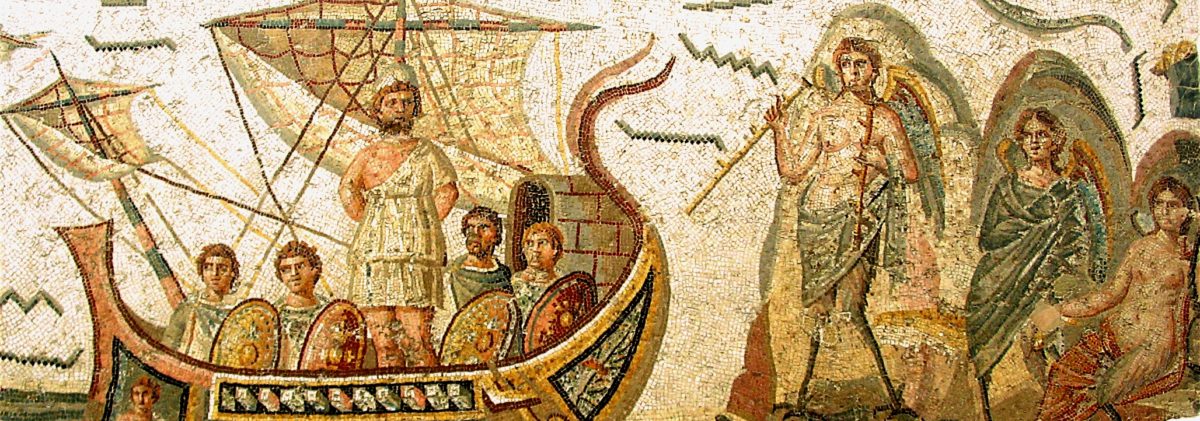
ABOVE: Ancient Roman mosaic of the god Pan as a man with goat horns and goat legs
The earliest surviving depictions of Satan
Even before Christians began to depict Satan in art, they already associated him with goats because of the Parable of the Sheep and the Goats, which occurs in the Gospel of Matthew 25:31–46. In this parable, Jesus says that, when the Son of Man returns, he will separate the righteous from the wicked as a herdsman separates sheep from goats, putting the righteous on his right and the wicked on his left. Then he will allow the righteous to enter the Kingdom of Heaven, but he will cast the wicked into “the eternal fire prepared for the devil and his angels” (Matthew 25:41).
The earliest surviving possible artistic depiction of Satan occurs in a sixth-century CE mosaic depicting the Parable of the Sheep and the Goats, which is located above a window on the wall of the nave of the Basilica of Sant’Apollinare Nuovo in Ravenna, Italy. Jesus sits in the center of the scene, while an angel who has red wings and a red robe stands on his right along with three sheep, and an angel who has blue wings and a blue robe stands on his left along with three goats.
Over eighty years ago, the scholar E. Kirschbaum hypothesized that the blue angel on Jesus’s left may be Satan (Kirschbaum 1940, 209–48). Jeffrey Burton Russell, an eminent historian of the Middle Ages who wrote a five-volume series of monographs on the history of the Devil, seems to accept this interpretation (Russell 1984, 129).
I, however, am personally skeptical. The blue angel is not iconographically distinct from other angels in early Christian art. Furthermore, he and the red angel are flanking Jesus, and both angels are standing in exactly the same posture, with each one raising his right hand as though as a sign of obeisance to Jesus. It looks to me like both angels are simply there to reinforce Jesus’s authority.
I also think it is unlikely that a Christian in the sixth century CE would have depicted Satan in a large mosaic that was meant to be displayed in a prominent location on the wall of a church. The conclusion that the blue angel is Satan seems to me to be no more than wishful thinking on the part of scholars who want it to be Satan.

ABOVE: Mosaic of the Parable of the Sheep and the Goats from the Basilica of Sant’Apollinare Nuovo in Ravenna
The earliest certain depiction of Satan or a demon in Christian art is an illumination in the Rabbula Gospels, a Syriac manuscript of the gospels dated c. 586 CE, which shows Jesus casting a small, dark, winged silhouette out of a pair of demoniacs. The contrast between this demon and the blue angel in the Ravenna mosaic could not be more striking. The demon in the Rabbula Gospels is a tiny, faceless shadow who is excluded to the margin of the page, as though the illustrator was too afraid to make it any bigger or even give it a face.

ABOVE: Illustration of Jesus casting the demon out of the Gadarene demoniacs from the Rabbula Gospels
Another very early depiction of Satan is a miniature in the Book of Kells, an illuminated manuscript of the four gospels in Latin produced at a Columban monastery in Scotland around 800 CE. The miniature in question occurs on folio 202v of the manuscript and depicts the temptation of Christ by Satan, an episode described in all three Synoptic Gospels (specifically in Matthew 4:1–11, Mark 1:12–13, and Luke 4:1–13). Satan appears on the right edge of the scene as a small, ink-black, winged figure. His arms, legs, torso, and tongue are all extremely elongated, giving his appearance a deeply uncanny quality. Already in this illustration, Satan appears to have cloven feet and possibly horns.
Art historians have long suspected that the Devil’s cloven feet and horns may be a borrowing from the iconography of Pan. Given the fact that many ancient and early medieval Christians believed that the Greek and Roman deities were really demons, and the fact that both Pan and Satan were associated with goats and uncontrolled lust, it may have made sense for Christians to model their depictions of Satan on those of Pan.
The date and Scottish monastic origin of the Book of Kells may seem to cast doubt on this hypothesis, since it is unlikely that a monk at a Columban monastery in Scotland around 800 CE would have ever seen an artistic depiction of Pan. The hypothesis, however, remains plausible when one considers that most early medieval manuscripts have been lost, and it is very likely that the illustration of Satan in the Book of Kells draws on iconography from older manuscript illustrations that are now lost.

ABOVE: Illustration of Satan from the Book of Kells
The first appearance of the Devil’s pitchfork
The earliest surviving depiction of a demon holding a pitchfork or trident occurs on Muiredach’s High Cross, a stone cross bearing relief carvings, which stands at the site of an early medieval monastery in Monasterboice, Ireland. The cross probably dates to around the tenth century CE. The central panel of the east face of the relief shows the Last Judgment with Christ standing in the center, while, to his left, a small demon holding a pitchfork drives the wicked away from him and into the fires of Hell.
The association of the Devil with a pitchfork most likely derives from the Parable of the Wheat and the Chaff, which is attributed to John the Baptist in Matthew 3:12 and Luke 3:17. In Matthew’s version of the parable, John the Baptist says of Jesus (NRSVUE trans.): “His winnowing fork is in his hand, and he will clear his threshing floor and will gather his wheat into the granary, but the chaff he will burn with unquenchable fire.”
Although the original parable describes Jesus as wielding a winnowing fork rather than Satan, once Satan came to be seen as driving the wicked into Hell, the association of the winnowing fork with Satan became virtually inevitable.

ABOVE: Central panel of the east face of Muiredach’s High Cross, showing a demon using a pitchfork to drive the wicked into Hell
Satan’s iconography in high and late medieval art
Depictions of Satan start to become more common during the High Middle Ages. Initially, these depictions look relatively human and resemble the Devil in the Book of Kells. For instance, the illustration of the temptation of Christ on folio 4r in the Melisende Psalter, which was produced in the Crusader Kingdom of Jerusalem between 1131 and 1143, shows Satan as a nude, black-skinned man with feathered wings and wild hair.

Gradually, however, depictions of Satan become more monstrous. By the thirteenth century, he is usually shown with an extremely long tongue, long horns, often fangs, claws, and cloven hooves. He is typically covered in fur or hair and is black or very dark brown in color. He rarely has a tail.
A famous full-page illustration in the Codex Gigas, folio 290r, produced in the early thirteenth century in Chrast, Czech Republic, shows the Devil crouching with his arms raised. He has enormous, red horns; red, curved claws; two insanely long tongues both dangling out of his mouth; a green face; wide eyes; an unnaturally large smile; and sharp teeth. He wears only a loincloth.

The Smithfield Decretals, produced in Toulouse in the late thirteenth or early fourteenth century, with additional illustrations added by a group of London illuminators sometime before 1340, contains a wide variety of illustrations of Devils. One illustration shows the Devil as a wrinkled, green creature with pointy ears and fins for hands wearing the robe of a canon law professor; many internet observers have noted that this Devil looks like the character Yoda from Star Wars.

Another illustration, on folio 192, shows a more conventional Devil covered in black fur with long, twisted goat horns and a fanged grin in the act of drowning a nun.

Yet another illustration, on folio 188v, shows two demons covered in dark fur who have horns; pointed, horse-like ears; bestial faces; red, bat-like wings; and long tails ending in tufts of fur sitting in the stocks while two angels make fun of them. The demon on the viewer’s left has a second face in his belly and fish fins for feet, while the demon on the viewer’s right has three-toed bird talons for feet.

The Spanish painter Nicolás Francés’s painting The Fall of the Angels, dated c. 144o, which is now held in the Cincinnati Art Museum, depicts white-robed, winged angels wielding cross-tipped spears against other angels, who are shown transforming into demons as they fall from Heaven into the depths of Hell.
Francés’s demons have vertical tufts of hair on their heads that make them somewhat resemble twentieth-century troll dolls, as well as pointed ears, dragon-like wings, and hairy legs. None of the demons have horns, and none of their feet are visible, so it is impossible to tell whether they have cloven hooves. The demons are shown as being a motley array of colors; two are black, two are red, one is white, and one is ashen gray.

Anti-clericalism is an element of some depictions of Satan from the late fifteenth century onward, a reflection of growing criticism of perceived corruption in the late medieval church. An illustration from Codex Palatini Germanici 137, folio 216v, dated c. 1460, probably produced in Heidelberg, shows Pope Sylvester II meeting with Satan. This Satan is completely covered in brown fur, and his arms are webbed like fish fins. He has curved horns, pointed ears, cloven hooves, and menacing faces all over his naked body, including a face on his buttocks that is breathing fire.

The right panel of Hans Memling’s Triptych of Earthly Vanity and Divine Salvation, painted c. 1485 in the Netherlands, shows Satan as a naked creature with batlike wings; claws; spikes on his elbows; goat-like horns; fangs; pointed ears; a red upper body; a second, green, menacing face in his stomach; black legs; and three-toed bird talons for feet.

The Flemish miniaturist Simon Bening’s early sixteenth-century miniature painting of the temptation of Christ shows a rather atypical Satan as an ugly, older man with ashen gray skin, pointed ears, and bird talons for feet dressed in the guise of a Dominican friar.

Satan’s early modern iconography
In the early sixteenth century, the discontent with perceived corruption in the church that had been mounting over the Late Middle Ages exploded into the Protestant Reformation, which set off a series of religious wars and controversies across Europe that lasted throughout most of the sixteenth and seventeenth centuries.
In the midst of all this upheaval, both Catholics and Protestants became convinced that there was a European-wide conspiracy of witches who had made secret pacts with Satan to receive supernatural powers in exchange for using those powers to hurt Christians. They believed that the sorcery sect was Satan’s final and greatest effort to undermine Christianity and try the faithful before God’s imminent final judgment.
They believed that witches used the powers Satan granted them to fly through the sky at night to secret gatherings in the woods and mountains in which they would commit all kinds of unspeakable atrocities, which included having sexual orgies with demons, kissing the Devil’s anus, sacrificing unbaptized infants to Satan, and performing Satanic mockeries of the Eucharist.
Early modern Christians saw Satan’s influence everywhere. In the context of this fear and paranoia, Satan’s iconography became, if anything, even more bizarre and bestial. It also took on pronounced sexual dimensions, with Satan’s genitals and anus becoming the focus of intense horror and fascination.
An early sixteenth-century illustration of a witches’ Sabbath in the chronicles of the Swiss Protestant theologian Johann Jakob Wick shows a red Satan with horns and cloven hooves sitting on a throne and wearing a fur-trimmed robe at the center of the gathering of witches and demons. Meanwhile, in the foreground, a demon with red skin, horns, and a tail ending in a tuft of fur is bending over with his breeches down so that a witch can kiss his anus. A demon stirring a cauldron in the bottom left corner has cloven hooves and is covered in red fur, while two other demons in the scene are covered in green fur and have horns, bird talons for feet, and claws.

A particularly bizarre and memorable depiction of Satan occurs in the Flemish Mannerist painter Jacob de Backer’s painting The Last Judgment, dated c. 1598. De Backer’s Satan is a naked man with the head of a boar and the horns of both a goat and a ram. He is wielding some kind of weapon—either a spear or a pitchfork. Instead of nipples, he has small horns that project sideways. Meanwhile, instead of a penis, he has the beaked head of a bird between his legs. A serpentine tail hangs behind him.

The woodblock illustrations of Francesco Maria Guazzo’s Compendium maleficarum, printed in 1608, show scenes of witches interacting with Satan, who appears with horns, a long tail, batlike wings, and various animal heads; in some scenes, he has a goat’s head, while, in others, he has a bird’s head or the head of an uncategorizable beast.

ABOVE: Illustration from Francesco Maria Guazzo’s Compendium maleficarum, printed in 1608, depicting witches kissing the Devil’s anus

ABOVE: Illustration from Francesco Maria Guazzo’s Compendium maleficarum, printed in 1608, depicting witches signing contracts with Satan

ABOVE: Illustration from the Compendium maleficarum depicting witches offering babies to Satan, who is depicted with moth-like wings, the head of a bird, the horns of goat, and a tail
Not all early modern depictions of the Devil, however, look so totally exotic. The frontispiece woodcut from a 1620 printing of Christopher Marlowe’s play The Tragical History of the Life and Death of Doctor Faustus depicts the main character Faustus as a sorcerer with a wand surrounded by a magic circle facing a Devil who is rising through the floor. This Devil has horns, a pointed goatee, batlike wings, and a tail. He is beginning to resemble the Devil that we all know and recognize today.

Paradise Lost, the Romantic movement, and the humanization of Satan
It was in the context of the early modern terror of, and fascination with, Satan that the English poet John Milton (lived 1608 – 1674) composed his epic poem Paradise Lost, which has become one of the most influential literary depictions of Satan of all time. The first edition of Milton’s poem was published in 1667, and a second edition with significant revisions, including a rearrangement of the poem into twelve books, appeared in 1674.
Paradise Lost retells the traditional story of the Fall of Man from the Book of Genesis chapter 3, but it gives the story a novel twist by making Satan (whom Milton follows Christian tradition in identifying with the serpent in the Garden of Eden) its central figure and tragic protagonist.
Milton was religiously a Puritan sympathizer and politically an ardent critic of the Stuart monarchy, and he portrays Satan as an analogue of King Charles I, whom he despised, representing Satan’s rebellion against God as a claim to monarchic authority. Satan in Milton’s poem is still very much a villain, but Milton transforms him from an inhumanly evil monster into a more human villain whose motives can be understood.
Milton had no idea how much his depiction of Satan would resonate with later poets and artists, especially those affiliated with the Romantic movement, which emerged in the late eighteenth century and swept across Europe and North America in the early decades of the nineteenth century. The Romantic movement emphasized powerful emotions, the transformative power of art and literature, and rebellion against traditional authority. Romantic poets and artists read Paradise Lost and found inspiration in its portrayal of Satan.
As a result of this, nineteenth-century artists largely either eliminated or de-emphasized the various monstrous and animalistic features associated with Satan in his late medieval and early modern iconography, including the horns and cloven hooves. Instead, artists in this period preferred to depict Satan as human-looking and beautiful, emphasizing his origin as an angelic being and his inner emotional turmoil.
The Romantic humanization of Satan is a major part of the reason why we no longer imagine Satan as being covered in shaggy fur or having fangs, tusks, claws, or the head of a beast, as people often imagined him during the Late Middle Ages and Early Modern Period.
Two of the most famous and widely-reproduced Romantic-influenced depictions of Satan from the nineteenth century are the French Academic painter Alexandre Cabanel’s 1847 painting L’Ange déchu (The Fallen Angel) and the Belgian sculptor Guillaume Geef’s 1848 sculpture Le génie du mal (The Genius of Evil), both of which depict Satan as angelic and beautiful in his appearance.
In Cabanel’s painting, Satan appears as a handsome, naked youth with tousled, curly, red hair, reclining on a rocky outcropping. He is shielding his face behind the bicep of his right arm, but the viewer can see that his eyes are red from crying, as though he bitterly regrets his decision to rebel against God. He has feathered, multicolored angelic wings and no trace whatsoever of horns, a tail, or cloven hooves.

In Geef’s sculpture, Satan is similarly seated on a rocky outcropping. He is also nearly naked, although, in this case, he has a cloak wrapped around his waist. He is still handsome and muscular, but he looks slightly older than the Satan in Cabanel’s painting. His long, flowing curls nearly conceal the small horns rising from his head. His downturned face displays a vivid expression of anguish, frustration, and hatred toward God. His right hand clutches a crown and a broken scepter, while his right leg is shackled and chained to the rock. His wings are dragon-like, with claws at their joints. An apple and the other half of the broken scepter lie on the ground at his feet.

The late nineteenth century: how the Devil came to be depicted in red
Although the Devil appears as red or with red features in a few late medieval and early modern depictions (e.g., Hans Memling’s triptych and the illustration in Wick’s chronicles discussed above), black is still by far the most common color for the Devil in medieval and early modern artistic depictions. Indeed, he wasn’t just depicted as black in art; early modern Christians referred to the Devil as “the Black Man,” and people who confessed under torture to practicing witchcraft regularly described having met the Devil in the form of a man with black skin.
Even in the mid-nineteenth century, some artists were still depicting Satan’s skin as black or ashen gray. The Dutch-French Romantic painter Ary Scheffer’s 1854 painting The Temptation of Christ, for example, shows Satan as a nude man with ashen gray skin and dark gray wings—a depiction that recalls those in the Book of Kells and the Melisende Psalter from centuries earlier.

I originally wrote about this topic in an answer to a question in the r/AskHistorians subreddit. When I wrote that answer, I wasn’t sure exactly why or how the idea of the Devil as red became canonical, only that it seemed to have happened around the late nineteenth century. The user Doug McCrae, however, pointed out that, in late nineteenth-century plays and operas based on Goethe’s Faust, the actor playing Mephistopheles, a demonic character often identified with Satan, typically wore a bright red costume and a goatee, which appears to have canonized these features as part of the Devil’s iconography.
Red makes sense as an appropriate color for the Devil because it is associated with fire (and hence Hell) and because it is associated with intense passions such as anger and lust that can lead people into sin. For theatrical productions, it also made the character of Mephistopheles stand out clearly on stage.
An 1883 edition of H. P. Grattan’s play Faust; or, the Demon of the Drachen-Fels describes the costume for Mephistopheles as follows:
Red doublet and hose, tight to the skin, little red cloak to his back, very small red hat, and a red cock’s feather, red leather slippers, red hair, long, gloves with long nails, red beard and eye-brows, aquiline nose (not too prominent), red scarf and belt.
A review published in the May 5, 1876 issue of Pall Mall Budget praises a production of Faust at the Royal Italian Opera for the “varied and fantastical costumes” worn by its Mephistopheles, noting, “Anything is better than the suit of red usually worn in this part.” A satirical piece in the Feb 2, 1887 issue of Puck Magazine critiques Charles Gounod’s grand opera Faust saying, “Gounod goes to work and presents [Mephistopheles] on the stage in a most unbecoming suit of red, with a fearfully ugly pair of eyebrows, and a ghastly goatee.”
Illustrations and opera posters from the later nineteenth century also show Mephistopheles in red. A poster for A. Boito’s opera Méphistophélès dated c. 1895 depicts the titular character wearing a red cloak and a red bycocket (a kind of medieval hat with a point at the front) with two red feathers.
These productions canonized the image of the Devil as wearing or being red and having a goatee.

Conclusion
Thus, by the early twentieth century, the modern image of the Devil as a man with horns, cloven hooves, a tail, red skin, a goatee, and a pitchfork was established—a blend of some features dating all the way back to the Early Middle Ages and others picked up only in the nineteenth century. No doubt the image of Satan will continue to evolve over the centuries to come.
Works cited
- Kirschbaum, E. 1940. “L’angelo rosso e l’angelo turchino,” Rivista di archeologia cristiana, 17, 209–48.
- Russell, Jeffrey Burton. 1984. Lucifer: The Devil in the Middle Ages. Cornell University Press.
(NOTE: This post is adapted from an answer I originally wrote to a question in the r/AskHistorians subreddit.)

When was Satan’s red dragon form from the Book of Revelation first depicted?