
It is a fact of life that, for as long as people have been making laws, there have been people who have tried to break those laws and get away with it. Laws, of course, are extremely ancient; the oldest surviving formal, written law code is the Code of Ur-Nammu, which King Ur-Nammu of the Sumerian city-state of Ur promulgated around 2100 BCE. Humans have probably had informal laws for far longer. The obvious corollary to this is that crime is also very ancient—and, when the law becomes organized, criminal organizations tend to follow.
To modern readers, the phrase “organized crime” may conjure up images of recent historical gangsters like Al Capone or fictional criminals like Walter White from the AMC television series Breaking Bad, but various kinds of criminal organizations have existed in various civilizations since at least the Bronze Age. In this post, I will discuss examples from pharaonic Egypt, Classical Greece, and ancient Rome.
Ancient Egypt
During the late New Kingdom and the Third Intermediate Period, organized gangs of looters broke into and robbed the tombs of the Egyptian pharaohs and high officials. These operations seem to have been quite large and well-organized, involving many co-conspirators. In some cases, officials charged with overseeing and protecting the tombs may have been directly involved or complicit in the looting.
The Abbott Papyrus, which dates to around 1100 BCE, records that Paser, the mayor of Eastern Thebes, accused Paweraa, the mayor of Western Thebes who had authority over the necropolis, including the royal tombs in the Valley of the Kings, of not taking action against—or being outright complicit in—the extensive tomb robbery that was taking place.
Papyrus Leopold II, which dates to around the same time, records the confessions of eight men who, after being tortured, admitted that they had broken into and robbed the tomb of the Second Intermediate Period pharaoh Sobekemsaf II. The confessions provide evidence of the robbers’ methods and scale of organization.

ABOVE: Photo from Wikimedia Commons of the Abbott Papyrus, dated c. 1100 BCE, which provides important evidence concerning the organized bands of tomb robbers who looted tombs of the pharaohs and other prominent figures during the late New Kingdom

Ancient Greece
The evidence for criminal organizations in the ancient Greek world is less plentiful than for Egypt, which may be partly due to the fact that the Greek world was made up of many independent polities with distinct legal systems. Nonetheless, one intriguing source does indicate the existence of youth street gangs in Classical Athens.
The Athenian orator Demosthenes (lived 384 – 322 BCE) in his court speech Against Konon, which he delivered in either 357 or 343 BCE, attests that gangs of young men from aristocratic families prowled the streets of Athens at night and occasionally robbed or beat people up. He mentions that one of these gangs called themselves the Ithyphalloi, which means “Erect Penises” (Dem. 54.14).
A related gang, who called themselves the Triballoi after a Thrakian tribe who had a reputation for being especially savage, were allegedly in the habit of stealing the offerings that people left out to the goddess Hekate and the pigs’ testicles that people left out for purification before meetings of the Athenian assembly. Demosthenes also says that they swore false oaths and committed perjury many times (Dem. 54.39).
The scale of these groups’ criminal activities seems to have been relatively petty compared to modern organized crime groups, but, for the ancient Athenians, their crimes were still very serious. Stealing offerings that the people had left out for the gods, swearing false oaths, and committing perjury were all simultaneously acts of sacrilege and political crimes against the people or demos of the city as a whole.

ABOVE: Roman marble statue of the Athenian orator Demosthenes, based on a Greek original from around 280 BCE or thereabouts
Ancient Rome
In ancient Rome, there were associations known as collegia, which functioned as social clubs, religious fraternities, and merchant guilds. In general, these were legal, legitimate organizations. The biographer Gaius Suetonius Tranquillus (lived c. 69 – after 122 CE), however, records in his Life of Augustus 32.1 that, during the civil wars of the mid-first century BCE and into the early reign of the emperor Augustus (ruled 27 BCE – 14 CE), armed gangs openly went about the streets of the city of Rome and new collegia were formed devoted to criminal activities. He writes (trans. J. C. Rolfe, edited):
Many pernicious practices militating against public security had survived as a result of the lawless habits of the civil wars, or had even arisen in time of peace. Gangs of thieves openly went about with swords by their sides, ostensibly to protect themselves, and travelers in the country, freemen and slaves alike, were seized and kept in confinement in the workhouses of the landowners; numerous leagues, too, were formed for the commission of crimes of every kind, assuming the title of some new guild [collegium]. Therefore to put a stop to brigandage, [Augustus] stationed guards of soldiers wherever it seemed advisable, inspected the workhouses, and disbanded all guilds [collegia], except such as were of long standing and formed for legitimate purposes.
If we take Suetonius’s description as both factually accurate and literal, then he seems to be describing criminal organizations similar to the mafia. This passage, however, is the only surviving mention of these alleged criminal collegia, and Suetonius does not provide many details about their activities.
This passage from Suetonius seems to have been the inspiration for the depiction of warring criminal collegia in the city of Rome during the era of the civil wars in the second season of the classic HBO drama series Rome (aired 2005–2007). Rome‘s depiction of the criminal collegia, however, is highly speculative and should not be taken as historically accurate.
(This blog post is an expansion of this answer I originally wrote in response to a question in r/AskHistorians.)

I wonder what a TV show about any of these ancient organized crime groups would be like…
Well, if you want to know, the second season of HBO’s Rome comes pretty close. Without giving too many spoilers, one of the two main characters of the show, Lucius Vorenus, becomes the leader of the Aventine Collegium, which is one of several criminal collegia battling for supremacy in the streets of Rome. The main image for this post is a shot from one of the episodes in that season, in which Vorenus’s supporters, led by the other main character Titus Pullo, line up in preparation for a fight.
If you haven’t watched Rome, I do highly recommend it, since it is possibly the best modern television series set in the ancient world that I have seen. (The other contender for that title is the 1976 BBC series I, Claudius, which conveniently picks up very close to the point in the history where Rome leaves off.) The writing, acting, characterization, and production values are all phenomenal. There are some significant historical inaccuracies, anachronisms, and creative liberties taken, but, overall, it does cover the broad events of the late Roman Republic and capture the general vibes of the era very well.
Great to have a post from you!
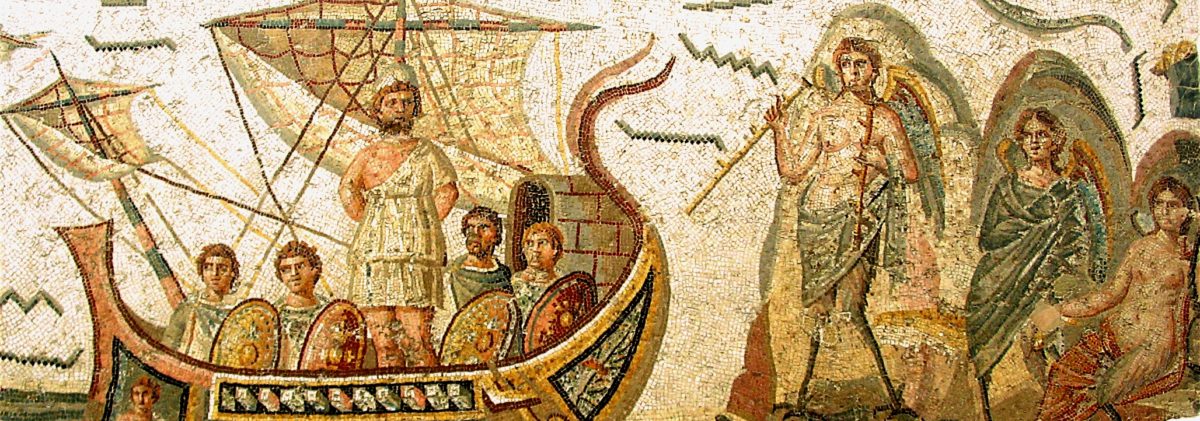
The pirate gangs in The Odyssey speak to an organised band of criminal types that were commonly known about. I guess the waring soldiers on the move were no better.
Excellent point! When I wrote this post, I wasn’t thinking about pirates.
I apologize for the fact that I didn’t write any posts for nearly three months. My workload this semester has been a lot heavier than last semester, I’ve had a lot of other things going on, and there have also been a lot of distressing events in the news that have been hard to keep up with, so I haven’t had much time to write posts for this blog. That being said, I am currently on spring break and I’m hoping to make a few posts this week during the time I have off. Keep your eyes peeled for more!